
Back in February, I picked one word for the stock market in 2026: dispersion.
It’s a fancy word for a simple idea.
Some stocks can have a great year while others have a terrible one, even when they live in the same market.
Think about a family’s average temperature.
If one kid has a fever and another just came inside from playing in the snow, the average might look perfectly normal. It still wouldn’t tell you much about either kid.
The stock market can work the same way.
Six weeks into the year, the S&P 500 was roughly flat. But the middle stock in that group was up more than 7%, and more than 200 of its stocks had already gained at least 10%.
Meanwhile, all seven of the giant companies known as the Magnificent Seven were down.
If you only looked at the big index, you missed a whole lot of action.
That was the point of watching dispersion.
It wasn’t a promise that stocks would rise or fall. It was a reason to look under the hood and see which stocks were actually moving.
What I didn’t know in February was how big this story would get. Different groups have taken turns leading throughout the year.
Now, one of the clearest trends is showing up in a place where plenty of investors had stopped looking: value stocks.
One Market. Two Very Different Years.
Investors often divide stocks into two broad teams: growth and value.
With growth stocks, buyers are paying for the chance that a business will become much bigger.
With value stocks, buyers generally put more weight on how cheap the shares look compared with the company’s earnings and other measures.
Those labels aren’t perfect, but the gap between the teams is hard to miss.
Through October 29, the iShares Russell 1000 Value ETF, which trades under the symbol IWD, was up about 24% this year. Its growth counterpart, IWF, was up about 2%.
These funds hold baskets of stocks, giving us a way to compare the two groups.
Here’s the fifth-grade math.
A $100 investment gaining 24% becomes $124. A $100 investment gaining 2% becomes $102.
Same stock market, a very different experience.
October made that gap even wider. Value gained about 5%, while growth lost about 3%.
The value fund reached a record high this week, and the line comparing value with growth climbed to its highest level in several years:
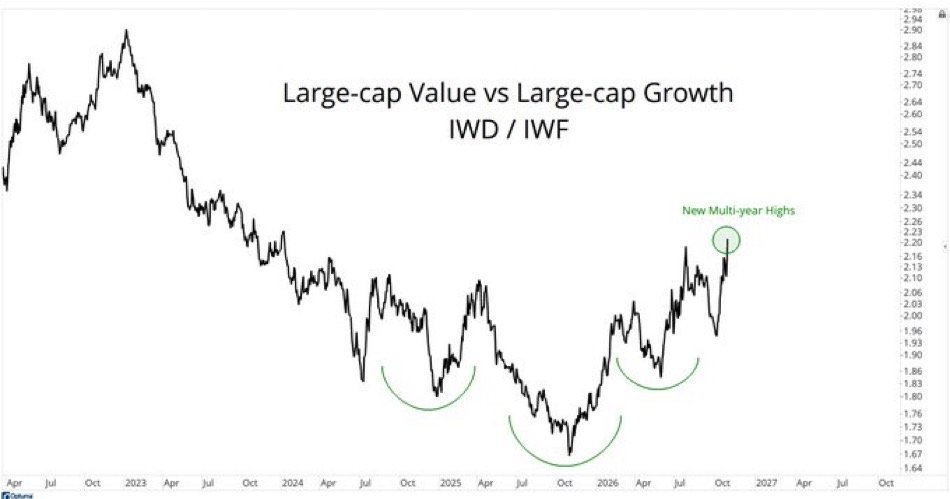
That chart measures a race. When the line rises, value is doing better than growth.
Both groups could be rising, both could be falling, or they could be heading in opposite directions. The line tells us which team is getting ahead.
Right now, value has been pulling away.
And if you think you know which companies are leading that team, this next part might surprise you.
Apple and Amazon Walk Into the Value Aisle
The two biggest holdings in the value fund are Amazon (AMZN) and Apple (AAPL), at roughly 6% each.
Yes, the company delivering boxes to your front door and the company selling you the phone you used to order them.
Microsoft (MSFT) is a major holding, too.
If your picture of value investing is a dusty collection of companies nobody talks about, that lineup probably needs a moment to sink in.
The familiar labels don’t always match what’s inside the basket.
FTSE Russell, which builds these indexes, uses a formula to decide where companies belong. A company can qualify partly as growth and partly as value, so pieces of the same business can appear on both teams.
There’s no rule that says a famous company must spend its entire life wearing a growth jersey.
The bigger difference is how the teams are built.
Technology makes up roughly 60% of the growth index, compared with roughly 20% of the value index.
Value has more money spread across financial companies, industrial businesses, health care and energy.
Those differences give investors very different results when leadership changes.
That’s why I’m watching this breakout. It supports the case for looking beyond technology for opportunities
You don’t have to guess in January which group will win the whole year.
You can watch the evidence, notice when leadership changes and give yourself permission to change with it.
There are plenty of stocks to choose from, and no prize for staying loyal to a group that has stopped working.
In February, dispersion told us to pay attention to the differences.
Today, those differences are telling us where leadership has moved.
I’m sticking with that evidence until it changes.