I grew up around healthcare.
My father is a pharmacist, my mother is a nurse, and together they built a successful independent pharmacy business here in rural Kansas.
I spent plenty of time working in that pharmacy, surrounded by doctors, nurses, pharmacists, and patients who depended on them.
It gave me an appreciation for something that most people don’t think about until they need it.
Good healthcare changes lives.
And, sometimes, it saves them.
That’s why one of the most exciting developments in artificial intelligence has nothing to do with chatbots, self-driving cars, or generating pictures of cats wearing cowboy hats.
It’s what’s happening in medicine.
Most investors associate the AI revolution with semiconductors, data centers, and the enormous amounts of electricity needed to power them.
Those have been extraordinary trades, and we’ve made plenty of money participating in them.
But what if one of AI’s greatest opportunities is somewhere completely different?
What if it’s healthcare?
AI Is Already Changing Medicine
Think about what artificial intelligence can do for a doctor.
It can analyze medical images, identify suspicious abnormalities, and help physicians recognize conditions that might otherwise go undetected.
And this isn’t some futuristic technology that might become useful in 20 years.
It’s happening today.
In a major Swedish clinical trial involving more than 100,000 women, AI-assisted mammography improved breast cancer screening sensitivity from 73.8% to 80.5%, without increasing the false-positive rate.
That’s a meaningful improvement in detecting cancer, although longer-term research is still needed to establish its impact on survival.
Then there’s drug discovery.
Google DeepMind’s AlphaFold has predicted the structures of more than 200 million proteins, giving scientists an extraordinary resource for understanding diseases and developing potential treatments.
A problem that once required tremendous amounts of laboratory work can now be approached with powerful computational tools.
And the applications extend well beyond cancer.
Researchers are using AI to study everything from Alzheimer’s disease and cardiovascular conditions to genetic disorders and personalized medicine.
We’re still in the early stages, but the potential is extraordinary.
The Next AI Winners
What’s especially interesting is that some of the most important companies driving this revolution aren’t traditional technology companies.
They’re life sciences businesses.
Take Thermo Fisher Scientific (TMO), which has partnered with Nvidia (NVDA) and OpenAI to bring advanced AI into scientific instruments, laboratories, and drug development.
Or Danaher (DHR), which recently announced plans for an AI-powered autonomous laboratory designed to dramatically accelerate scientific research.
Agilent Technologies (A) is pursuing similar opportunities, incorporating AI into its instruments, software, and laboratory workflows.
These companies supply the tools, equipment, and services that scientists depend on to develop new medicines and better understand human biology.
And as AI becomes more deeply integrated into scientific research, I think these businesses could become some of the biggest beneficiaries.
That’s the fundamental story.
But you know what matters even more to me?
The charts!
Med Tech Is Breaking Out
One of the strongest setups I’ve been monitoring recently is the S&P 500 Life Sciences Tools & Services Industry.
After peaking in 2021, this group spent nearly five years going absolutely nowhere, frustrating investors while technology stocks captured almost all the attention.
Now that’s changing…
After years of consolidating, the industry is finally resolving higher and trading at its highest levels since 2021:
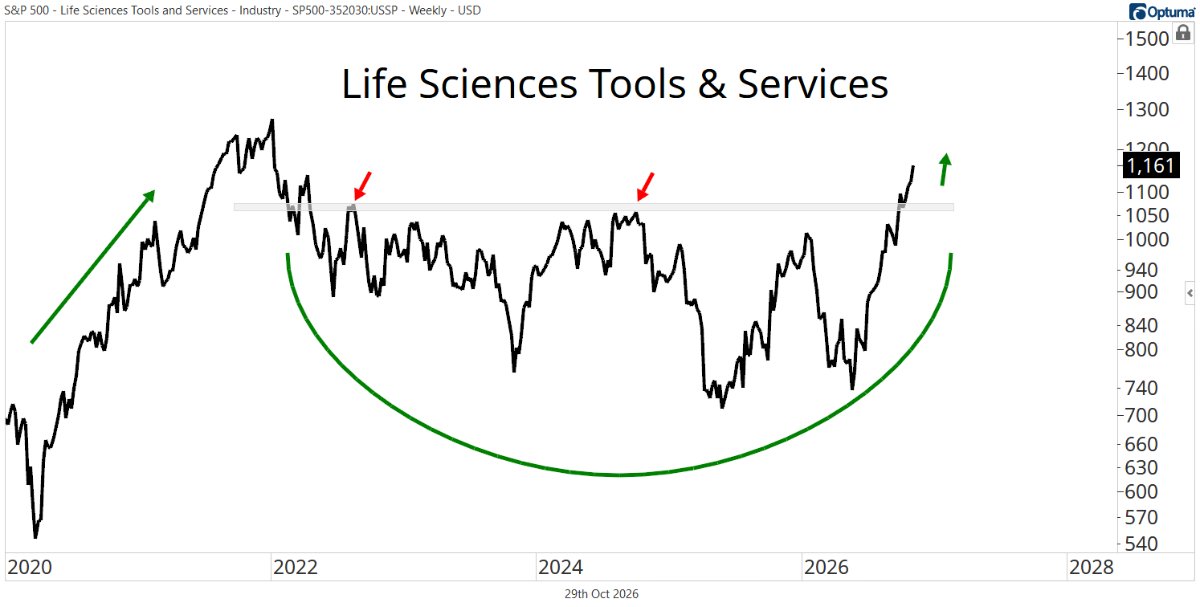
That’s exactly what I want to see when looking for the next major leadership group.
And the timing couldn’t be better, given the extraordinary advances we’re seeing in AI-powered medicine.
Of course, not every company in this industry is an AI pure play, and these advances don’t guarantee higher stock prices.
But the combination of a powerful secular theme and a major technical breakout is enough to get my attention.
For years, investors have chased the companies building the infrastructure behind artificial intelligence.
Now I’m watching the companies putting that technology to work where the stakes are considerably higher.
Growing up in a pharmacy, I saw firsthand what better medicine could mean to patients and their families.
If AI can help deliver earlier diagnoses, more effective treatments, and longer, healthier lives, that’s a revolution I want to be part of.
And judging by the charts, investors are starting to recognize the opportunity, too.
Because the next great AI breakthrough might not write your emails or generate your vacation photos.
It might save your life.
Stay safe out there,
Sam Gatlin
Analyst, Everybody’s Wrong