
I keep hearing about how bad market breadth is.
To be fair, if you’re looking at the very short term, there’s something to talk about.
Only 26% of the stocks in the S&P 500 are above their 20-day moving average. Just 30% are above their 50-day moving average.
Those aren’t great numbers.
But this is where I think investors can get themselves into trouble.
If you stare too closely at one indicator, over one short period of time, you can completely lose sight of what’s actually happening.
So let’s zoom out.
The Nasdaq Composite just closed at a new all-time high.
Not near an all-time high. Not trying to get back to an all-time high.
A new all-time high:
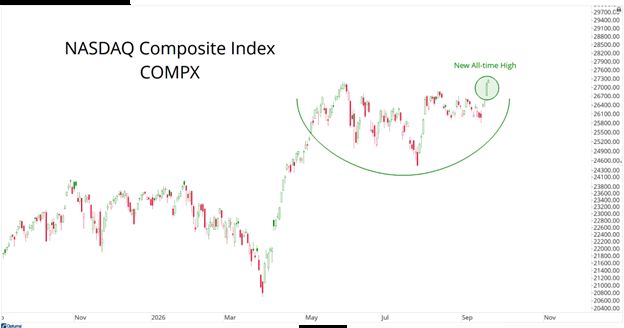
Meanwhile, the S&P 500 is just 0.3% from its own record.
And this isn’t just an American thing.
We went through the major stock market indexes of the G10 countries.
Seven of those 11 stock markets are within 3% of an all-time high. On average, the group is only about 3.3% from record highs.
Think about that for a second.
We’re being told to worry about terrible stock-market breadth while the Nasdaq is making new all-time highs, the S&P 500 is less than 1% from one, and most of the world’s biggest developed stock markets are sitting within a few percent of their highest levels ever.
Maybe we should at least consider the possibility that things aren’t quite as bad as they sound.
Your Best Players Are Scoring Again
One of the things I’ve learned studying bull markets is that technology tends to be a leader.
That makes sense.
Bull markets are usually about growth. They’re about innovation, investment, productivity, and companies making more money.
Technology tends to live right in the middle of all of that.
So if you want to know whether the stock market is healthy, I think a pretty reasonable question is, how are technology stocks doing?
Well, they’re making new all-time highs.
And something else important is happening underneath the surface.
Mega-cap growth is leading again.
The Magnificent Seven just broke out to new all-time highs.
The group spent almost a year going sideways while other parts of the market took their turn leading.
For much of 2025, people complained that the entire stock market depended on these seven companies.
Then the Magnificent Seven stopped leading, and the market kept going anyway.
That’s sector rotation.
Leadership moved elsewhere, the bull market broadened, and now the Magnificent Seven are joining the party again.
Think about a basketball team. Your star players don’t need to score every point. In fact, you probably don’t want them to.
You want other players contributing while the stars catch their breath. But when your best players start scoring again, too?
That’s not usually the part of the game you complain about.
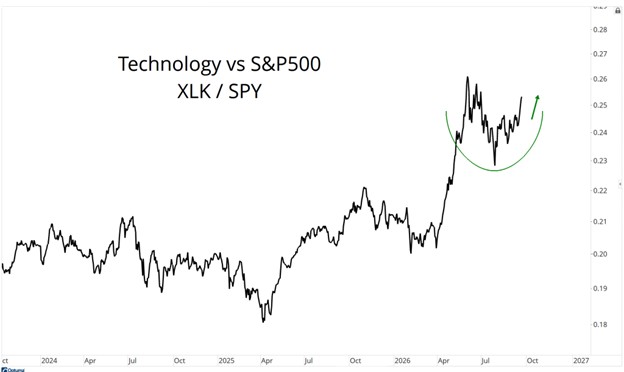
This isn’t some tiny corner of the market, either.
Technology itself is an enormous piece of the U.S. stock market, and more than half of the Nasdaq Composite’s weight comes from tech-related companies.
So when these stocks start breaking out, we should pay attention.
Apple (AAPL) is another great example.
Apple just pushed to a new all-time high. Nvidia (NVDA) is on pace to close the month at its highest monthly level ever.
Those aren’t exactly the places I’d expect to see collapsing if the message from the market were that investors should be running for the exits.
Zoom Out
None of this means breadth doesn’t matter. It absolutely does.
If only 26% of S&P 500 stocks are above their 20-day moving averages, I want to know that.
If only 30% are above their 50-day moving averages, I want to know that, too.
But those are pieces of evidence. They aren’t the entire market.
A 20-day moving average tells us what stocks have been doing over roughly the past month.
A 50-day moving average tells us what they’ve been doing over the past couple of months.
They’re supposed to move around.
That’s what markets do.
Meanwhile, the Nasdaq Composite is at an all-time high. The S&P 500 is within 1%.
Technology is breaking out. The Magnificent Seven are breaking out. Apple is making record highs.
And seven of the 11 G10 stock markets are within 3% of their own records. That’s evidence, too.
I’d argue it’s pretty important evidence.
This is why we don’t build an entire market thesis around one indicator or one sector.
Yeah, consumer staples and utility stocks are hitting new lows. What does that have to do with software stocks?
Markets rotate.
One group runs. Then it rests. Another group takes over. Then the first group comes back.
That’s not a bug. That’s the lifeblood of a bull market.
So yes, I’m watching breadth. I’m also watching price.
Right now, an awful lot of those prices are still trending higher.
And new ones are emerging.