
If you drive a car, heat your house, order packages from Amazon, or fly on an airplane, this matters to you.
In other words, it matters to almost everyone.
You don’t have to trade oil futures. You don’t need to watch CNBC. My mother-in-law doesn’t do either one. Neither do most people.
But if you understand what’s happening in the oil market today, you’ll understand why certain stocks are acting so well and where we think the next opportunities may be hiding.
Right now, one of the biggest clues has nothing to do with the price of crude oil itself.
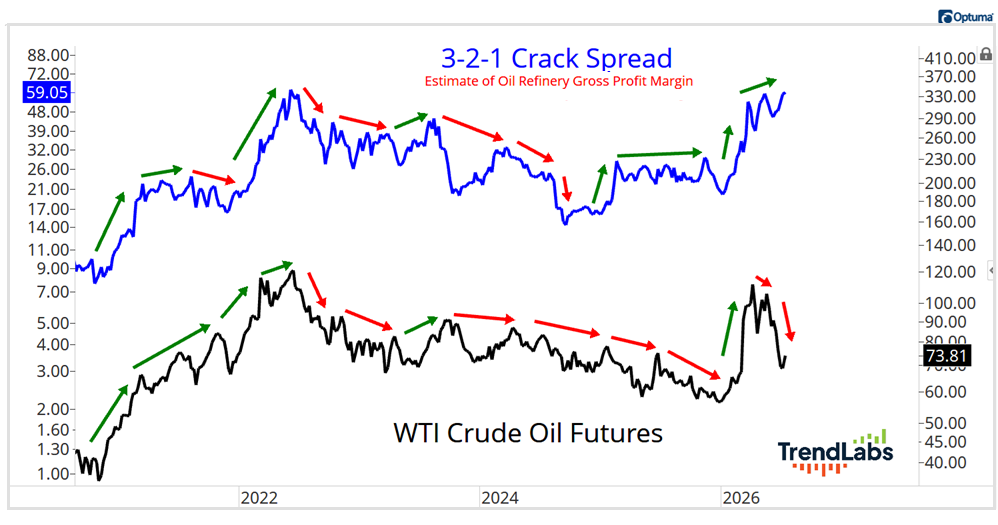
It’s something called the crack spread.
And it’s exploding.
What in the World Is a Crack Spread?
Let’s keep this simple.
Imagine you own a little apple pie stand.
Every morning you buy three baskets of apples.
By the afternoon you’ve turned those apples into fresh apple pies that people can’t wait to buy.
If you paid $30 for the apples and sold the pies for $60, you made a nice profit.
Now, imagine everyone suddenly wants apple pie.
You can still buy the apples for $30, but now people are willing to pay $90 for the pies.
Your profits just exploded.
That’s basically what’s happening at an oil refinery.
Refineries buy crude oil. Nobody pulls up to a gas station and pumps crude oil into their car.
First, the refinery has to break apart the long, heavy molecules inside crude oil into smaller ones that people can actually use.
That’s why it’s called cracking.
Those smaller molecules become gasoline, diesel, jet fuel and other products we use every day.
One of the most common measurements in the industry is called the “3-2-1 crack spread.”
The name sounds complicated, but it isn’t.
A refinery starts with three barrels of crude oil. On average, it turns those into about two barrels of gasoline and one barrel of diesel.
The crack spread simply measures how much more those finished products are worth than the crude oil that went into making them.
Think back to the apple pies.
The bigger the gap between what you paid for the apples and what people are paying for the pies, the happier you are.
Today, that gap is getting much bigger:
Why This Matters to Investors
Here’s the part that gets interesting.
When apple pie shops are making record profits, they don’t stop buying apples.
They buy more.
Oil refineries work the same way.
If every barrel of crude oil they process is making them more money than usual, they have every reason to buy more crude oil and keep those refineries running.
That’s why crack spreads matter.
They’re often telling us something before crude oil itself starts moving.
Strong crack spreads create a powerful incentive for refiners to buy more crude oil.
That’s one reason we’re paying attention.
Follow the Winners
One thing I’ve learned after decades of studying markets is that the strongest stocks usually don’t ask for permission.
They just start outperforming.
That’s exactly what we’re seeing across parts of the energy sector.
The refiners have been acting well, confirming what crack spreads are suggesting: that these guys are printing money.
The companies that move oil and natural gas around the country have been acting well, too.
Years ago, we mostly called them Master Limited Partnerships, or MLPs. Today, they’re usually called midstream companies.
They own pipelines, storage terminals and other infrastructure that keeps energy flowing from where it’s produced to where it’s needed.
We own a ton of them in our Divergence Portfolio.
The way I see it, when refiners are leading, midstream companies are leading, and crack spreads are exploding all at the same time, I don’t assume it’s a coincidence.
The market is trying to tell us something. Our job is to follow the evidence.
Right now, the evidence isn’t pointing me toward the weakest areas of the energy market.
It’s pointing me toward the strongest ones.
Here’s something I’ve learned the hard way: The biggest money is rarely made chasing yesterday’s headlines.
It’s made by paying attention to today’s clues before everyone else realizes they were clues.
And, right now, one of the loudest clues in the entire market isn’t coming from crude oil.
It’s coming from exploding crack spreads.
Stay sharp,
JC Parets, CMT
Founder, TrendLabs