A week ago, the market wasn’t even sure the Federal Reserve was going to raise interest rates.
The odds were only around 55% to 60%.
Now they’re well over 90%.
So unless something changes between now and Wednesday afternoon, the Fed is probably raising rates.
And I can’t stop laughing about the timing.
Because remember what happened the last time the Fed changed directions?
In September 2024, the Federal Reserve started cutting interest rates.
And that’s almost exactly when interest rates stopped going down.
Seriously.
The Fed started cutting rates.
Rates stopped falling.
You can’t make this stuff up.
And now, two years after the Fed started cutting rates, we may be about to get the exact opposite.
The Fed is getting ready to raise rates.
Meanwhile, interest rates have already been rising.
So I have a question:
Wouldn’t it be hilarious if rates stopped going up as soon as the Fed started raising them?
The Fed Doesn’t Control the Rates You Care About
Here’s where people get confused.
When you hear on the news that “the Fed raised rates,” that doesn’t mean Kevin Warsh gets up in the morning and decides what your mortgage rate should be.
The Federal Reserve controls a very short-term interest rate called the federal funds rate.
That’s basically the rate banks use when lending money to each other overnight.
But we’re not banks. We’re not lending JPMorgan (JPM) money until breakfast tomorrow.
For the rest of us, the rates that matter are farther out.
The 10-year Treasury yield is one of the most important interest rates in the world. It influences borrowing costs across the economy and is the benchmark investors watch most closely.
Then there’s the 30-year Treasury yield, which is much more closely connected to the world of long-term borrowing and mortgage rates.
That’s where I live.
The 10s and the 30s.
And those rates are determined by the bond market.
Millions of people buying and selling bonds every day.
That’s why the Fed can cut its overnight rate while longer-term interest rates actually go up.
In fact, that’s exactly what happened.
The Fed began cutting rates in September 2024.
The 10-year Treasury yield bottomed right around the same time.
Then it went much higher.
So when somebody tells you, “The Fed is cutting rates, so rates are going down,” remember:
Which rates?
That’s an important question.
This Would Be the Perfect Spot
Now take a look at where the 10-year Treasury yield is today:
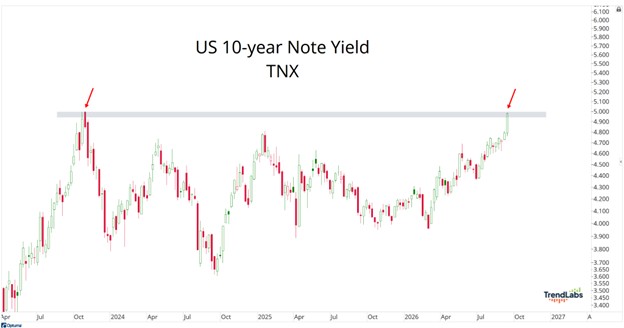
Look at those old highs from 2007.
Almost 20 years later, the 10-year yield is right back at the same levels.
Wouldn’t this be the perfect place for rates to stop going up?
I don’t know if they will. I don’t have a crystal ball.
But you have to admit, the timing would be hilarious.
In September 2024:
Fed starts CUTTING → rates stop FALLING.
Now, in September 2026:
Fed starts HIKING → rates stop RISING?
Come on.
That’s funny.
The Market Already Made Its Move
Markets look forward.
By the time the Fed actually does something, the bond market has usually been moving in that direction long before the announcement.
Just look at what’s happened over the past week.
Seven days ago, the fed funds futures market was putting the chances of a rate hike on Wednesday at roughly 55% to 60%.
Now it’s over 90%.
And these aren’t odds coming from some guy in Las Vegas.
They’re based on actual prices in the fed funds futures market, where real money is being traded based on where investors expect the fed funds rate to be.
In one week, a rate hike went from a coin flip to something the market overwhelmingly expects.
Meanwhile, the 10-year yield has climbed all the way back to those old 2007 highs.
Could rates break through and keep going?
Of course.
That’s why we watch price instead of pretending we know the future.
But could the Fed finally start raising rates at almost the exact moment longer-term rates stop rising?
Absolutely.
And if that happens, get ready for people on television to explain how the Fed raised rates on Wednesday and somehow interest rates started falling.
We’ll just be sitting here laughing.
Because we already watched the exact opposite happen two years ago.