
I can’t believe nobody cares about Brazil.
We’re talking about the world’s 10th-largest economy. Brazil is bigger than Canada, South Korea, Spain, and Switzerland.
This isn’t some tiny country you only hear about during the Summer Olympics.
And its stock market just got absolutely hammered.
The iShares MSCI Brazil ETF (EWZ), which lets investors buy a basket of Brazilian stocks in one trade, fell more than 25% before the market opened:
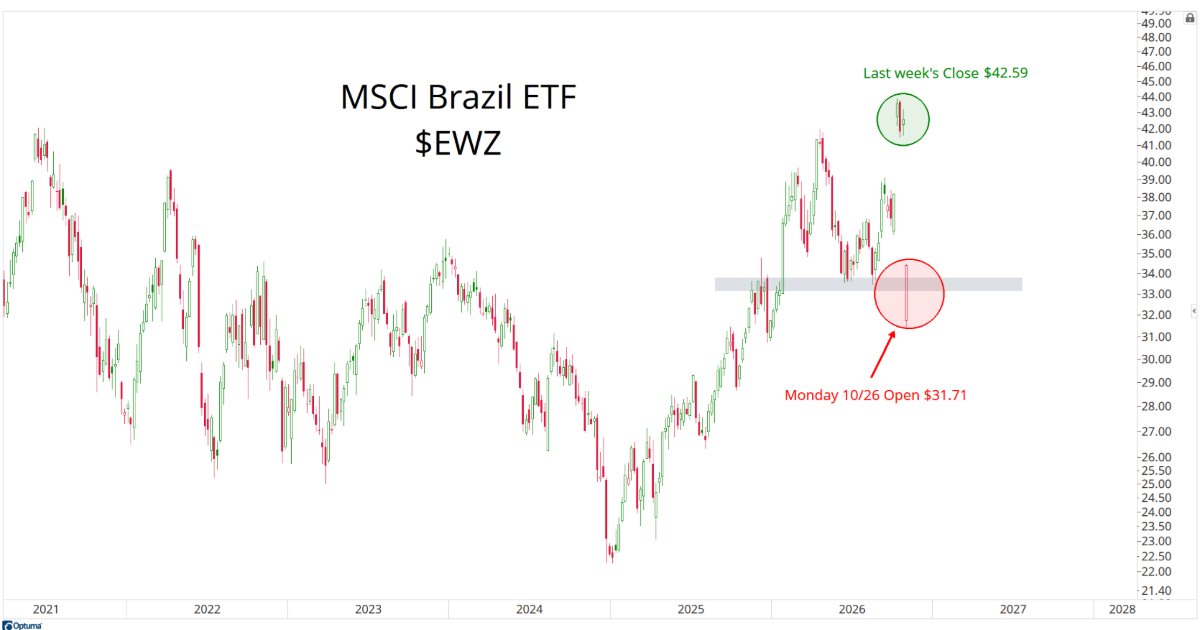
It recovered some ground, but was still down around 20% during the day.
Think about what that means.
If you had $100 invested, over $20 disappeared in a single day. Some individual stocks did considerably worse.
For comparison, on Black Monday in October 1987, the Dow Jones Industrial Average fell 508 points, or 22.6%.
People are still writing books about that crash almost 40 years later. Brazil just had a stock market event in that neighborhood.
Meanwhile, the Nasdaq was up more than 1%, the Dow was higher, and European stocks were rising.
Brazil was having a financial fire drill, and everybody else kept eating lunch.
The Watch List Has an Exit Door
What makes this particularly interesting to me is that Brazil had been getting my attention for the right reasons.
Stocks were showing strength. Charts were improving. There were potential opportunities worth watching.
We hadn’t bought any Brazilian stocks in our portfolios, fortunately. But some had earned a place on the watch list.
They’ve now earned their way off it.
XP (XP), a Brazilian investment platform, lost roughly half its value. Nu Holdings (NU), the company behind digital bank Nubank, fell close to 20%. Petrobras (PBR), the big Brazilian oil company, was down around 15%.
These aren’t little scratches on otherwise healthy charts. A lot of these stocks have serious repair work to do.
And that’s what a watch list is for. It’s a place to keep track of potential opportunities while you wait for the conditions you need to buy.
Getting on the list doesn’t guarantee a stock gets into the portfolio.
Sometimes you watch something improve, get interested, then watch it fall apart before you ever buy it.
You take it off the list and move on. That’s part of the process.
This is also a reminder about those fancy statistical explanations we hear after a crash.
Somebody calls it a “six-sigma event,” which is basically a complicated way of saying, “According to our math, that wasn’t supposed to happen.”
Well, it happened.
The neat bell curve from statistics class makes extreme moves look incredibly rare.
Markets have a habit of delivering them more often than those tidy models suggest.
Real people panic, borrow too much money, then they all try to squeeze through the same exit at the same time.
Your portfolio has to survive what happens in the market. It doesn’t get paid for explaining why something was supposed to be impossible.
For us, the action here is straightforward: Brazil comes off the watch list.
If the stocks repair themselves and start showing strength again, we can take another look.
There’s no prize for being the first person back into a broken stock. In this case, a broken stock market for the country.
The Crash That Didn’t Travel
But the biggest story, to me, is what happened everywhere else.
Very little.
If you had told me beforehand that Brazilian stocks would lose about a fifth of their value overnight, I’d have expected trouble somewhere else.
Maybe other emerging markets get dragged down. Maybe investors start dumping stocks around the world.
Maybe somebody who borrowed too much money gets forced to sell whatever they can.
That would have sounded reasonable.
Instead, investors kept buying U.S. stocks.
Technology led the way. European stocks rose. The selling in Brazil didn’t turn into a broad rush for the exits.
That’s fascinating.
When something this bad happens and the rest of the market holds up, I want to pay attention.
We spend so much time studying what makes stocks fall. Watching what fails to make them fall can teach us something, too.
I certainly wouldn’t take this reaction as bearish.
How much trouble are investors expecting elsewhere if they can watch Brazil get slaughtered and keep buying?
The market clearly has other things on its mind.
You’ll hear people call the market a “forward-looking discounting mechanism.”
All that means is investors buy and sell based on what they think is coming next. Today’s prices reflect those expectations, even when the news right in front of us looks terrible.
That doesn’t mean investors always get it right. It means I need to look at what they’re actually doing before deciding what they should be doing.
Right now, they’re treating Brazil’s problems as Brazil’s problems. If that changes, we can change with it.
But I’m not going to invent a worldwide crisis while stocks elsewhere are rising.
Sorry, Brazil. I was getting excited about some of your stocks. We’re going to have to put that on hold.
In the meantime, there are other markets showing strength and other stocks worth watching. I’d rather spend my time looking at those.
Brazil gave the world a pretty good reason to sell.
The world kept buying.