
Brazil just had one of those days.
The iShares Brazil ETF (EWZ) exploded higher after the election. At one point Monday afternoon, it was up more than 13%, with volume running several times higher than normal.
That’s not a normal move.
Depending on how you measure volatility and how far back you look, we’re talking about something in the neighborhood of a 10-sigma event.
I’ll let the mathematicians fight over whether it’s actually nine sigma, 10 sigma, or 11.
That’s not really the point.
The point is that Brazil just did something it almost never does.
And when markets suddenly start doing things they almost never do, I pay attention.
Brazilian stocks have actually been doing pretty well for a while. The Bovespa, Brazil’s main stock market index, has been making new all-time highs when priced in Brazilian reais.
But that’s not how we experience the trade here in the U.S. We buy Brazil in dollars.
And when you price Brazilian stocks in U.S. dollars, the picture hasn’t been nearly as impressive:
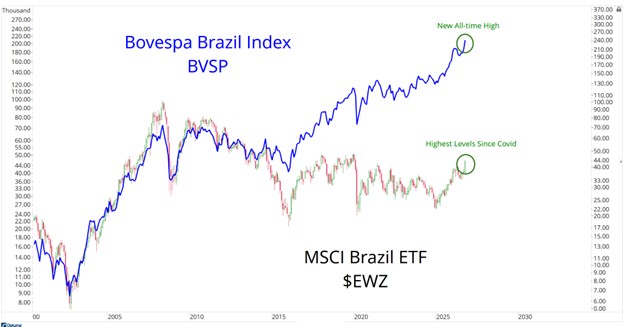
That’s why Monday matters so much.
Something changed.
What the Hell Is a Sigma?
“Sigma” is just a fancy statistics word for “standard deviation.”
And standard deviation is really just a way of asking:
How weird was that?
If a stock normally moves around 1% a day and suddenly moves 2%, that’s unusual.
If it moves 5%, that’s really unusual.
If it moves 13%?
Now we’ve really got something to talk about.
A one-sigma move is roughly within the normal neighborhood. Two sigma is more unusual. Three sigma starts getting pretty rare.
By the time you get anywhere near 10 sigma, the math starts getting ridiculous.
If stock market returns were perfectly distributed like the bell curves you learned about in school, a true 10-sigma event would be so unlikely that waiting a billion years wouldn’t even begin to cover it.
You’d need a number of years with so many zeros that we’d lose half the readers trying to print it.
According to the textbook, this basically shouldn’t happen.
According to financial markets, it happens every few years.
LOL.
Welcome to markets.
Markets don’t follow nice little bell curves. People panic. People get greedy. Elections happen. Wars start. Governments change.
Everyone who was leaning one way suddenly has to run the other way at the same time.
That’s why the exact sigma number isn’t what interests me.
It’s the thrust.
That’s information.
This Isn’t How Cycles Usually End
Here’s what I find most interesting about moves like this.
You tend to see these violent thrusts early in moves, not late.
Think about what has to happen for a market to jump 13% in a day on enormous volume.
Investors weren’t positioned for it. Then something changed.
And, suddenly, everybody wanted in.
The explanation this week is politics. Investors clearly preferred the election result to the alternative. That’s fine.
I’m not here to tell Brazilians who should run their country. They can figure that out themselves.
I’m here to watch what investors do with their money. And they just voted with both hands.
Now comes the important part.
Brazil doesn’t need to go up another 13% tomorrow. In fact, I’d almost rather it didn’t.
What I want to see is how it handles these gains.
If EWZ can sit up here, digest this enormous move, and refuse to give much of it back, that would tell us a lot. Markets that absorb huge gains without collapsing are showing you that buyers are willing to own them at these new, higher prices.
That’s strength.
And we’re seeing it in individual stocks, too. Some of the Brazilian conglomerates and fintech companies are acting really well.
Those are businesses that own a bunch of other businesses, and companies using technology to change how people bank, borrow, and pay for things.
We’re already looking for opportunities in those names, and we’ll likely be buying some of them this week.
And I don’t think this is necessarily just a Brazil story.
A sustained breakout in Brazil could be a major tailwind for Latin America more broadly.
Brazil is the giant in the neighborhood. When investors start getting excited about Brazilian assets, they tend to look around and ask what else they might have been ignoring.
That’s how new leadership can develop.
For years, Brazil priced in dollars hasn’t given U.S. investors much reason to get excited. Monday was different.
Call it nine sigma. Call it 10. Let the mathematicians argue about it.
I’m calling it a thrust. A Brazilian Thrust.
And thrusts like this deserve our attention.