
Someone, somewhere a long time ago told people the goal is to “buy low and sell high.”
Sounds great.
Also sounds like a good way to spend your life guessing.
Because think about what that actually requires.
To buy low, you need to pick bottoms. To sell high, you need to pick tops.
So now the game isn’t about making money. It’s about trying to be right.
And that’s the trap.
Because once you’re trying to be right, you stop listening to the market.
You start arguing with it.
You’re stepping in front of something going down, calling it “cheap,” hoping it stops so you can feel smart.
That’s not a strategy. That’s ego.
And the market punishes ego.
I’m not smarter than the market. I know that. So I have no interest in fighting it.
I’m not in the business of being right.
I’m only in the business of trying to make money.
Buy High, Sell Higher
Stock prices trend. That’s the whole thing.
We’ve seen it forever. We have the data. This isn’t a debate.
You don’t need to be first. You don’t need to be cute. And you definitely don’t need to pick turning points.
Let the market do the heavy lifting.
Wait for it to prove there are real buyers. Wait for it to show you people are willing to keep paying higher prices:
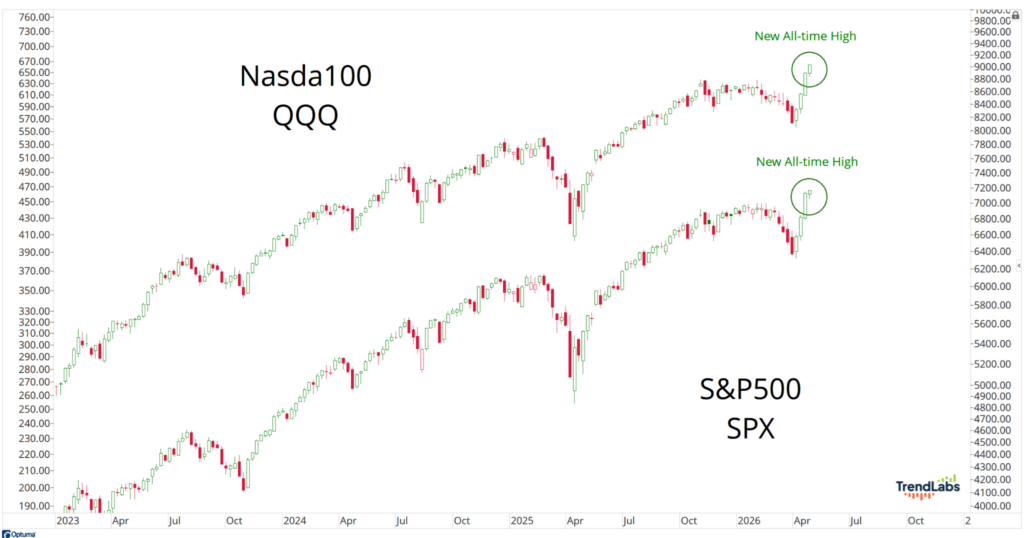
That’s what that looks like.
Both the S&P 500 and the Nasdaq-100 just closed at new all-time highs.
That’s not something to fade. That’s something to respect.
Because this is how uptrends behave.
They don’t look cheap. They don’t give you perfect entries. And they don’t wait for permission.
They just keep going.
And while people sit there waiting for a pullback, telling themselves they’ll “buy it lower,” price keeps moving higher without them.
That’s the cost of needing to be right.
Besides, as Walter Deemer says, “When the time comes to buy low, you won’t want to.”
Professionals don’t buy weakness hoping it turns into strength.
They buy strength that’s already working.
That’s the difference.
The goal is not to buy low and sell high.
The goal is to buy high and sell higher.
Data Doesn’t Care About Your Feelings
And the numbers back it up.
Since 1989, buying the S&P 500 at new all-time highs, for example, has led to better forward returns than buying on a random day:
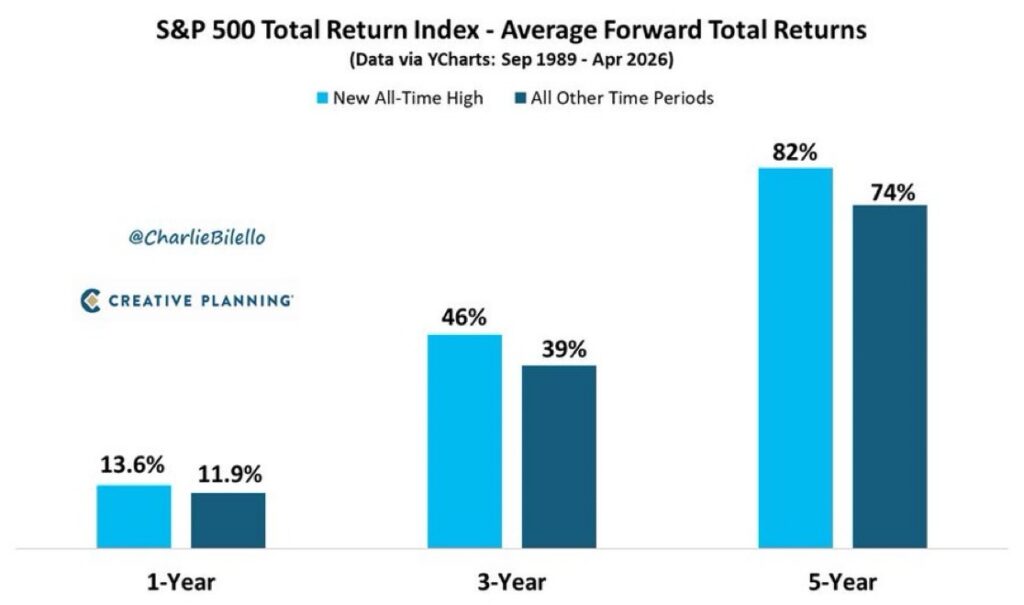
Source: Charlie Bilello and Peter Mallouk of Creative Planning
One year. Three years. Five years. Across the board.
Think about that.
The thing everyone is afraid of has consistently been the place with the highest probability of success.
Higher highs tend to lead to even higher highs.
That’s what uptrends do.
So while people wait for better prices, the market keeps offering worse ones.
And here we are again.
New highs.
If history is any guide, that’s not a warning sign.
That’s an opportunity.
You can keep trying to buy low and hope.
Or you can buy strength and get paid.
Stay sharp,
JC Parets, CMT
Founder, TrendLabs