
You can be right about the future and still lose a fortune investing in it.
Just look at critical minerals.
We’re constantly hearing about the extraordinary demand for copper, lithium, nickel, rare earths, and everything else needed to power artificial intelligence, electric vehicles, and this modern economy.
And much of that excitement is justified.
These materials are essential to technologies that will shape the world for decades.
But that doesn’t mean their stocks have to go up.
Over the past several months, I’ve watched one metals group after another fall apart, even as investors continue celebrating their long-term prospects.
Precious metals have struggled.
Lithium and nickel have come under pressure.
Rare earth stocks have been absolutely demolished.
And now I’m wondering whether copper is next.
The charts are raising serious red flags, especially given what’s happening in currency markets and how aggressively speculators have positioned themselves for higher copper prices.
The Rare Earth Bubble Has Burst
Start with rare earth stocks, which were among the hottest trades in the entire market last year.
These companies produce materials used in everything from EVs and wind turbines to fighter jets and advanced electronics.
With governments scrambling to secure domestic supplies, investors couldn’t seem to buy enough of them.
My equal-weight Rare Earth Index rallied roughly 400% last year, climbing from around $3 to $15 in months.
Then the music stopped:
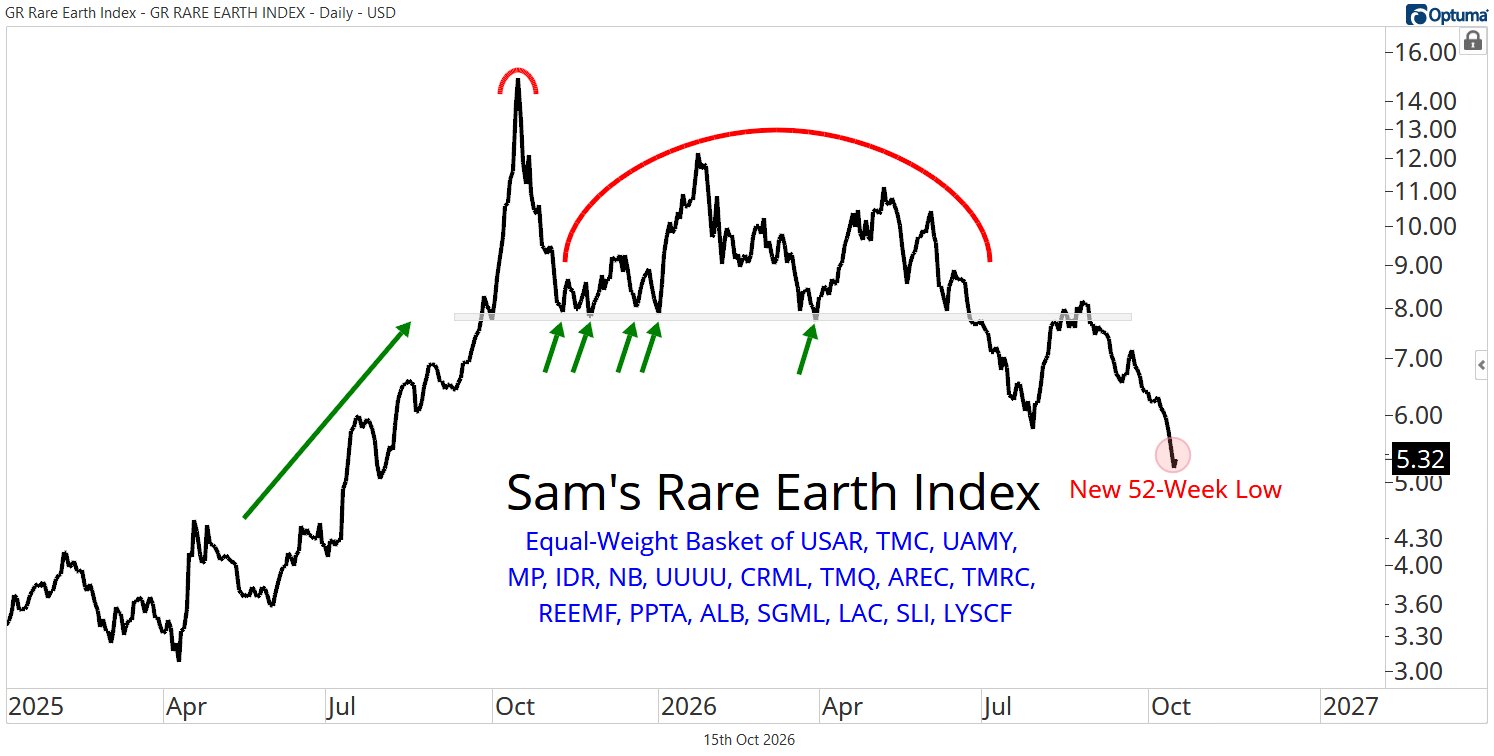
After putting in a textbook climax top last October, the group spent months carving out a massive distribution pattern before finally breaking down.
Now the index is trading near $5, roughly two-thirds below its peak, and making fresh 52-week lows.
What’s remarkable is that the fundamental story hasn’t disappeared.
China remains the dominant supplier of rare earths, and its exports actually increased 6.7% year over year in September.
These materials are still incredibly important, but that hasn’t stopped investors from abandoning the stocks.
That’s the difference between a good story and a good trade.
And, right now, rare earth stocks are terrible trades on the long side.
Copper Is Losing Its Wingman
Copper has been one of the few metals holding up remarkably well, supported by legitimate demand from electrification, AI, and infrastructure investment.
But one relationship we’ve been monitoring has me increasingly concerned.
Copper miners and the Mexican peso have historically moved together, reflecting their shared sensitivity to global economic conditions, industrial demand, and investor risk appetite.
Throughout 2026, both carved out constructive accumulation patterns within strong primary uptrends, and until recently, they appeared ready to break out together.
Then something changed:
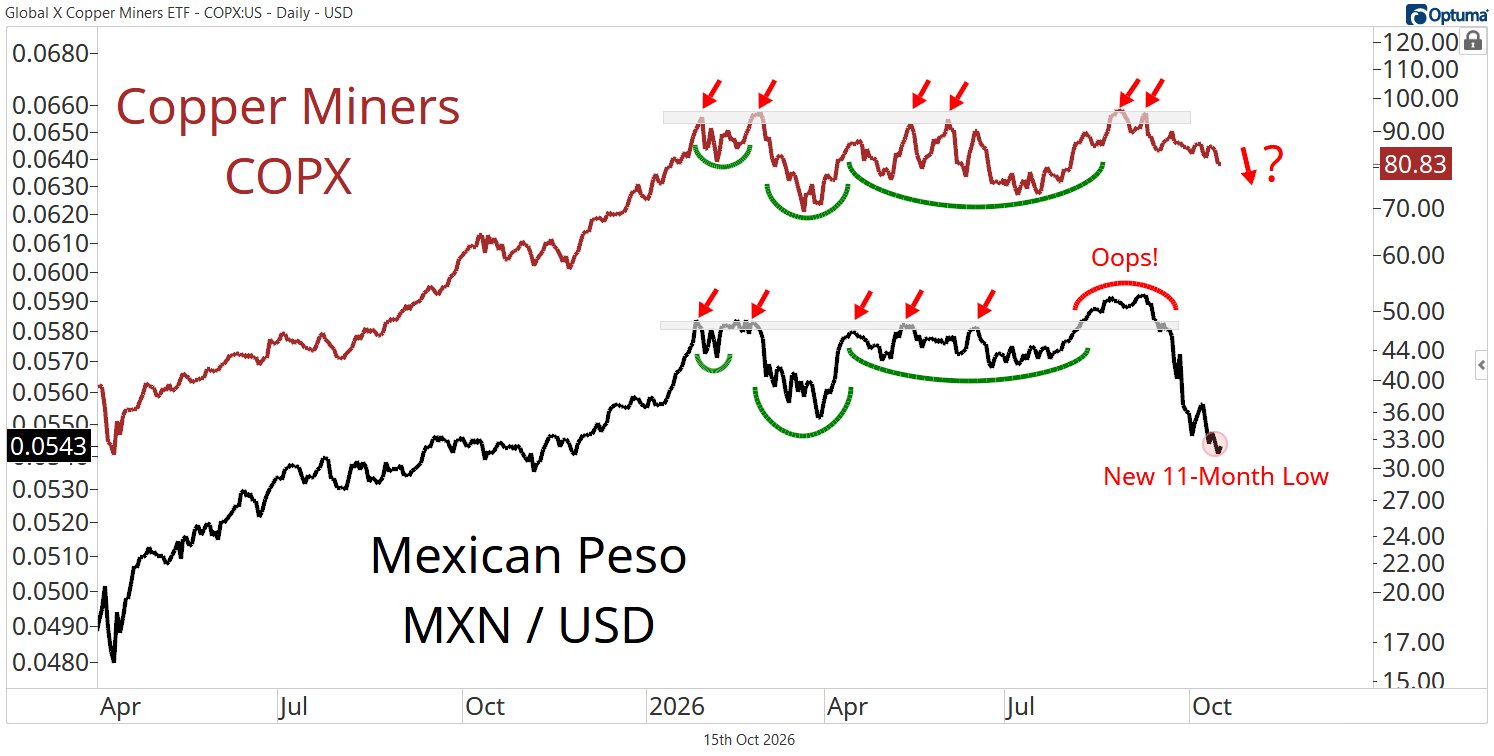
The Mexican peso briefly broke out to new highs, failed miserably, and has since collapsed to its lowest level in roughly 11 months.
Meanwhile, copper miners are still hanging around the upper end of their trading range, seemingly oblivious to the weakness in their longtime companion.
That divergence has my attention.
The peso doesn’t dictate where copper miners trade. But, historically, these two markets have shared a remarkably similar rhythm.
And when that relationship gets stretched, I start looking for opportunities on the other side.
There’s also an interesting fundamental wrinkle.
U.S. copper stockpiles have swollen to roughly 1.6 million metric tons, partly because traders rushed to import metal ahead of potential tariffs.
So while everybody’s talking about future copper shortages, America’s sitting on an extraordinary amount of inventory.
That doesn’t mean copper prices must collapse. But it certainly complicates the bullish narrative.
And the positioning makes the bearish case even more compelling.
Everybody Loves Copper
One of my favorite things to study is speculative positioning in futures markets.
We want to know where traders are placing their bets, how crowded those trades have become, and whether price is confirming their expectations.
Right now, copper is showing a rare setup:
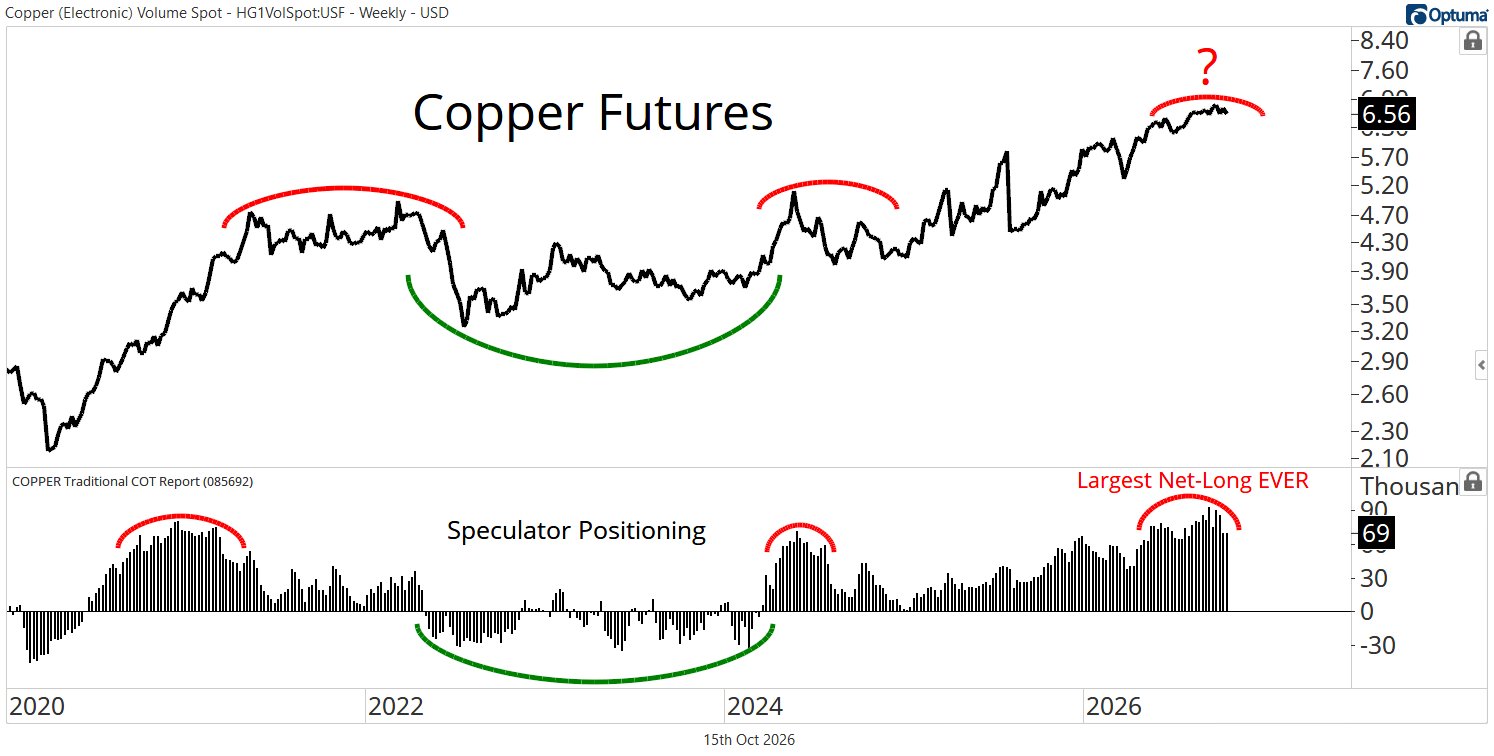
Historically, speculative positioning has moved closely with copper prices.
When speculators become aggressively bullish, prices tend to be near important highs, while extreme pessimism often accompanies major lows.
Right now, speculators are coming off the largest net long position in history.
In other words, there’s nobody left to buy.
Although the primary uptrend remains intact, positioning is rolling over.
The latest Commitment of Traders (COT) data from the Commodity Futures Trading Commission (CFTC) data show large speculators reducing their net long exposure by nearly 17,000 contracts in a single week.
That’s important because when a crowded trade starts moving against its participants, the selling can feed on itself.
Longs start taking profits.
Others hit their stops.
Leveraged traders reduce exposure, and suddenly a normal pullback can turn into something much more violent.
I’m not suggesting copper is guaranteed to collapse.
And I’m certainly not interested in fighting a powerful primary uptrend without confirmation.
But look at the evidence…
Rare earth stocks are collapsing.
The Mexican peso has already broken down.
Copper miners are struggling to keep pace, and speculative positioning is coming off historic extremes.
That’s a lot of warning signs for a market that everyone seems convinced can only go higher.
JC taught me to not get married to narratives.
He taught me to follow price, manage risk, and adapt when the evidence changes.
If copper finally breaks down, I think the unwind could be spectacular.
And unlike the investors who insist on owning these stocks because of what they might become in ten years, we can profit from both rising and falling markets.
That’s the beauty of having an adaptable process.
The future of copper may be incredibly bright.
That doesn’t mean its price can’t get crushed along the way.
Stay safe out there,
Sam Gatlin
Analyst, Everybody’s Wrong