
Some stocks just refuse to go down.
Berkshire Hathaway (BRK.B) is starting to look like one of them again.
Around here, we have a pretty simple rule: We like to do more of what’s working and less of what’s not.
We’ve been long Berkshire Hathaway for a while now.
A few months ago, we caught a monster move using call options, which are simply a way to bet on a stock going higher without buying all the shares outright.
That trade worked out beautifully.
Now, looking at BRK.B again, I’ve been wanting to add to our common stock position.
Here’s what makes this interesting.
Financial stocks have been correcting for the better part of four or five weeks.
Banks, insurance companies, and other financial businesses have been having a tougher time.
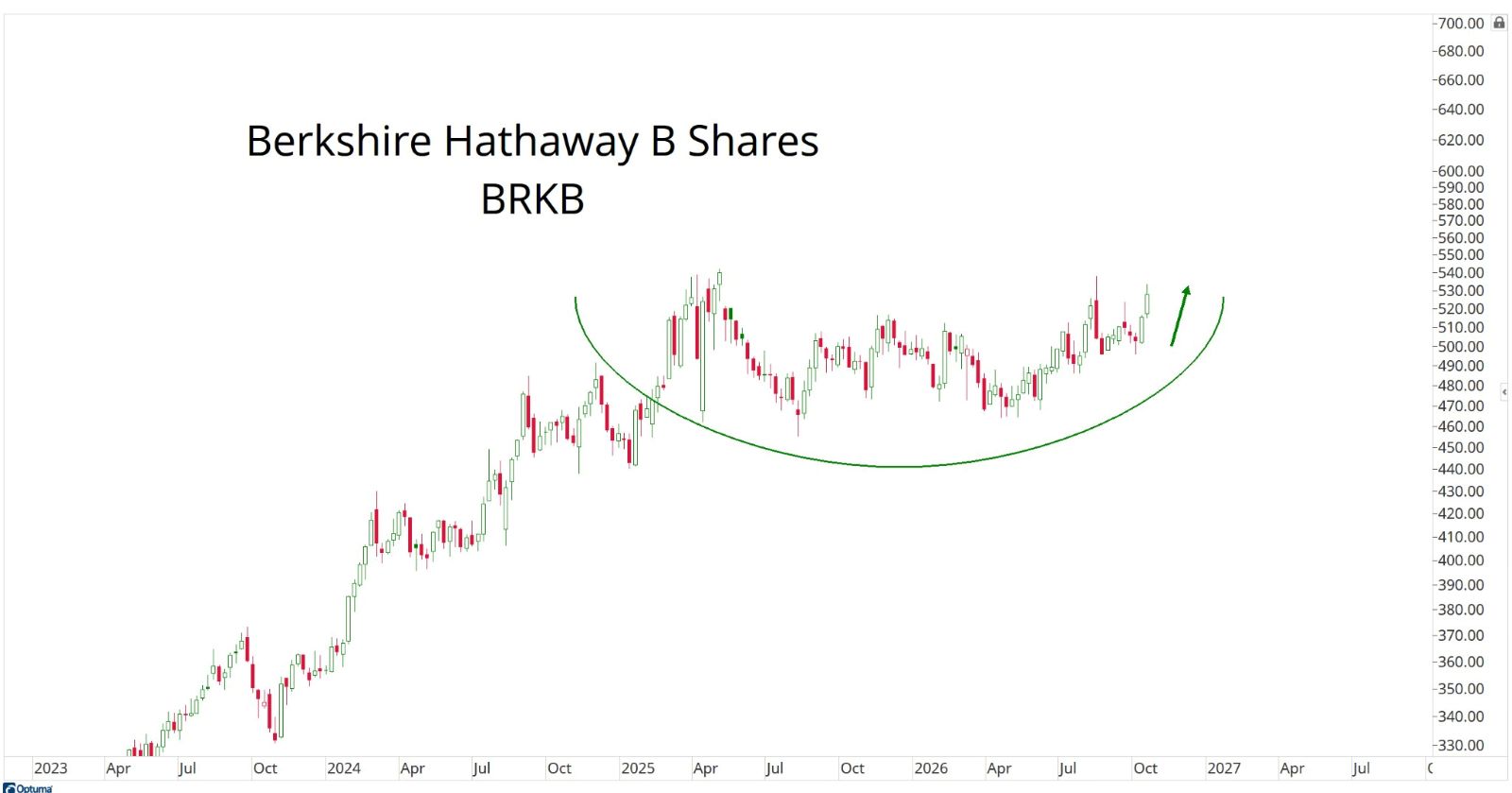
Meanwhile, Berkshire Hathaway, the biggest company in the financial sector, is pushing right back up toward its all-time highs.
That’s not something I want to ignore.
When the biggest stock in a struggling sector is acting like it wants to make new highs, I pay attention.
That’s what we call “relative strength.”
While its neighbors are having trouble, Berkshire is holding its own and pushing higher:
Something’s up.
And I like it.
Is Berkshire Really a Safe Haven?
Whenever Berkshire starts outperforming, somebody inevitably comes along to explain that investors are hiding in safety.
Apparently, Berkshire Hathaway is where everybody goes when they’re afraid of the stock market.
Really?
Let’s think about what Berkshire Hathaway actually owns.
We’re talking about insurance companies, railroads, electric utilities, manufacturing businesses, homebuilders, and all sorts of businesses that sell products and services to regular Americans.
Berkshire owns GEICO, where millions of Americans insure their cars. It owns BNSF Railway, which moves everything from grain to automobiles across the country.
It owns Dairy Queen, where you can get a Blizzard after dinner, and Duracell, which makes the batteries for your kids’ toys.
It owns Clayton Homes, one of the country’s largest builders of manufactured homes.
It also owns Benjamin Moore paint, Fruit of the Loom underwear, and Precision Castparts, which makes components used in airplanes and other industrial equipment.
That’s before we even get to the publicly traded stocks.
Berkshire has owned enormous positions in companies such as Apple (AAPL), American Express (AXP), Coca-Cola (KO), and Bank of America (BAC).
Does that sound like a company that has nothing to do with the economy?
If Americans stop buying houses, cars, insurance, electricity, train shipments, batteries, underwear, and ice cream, Berkshire’s going to know it.
I’m not saying Berkshire doesn’t have defensive qualities. The company has a massive cash position, a strong balance sheet, and businesses that produce cash through all sorts of economic conditions.
Those are real advantages.
But the idea that Berkshire going up automatically means investors are running away from risk seems like a pretty lazy explanation to me.
I see a giant collection of U.S.-based businesses, a long-term uptrend, and a stock that refuses to break down while its sector struggles.
Looks like the heart and soul of America to me.
Why do we need to make it more complicated than that?
Berkshire Hathaway Is Its Own Index
I’ve been saying this for 20 years. I don’t look at Berkshire Hathaway the same way I look at most individual stocks.
To me, Berkshire is practically another stock market index.
You’ve got the Dow Jones Industrial Average, the S&P 500, the Nasdaq, the Russell 3000, and Berkshire Hathaway.
Obviously, Berkshire isn’t literally an index. It’s one company.
But when you own that many different businesses across that many different parts of the economy, the distinction starts to matter a little less from where I’m sitting.
Think about it.
The Dow tracks 30 major American companies. The S&P 500 tracks roughly 500 large companies.
Berkshire owns dozens of operating businesses, many with their own subsidiaries, along with a large portfolio of publicly traded stocks.
Some of those businesses make money when people buy homes. Others get paid when Americans drive their cars, turn on the lights, buy groceries, ship products, or stop for ice cream.
That makes Berkshire a pretty interesting window into the American economy.
Manufacturing alone generates more than one-third of its earnings.
And while Apple and Coca-Cola get plenty of attention, Berkshire’s public stock holdings are worth only about one-third of its market value.
The rest reflects its operating businesses, cash, and other net assets.
That’s why I’ve always treated Berkshire as a bellwether. There’s a whole lot of America inside this one stock.
There are other bellwethers, of course. I pay close attention to Apple. I watch JPMorgan Chase (JPM).
These are enormous companies that can tell us a lot about what’s happening beneath the surface of the stock market.
But Berkshire is different.
Apple tells us a lot about technology and consumers. JPMorgan tells us a lot about banks, lending, and financial markets.
Berkshire gives us a look at a much wider collection of businesses, many of which don’t even trade on a stock exchange.
So when Berkshire is pushing toward new all-time highs, I’m not going to automatically interpret that as bad news for stocks.
Why would I?
Does a giant collection of American businesses going up in value sound like something we should be upset about?
Maybe there’s some complicated explanation for why Berkshire is outperforming.
Maybe investors are looking for quality. Maybe they’re attracted to the cash. Maybe they like the insurance business.
I don’t know.
And I don’t particularly care.
What I do know is that Berkshire has spent a long time building a massive base within a much larger uptrend.
Now it’s pushing toward the top of that range while financial stocks have been struggling.
That’s exactly the sort of behavior I want to see from stocks we own.
So we’re looking to add to our common stock position.
And I wouldn’t be surprised if we went shopping for Berkshire call options again, either.
We’ve already made good money here. If the stock keeps acting this well, why shouldn’t we try to make some more?
Remember, our job isn’t to come up with the most creative explanation for every move in the market.
Our job is to identify what’s working, manage our risk, and take advantage of the opportunities in front of us.
Right now, Berkshire Hathaway is working.
And I’m paying attention.