
A lot of people think Berkshire Hathaway (BRK.B) is just Warren Buffett sitting on a mountain of cash making boring investments.
But Berkshire is actually the biggest stock in the entire S&P Financials Index.
Not JPMorgan Chase (JPM). Not Goldman Sachs (GS). Not Bank of America (BAC).
Berkshire.
And by a pretty wide margin, too.
In fact, Berkshire carries a larger weighting in the Financials Index than Morgan Stanley, Goldman Sachs, and Bank of America combined.
So when financials have been getting smoked relative to the S&P 500, Berkshire has been right there taking punches with them.
And everybody knows why.
Buffett raised record amounts of cash in the middle of a raging bull market while stocks kept ripping higher without him.
Meanwhile, the S&P 500 is up more than 30% over the past year. The Nasdaq 100 is up more than 45%.
Berkshire Hathaway?
Down, and not just a little bit, either.
You can practically hear the disappointment at every country club, steakhouse bar, and golf course in America.
“How could Buffett miss this move?”
“Why is Berkshire dead money?”
“Maybe he’s lost it.”
This is usually the part where things start getting interesting.
Because throughout my career, one thing I’ve learned is that when everybody suddenly agrees that Berkshire is washed up, it often means the damage is already done.
So we bought it.
Long Berkshire and Selling Puts
Throughout my career, and especially over the past decade or so, I’ve called out the “sell puts in Berkshire” strategy quite a bit.
Whenever Berkshire goes through a period of underperformance and just looks ready to completely fall apart, it usually doesn’t.
That’s why we sell naked puts.
Now, what exactly does that mean? It essentially means that we’re betting Berkshire Hathaway doesn’t go down much more.
For a trade like this to work, the stock doesn’t necessarily have to go up. It just needs to stop going down.
Selling puts is traditionally a more aggressive strategy, especially in volatile stocks where anything can happen overnight.
But Berkshire is different. It’s not some one-product company depending on a single earnings report or FDA approval.
It’s a giant basket of businesses with railroads, insurance companies, energy assets, consumer brands, and one of the greatest capital allocators ever sitting on top of it all.
That diversification helps reduce a lot of the chaos.
This is one of those environments where selling puts makes a ton of sense.
Now, here at TrendLabs, selling naked puts is not a core strategy for us operationally. So this is more of a philosophical discussion and the type of thing we talk through internally during analyst meetings.
But we still needed a way to express the same bullish thesis.
So we bought the stock.
Here’s the chart of Berkshire and why we think the downside is probably limited while the upside could surprise people:
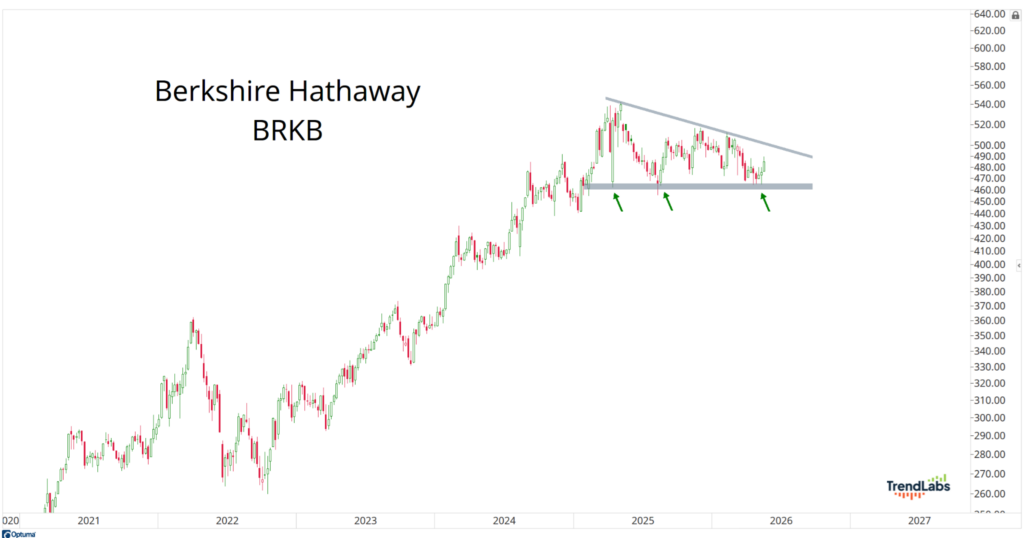
See that flat line near $460 underneath this massive consolidation over the past year?
That’s the level we’re betting Berkshire stays above.
If you’re selling puts, those are the strike prices we’d want to focus on.
And if you don’t trade options, don’t want the leverage, or simply prefer keeping things simple, owning the stock accomplishes the same thing philosophically.
We’re betting the stock stops going down.
That’s the trade.
Lessons Everywhere
There are a few important lessons here.
First, even Warren Buffett gets punished for raising too much cash during a raging bull market. Nobody is bigger than the trend, not even Buffett.
Second, when the largest component in the financials sector can’t get going, the entire group feels the weight of it.
Finally, when Berkshire starts looking hopeless and everyone gets bored with it, historically that’s been a pretty good time to step in.
Not when Buffett is on magazine covers. And definitely not when CNBC is broadcasting live from Omaha all day.
It’s when people stop caring that we start paying attention.
That’s usually when the risk-reward begins to shift.
So we bought the stock.
Same idea as selling puts. Different wrapper.
Now we wait for Berkshire to stop going down and start acting like Berkshire again.
We’re long.
Stay sharp,
JC Parets, CMT
Founder, TrendLabs