
If you only followed financial media, you’d think the stock market was nothing but Nvidia (NVDA), artificial intelligence (AI), and whatever giant technology company happened to report earnings last week.
Those are incredible businesses. They’re changing the world, creating enormous wealth, and attracting most of the attention.
But while everybody’s focused on Silicon Valley, something else is happening.
The stocks that represent the heart and soul of America are quietly making new all-time highs. And almost nobody is talking about it.
When I think about the center of the American economy, my mind doesn’t immediately go to software companies or social media platforms.
I think about machinery companies in Ohio, manufacturers in Illinois, industrial businesses in Minnesota, and the thousands of companies that spend their days making things, building things, fixing things, and supplying the people who do.
To me, that’s the bullseye of the American economy.
One of the things I do every week at TrendLabs is go through every major sector in the market.
Technology. Financials. Healthcare. Industrials. Energy. Utilities. Materials. Consumer stocks. Communications. Real estate.
I look at them from several different angles because markets can tell different stories depending on where you look.
The most common approach is market-cap weighting. That’s just a fancy way of saying the biggest companies get the biggest vote.
Nvidia carries enormous weight in technology. JPMorgan (JPM) dominates financials. Exxon Mobil (XOM) is a major piece of energy.
That makes sense. They’re giant companies. Amazon.com (AMZN) trucks seem to show up at my house every day, so yes, Amazon should probably be a huge part of the Consumer Discretionary Index.
But I also like to look beneath the surface.
What happens when every company gets the same vote? What happens when you move beyond the largest stocks and look at mid caps and small caps instead?
That’s often where the most interesting clues show up.
For those unfamiliar with the term, mid-cap stocks are simply companies that sit between the giant household names and the smaller up-and-coming businesses.
They’re big enough to matter, but still close enough to the ground that they can offer a useful read on what’s actually happening in the economy.
Lately, no group has been grabbing my attention more than mid-cap industrials.
One of the oldest ideas in market history is that stocks tend to sniff things out before economists do.
Markets don’t know the future, but they do reflect the collective decisions of millions of people putting real money at risk.
Right now, those decisions are sending a pretty clear message.
What the Market Is Telling Us
The S&P Mid-Cap 400 Industrials Index just hit a new all-time high:
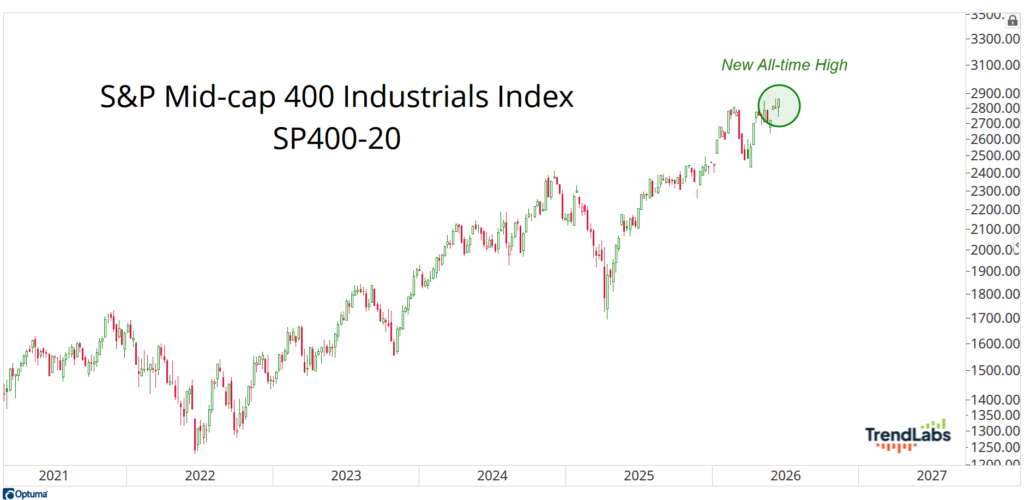
That’s not a five-year high, or a post-pandemic high. That’s an all-time high.
At the same time, the Dow Jones Industrial Average is making new highs, Caterpillar (CAT) is making new highs, and the S&P 500 Banks Index is trading at the highest level in its history.
Those aren’t the areas I’d expect to be leading if investors were preparing for economic trouble. Quite the opposite.
The stocks most closely tied to building, lending, producing, transporting, and investing are acting exactly the way you’d expect them to act when investors are optimistic about the future.
That doesn’t mean every stock is going up. It doesn’t mean there won’t be corrections, surprises, or periods of volatility. Markets don’t work that way.
What it does tell us is where money is flowing.
And money continues flowing toward the businesses most closely connected to economic activity.
The Companies Behind the Move
That’s why I find mid-cap industrials so fascinating.
I’m talking about companies like Timken (TKR) in Ohio making bearings, Lincoln Electric (LECO) in Ohio building welding equipment, Donaldson (DCI) in Minnesota manufacturing filtration systems, Middleby (MIDD) in Illinois supplying commercial kitchens, and Valmont (VMI) in Nebraska building transmission towers and irrigation equipment.
Most people have never heard of these companies. They’re not launching apps, chasing clicks, or selling advertisements.
They’re making bearings that keep factories running, welders that build pipelines and bridges, filters used in everything from construction equipment to data centers, and infrastructure that helps move electricity, water, and food across the country.
In other words, they’re making the things that allow everyone else to do their jobs.
If these companies disappeared tomorrow, everybody would notice.
Factories would slow down. Construction projects would get delayed. Equipment would sit idle. Supply chains would feel it.
Yet most investors couldn’t tell you what these businesses do. That’s exactly why I think they’re so important.
The biggest stocks often get the headlines. The more useful information is frequently hiding underneath the surface, in the companies that rarely make the front page but touch the real economy every day.
When money is flowing into these businesses, it’s telling us something about confidence in future economic activity.
Because when the heart and soul of America is making new highs, it’s hard for me to spend much time worrying about all the reasons the market is supposedly falling apart.
The bullseye of the American economy just hit a new all-time high.
And nobody is talking about it.
Stay sharp,
JC Parets, CMT
Founder, TrendLabs