
Imagine it’s 1884.
You’re trying to figure out whether business is good. There are no economists on TV debating interest rates.
There aren’t thousands of analysts sharing opinions about what might happen next quarter.
There are no government reports hitting your inbox every few days. There’s no Federal Reserve.
So how would you know?
You’d look around.
Are trains full? Are ships busy? Are goods moving from factories to stores?
Are people buying enough stuff to keep the transportation network humming along?
That’s exactly what Charles Dow was thinking about more than 140 years ago.
Most investors assume the Dow Jones Industrial Average was the first stock market index. It wasn’t.
In 1884, Charlie Dow created his first market average, a collection of transportation companies dominated by railroads. He called it “the average.”
By the end of the 1890s, it had become widely known as the Railroad Average. In 1970, it was officially renamed the Dow Jones Transportation Average.
The goal wasn’t to create a famous benchmark. He was looking for a practical way to measure whether economic activity was expanding or contracting.
The logic was simple. If business was expanding, transportation companies would know. If business was slowing down, transportation companies would know that, too.
Why Transportation Stocks Still Matter
One of the fascinating parts of this story is that stock markets existed for centuries before anyone created a stock index. The Amsterdam Stock Exchange opened in 1602.
Yet there wasn’t much need for a market average because there weren’t many stocks to average.
If you wanted exposure to global commerce, you bought shares of the Dutch East India Company and moved on with your life.
By the late 1800s, investors suddenly had choices. Railroads, manufacturers, shipping companies, banks, and industrial firms were all competing for capital.
Investors needed a way to simplify an increasingly complicated market. Dow’s solution was to focus on transportation because transportation sat right in the middle of everything.
Factories could produce products all day long. If nobody was moving those products around the country, something wasn’t working.
Fast forward to today, and most of the conversation revolves around artificial intelligence, semiconductors, cloud computing, robotics, and data centers.
Those are important themes. They’re helping drive one of the strongest areas of the market.
But transportation stocks don’t care what the story is. They care whether things are moving.
That’s why I continue to pay attention to them.
The Dow Jones Transportation Average has rallied sharply off the April lows and has now worked its way back to the same area where sellers showed up earlier this year:
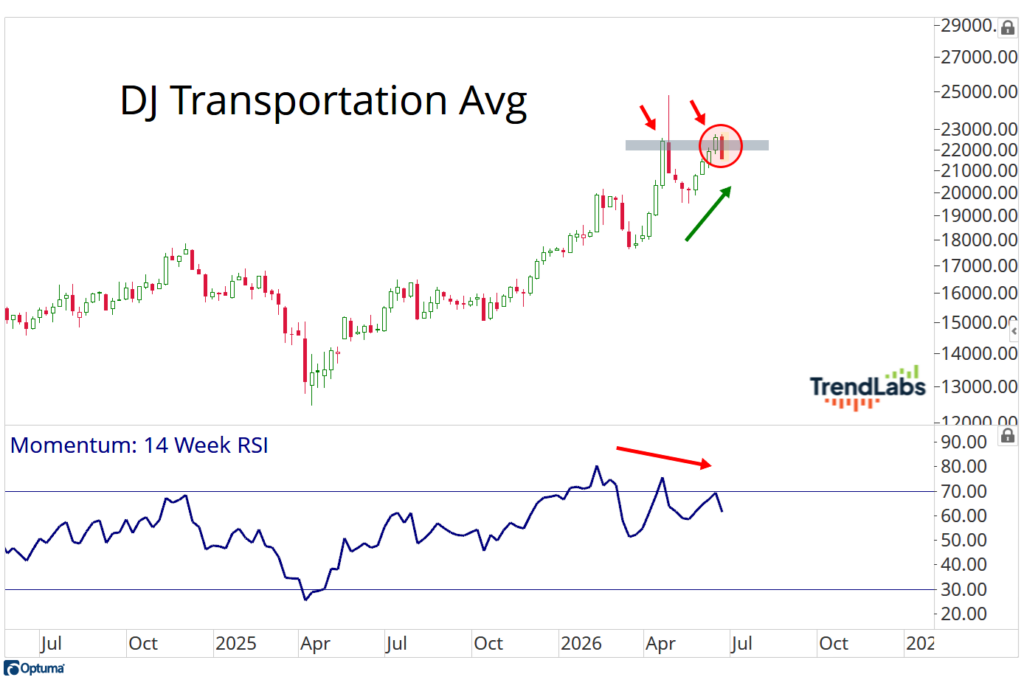
This is one of the purest examples of supply and demand you’ll find in markets.
We already know supply appeared here once because prices turned lower from these levels before. Now buyers are back and trying again.
What catches my attention is the momentum beneath the surface.
Prices are testing those prior highs, but momentum has not yet reached a new high of its own. That doesn’t mean prices have to fail.
It simply tells us we’re looking at an important battleground where buyers and sellers are negotiating price.
The market is asking a question. We don’t have the answer yet.
The Test Happening Right Now
The S&P Transportation Index may be even more interesting.
Unlike the Dow Transports, this group already broke out to new highs in late May.
Since then, prices have pulled back and are now retesting that former breakout level for the first time:
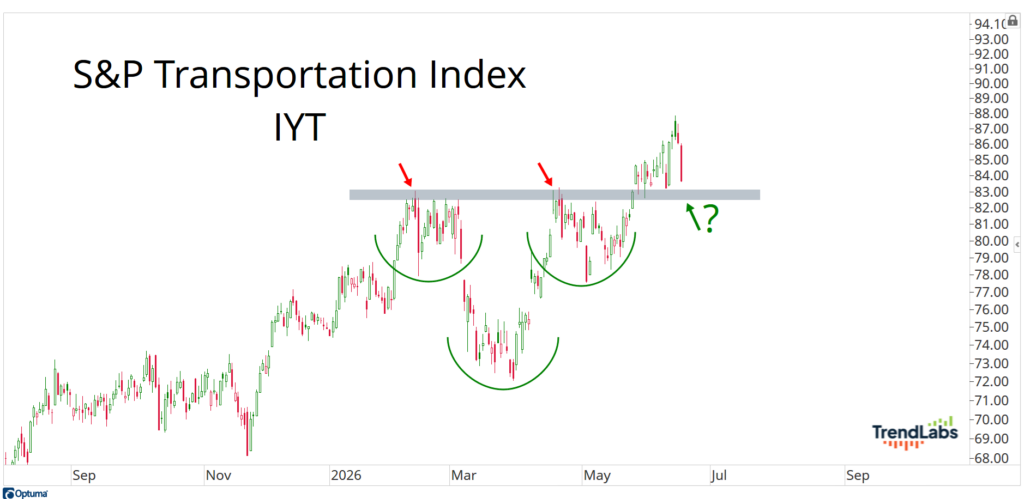
This is something we see constantly throughout market history: Resistance turns into support.
At least that’s what is supposed to happen in a healthy uptrend. Buyers who missed the initial breakout often get a second chance. Sellers who were leaning against resistance are forced to rethink their position.
Now, we get to see whether demand shows up.
If buyers defend these levels, the breakout remains intact and the trend continues. If they don’t, we’ll have new information to work with.
Either way, transportation stocks are sitting in a position where they’re likely to tell us something useful about the market’s underlying health.
That’s what makes this group so interesting to me right now.
Not because Charlie Dow said so. And not because Dow Theory has survived for nearly a century and a half.
Transportation companies still occupy a unique place in the economy. They connect manufacturers to customers, ports to warehouses, and products to consumers.
Charles Dow recognized that and did something about it in 1884.
The first stock index ever created was built to answer a simple question:
Are things moving?
That’s still a pretty good question today.
Stay sharp,
JC Parets, CMT
Founder, TrendLabs