
Nvidia (NVDA), the largest company in the world, just completed a $25 billion bond offering after initially targeting at least $20 billion.
That’s a huge number by itself, but it wasn’t the number that caught my attention.
What caught my attention was the demand.
Investors reportedly lined up with roughly $85 billion for a deal Nvidia ultimately sized at $25 billion. Think about what that means for a minute.
Nvidia wasn’t looking to raise $85 billion. It wasn’t even looking to raise $25 billion when the process started.
Investors simply wanted far more exposure than Nvidia was willing to provide.
In other words, the story here isn’t really about Nvidia borrowing money.
The story is that investors were willing to lend more than three times what Nvidia ultimately decided to take.
That’s a very different conversation.
If you’ve been following along, this probably sounds familiar.
A few weeks ago in Everybody Wants Your Money, I argued that the most interesting part of Alphabet’s (GOOGL) $80 billion raise wasn’t the size of the raise itself.
The most interesting part was that investors were willing to provide the money.
Then in Wall Street Gets An A+, I made the case that our financial system deserves more credit than it gets for directing capital toward the people and companies trying to build the future.
The Nvidia deal feels like another piece of evidence supporting the same thesis.
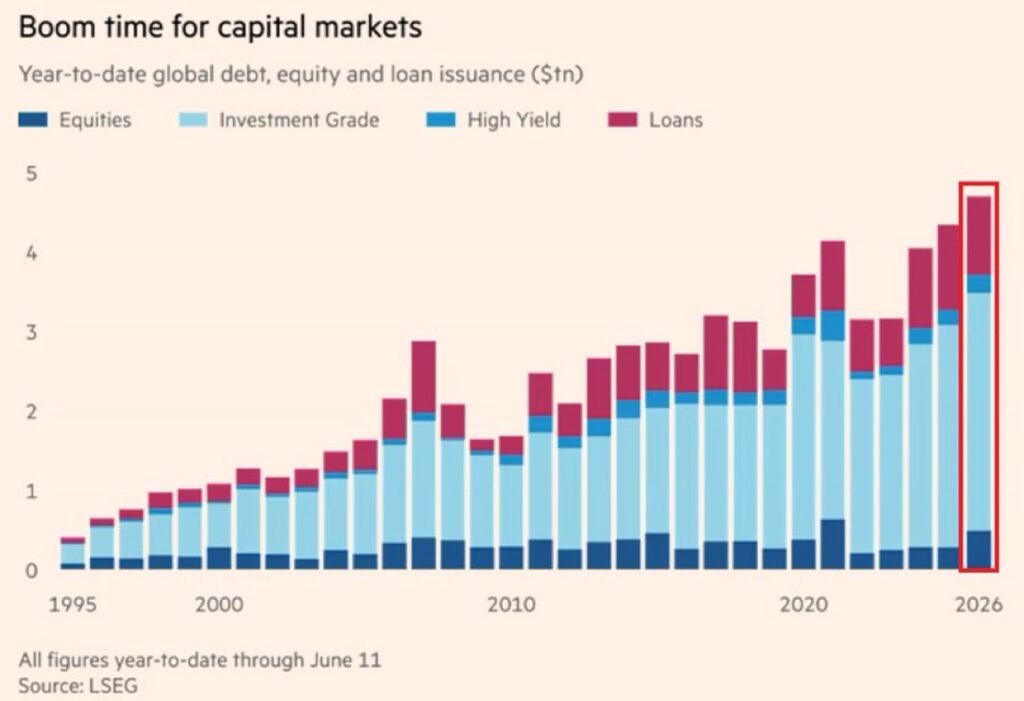
The chart tells the story better than I can.
Global debt issuance, equity offerings, and loan activity are running near the highest levels we’ve ever seen.
Nvidia didn’t create this environment. Nvidia is a symptom of it.
When companies come looking for capital, investors are showing an extraordinary willingness to provide it.
And Nvidia isn’t some isolated example. Earlier this year, OpenAI raised $122 billion. Alphabet followed with an $80 billion raise of its own.
Anthropic raised another $65 billion just last month. SpaceX (SPCX) completed the largest IPO ever and immediately became one of the largest companies in the world.
Everywhere you look, companies tied to artificial intelligence, semiconductors, data centers, robotics, energy infrastructure, and the technologies shaping the next decade seem to have little trouble finding capital.
At some point you stop looking at the individual transactions and start paying attention to the pattern.
Collectively, we’re talking about hundreds of billions of dollars flowing into a relatively small group of companies in an incredibly short period of time.
That’s the part I find fascinating.
The Biggest Opportunities Require Big Capital
One of the easiest mistakes investors make is assuming every capital raise is a warning sign. Sometimes that’s true.
A company issuing stock because it needs cash to survive is very different from a company raising money because it sees opportunities everywhere it looks.
Nobody thinks Alphabet is running out of money. Nvidia certainly isn’t. OpenAI didn’t struggle to find investors. Anthropic wasn’t scraping together financing to keep the lights on.
These companies aren’t raising capital because they’re desperate. They’re raising capital because they see enormous opportunities in front of them.
And, honestly, if you’re trying to build artificial intelligence infrastructure, robotics platforms, semiconductor manufacturing capacity, power generation, data centers, and next-generation networking equipment, it’s hard to imagine how you wouldn’t need enormous amounts of capital.
That’s the part many investors miss.
The companies asking for money today are often the same companies trying to build the future.
Railroads required massive amounts of capital. Telecommunications networks required massive amounts of capital. The internet required massive amounts of capital.
Today, it’s data centers, semiconductor manufacturing, power generation, networking equipment, and robotics.
The technologies change, but the pattern remains remarkably consistent. Every major technological revolution attracts huge pools of capital long before the full economic impact becomes obvious.
One of my favorite things about studying markets is that they force you to study history. Not because history repeats perfectly. It doesn’t.
But human behavior rhymes over and over again.
When investors become convinced they’re looking at the next great opportunity, they don’t sit around waiting for permission. They start writing checks.
That’s what we’re seeing now.
The companies building the future are asking for money, and investors seem more than happy to provide it.
The Market Keeps Sending The Same Message
When I wrote Everybody Wants Your Money, the focus was mostly on supply. Companies were showing up asking investors for capital.
What’s become increasingly obvious since then is that the demand side of the equation may be even more important.
Every dollar raised has a buyer on the other side. Every share sold has an owner. Every bond issued has an investor willing to lend.
What fascinates me isn’t that these companies are raising money. Companies have always raised money. What fascinates me is the scale.
Nvidia attracted roughly $85 billion of demand for a $25 billion bond offering. Google raised $80 billion. OpenAI and Anthropic have raised amounts that would have sounded ridiculous just a few years ago.
Then SpaceX came public at a valuation larger than the stock markets of most countries in the world.
Think about what kind of optimism is required for investors to commit that much capital.
Eventually, there will be too much enthusiasm. There always is.
History suggests human beings are incapable of discovering a genuinely transformative technology without eventually getting carried away.
But we’re not there yet.
Right now, what I see is a market directing enormous amounts of capital toward artificial intelligence, robotics, semiconductors, data centers, energy infrastructure, and the technologies that will likely define the next decade.
The companies building the future keep asking for money.
And the market keeps saying yes.
Stay sharp,
JC Parets, CMT
Founder, TrendLabs