One of my favorite things to do is ignore what people are saying and watch what they’re actually doing.
Economists can argue. Strategists can debate. TV can spend all day discussing what might happen next.
I want to know where the money is going.
Right now, companies are asking investors for more money than ever before.
And investors keep handing it over.
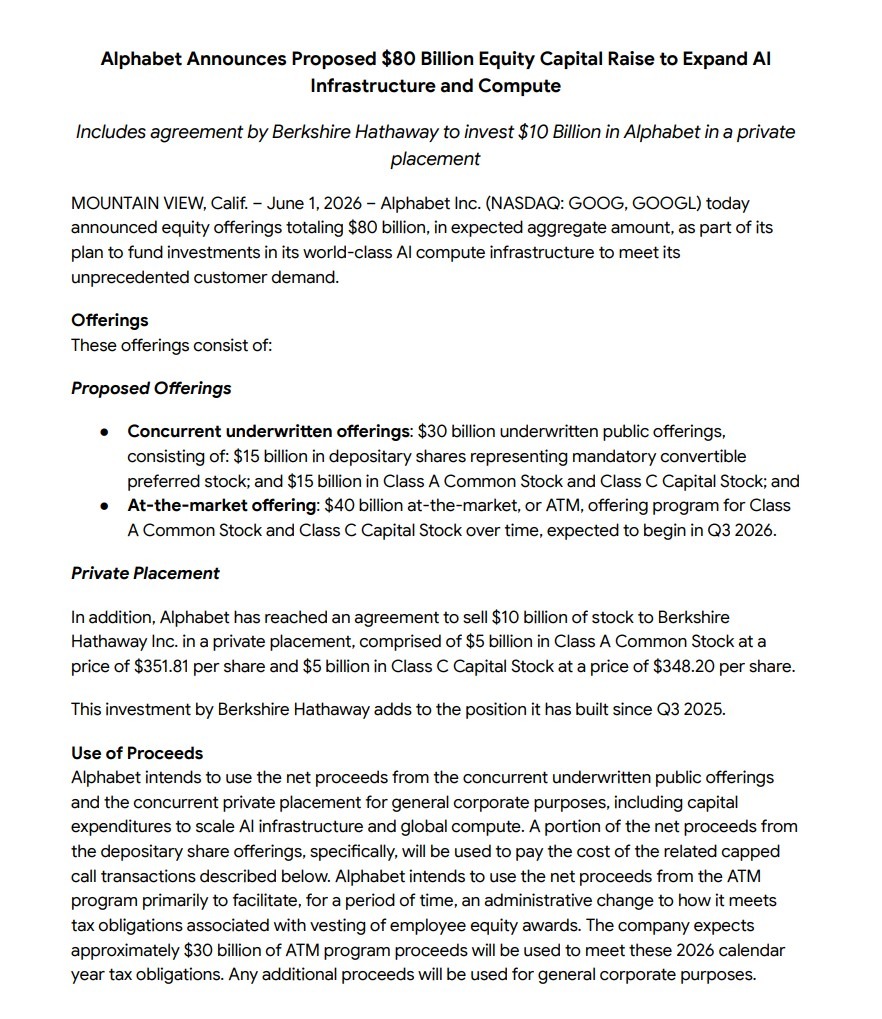
Alphabet (GOOG) just announced plans to raise $80 billion.
Think about that for a second.
Not $80 million. Not $8 billion. $80 billion.
As far as I know, that’s the largest secondary stock offering ever.
A secondary offering is when a public company goes back to the market and sells more shares.
Your slice of the pie gets a little smaller. But if the company deploys that capital to grow the whole pie, the dilution doesn’t matter.
That’s what’s happening here, as described in Alphabet’s press release:
Alphabet is already one of the largest and most valuable businesses in the world.
Yet they looked around and decided they wanted another $80 billion to spend building AI infrastructure.
And investors said, “Yes.”
Not only did they say yes. They said yes to the biggest secondary stock sale we’ve ever seen.
That matters.
Because investors don’t write checks like that when they’re scared.
Buffett Gets the First Phone Call
It gets better.
Included in that $80 billion raise is a $10 billion private placement with Berkshire Hathaway (BRK.B).
A private placement is exactly what it sounds like.
Instead of offering shares to everyone, the company picks a specific investor and says, “Would you like to buy this directly from us?”
In this case, Alphabet picked Berkshire Hathaway.
Ten billion dollars. As far as I know, that’s the largest private placement ever.
Think about that.
Most of us buy shares in the stock market alongside millions of other investors.
Berkshire gets a phone call. It’s a completely different world.
We’ve seen this movie before. During the financial crisis, Goldman Sachs (GS) called Warren Buffett when they needed capital.
Buffett got terms nobody else could get because he had something everybody wanted: a giant checkbook and a reputation for showing up.
Twenty years later, not much has changed.
When companies need enormous amounts of money, Berkshire still gets invited into the room.
The Market Is Open for Business
The fascinating part isn’t Alphabet.
The fascinating part is that investors are willing to absorb all this supply.
Everybody hears the word “dilution” and immediately assumes it’s bad.
Yes, if a company issues more shares, your ownership percentage gets a little smaller. That’s how math works.
But that’s missing the bigger point.
Companies only raise money when they think investors are willing to provide it.
Right now investors are providing it at a scale we’ve never seen before.
Record secondary offerings. Record private placements. Largest IPOs ever.
Everywhere you look, companies are showing up with their hands out asking for money.
And the market keeps saying yes. That’s the story.
Not whether AI is overhyped, not whether valuations are too high, and not whether some economist thinks a recession is coming.
The story is that companies are asking for enormous amounts of capital and investors are eagerly providing it.
We’re not done, either. I think more companies will come.
More stock offerings. More IPOs.
More attempts to take advantage of investors’ appetite for anything tied to the next phase of the AI buildout.
When companies start raising money in amounts that would have sounded completely ridiculous just a few years ago, I pay attention.
Because markets talk. And right now the message is pretty simple:
Capital is available. And everybody wants a piece of it.
This Week in Everybody’s Wrong
On Monday, we talked about a recent lifestyle upgrade.
It’s expensive, though: “Break out another thousand” is real.
At the same time, we know how to find the opportunity in just about any scenario.
On Tuesday, I shared my two favorite new words of 2026 so far.
The market is alive, it evolves, and it’s always inventing new vocabulary.
And new words are good signals to take a look at what’s happening under the surface.
On Wednesday, we acknowledged the passing of the 60/40 portfolio.
It happened years ago.
On Thursday, I explained why I don’t dig too deep into artificial intelligence.
I prefer to study natural stupidity.
On Friday, we revisited one of our favorite themes: not fighting trends.
If you’re going to do it, you better have very good reasons. And you’d better be right.
Indeed, it’s better to be with White House Capital than against it.
On Saturday, Sam Gatlin took us to Oklahoma City for what was a historic Game 7 on May 30 and a close-up on the energy sector.
You’re going to enjoy being inside for Spurs-Thunder.
And you just might profit from what you learn about the Cushing Terminal.
Have a great Sunday.
We’ll see you Monday morning…
Stay sharp,
JC Parets, CMT
Founder, TrendLabs