
Founder’s Note: Sam Gatlin is at that point in his career – in his life – where he’s getting better every day.
It can be that way when you’re young… if you’re paying attention. Sam is definitely paying attention.
Here he is with a cool reflection on a great experience with his brothers and a basketball game. – JC
By Sam Gatlin
I recently went to Oklahoma City with my two brothers for Game 7 of the Western Conference Finals.
Being born and raised in Kansas, I’ve been a Thunder fan for as long as I’ve cared about basketball.
That has meant living through the good stuff, like the Kevin Durant, Russell Westbrook, and James Harden years, when it felt like Oklahoma City had somehow stolen the NBA’s future and dropped it right in the middle of the Great Plains.
It has also meant living through some ugly years, when the building blocks were gone, the wins were scarce, and the only thing keeping the fan base sane was the belief that Sam Presti knew exactly what he was doing.
Turns out, he did…
The Thunder rebuilt themselves into one of the best teams in basketball, and this new era has been unbelievable to watch.
But this year, a new monster showed up in the Western Conference.
San Antonio and Victor Wembanyama
The Spurs beat the Thunder 111-103 in Game 7, ending Oklahoma City’s season and sending San Antonio back to the NBA Finals for the first time since 2014.
I hate that it happened to my team, but as a basketball fan, I get it.
Thunder vs Spurs could become the defining Western Conference rivalry of the next decade.
Shai Gilgeous-Alexander, Jalen Williams, Chet Holmgren, and the rest of Oklahoma City against Wembanyama and San Antonio, year after year, with trips to the Finals on the line.
That’s good theater.
And like everything else, it got me thinking about markets.
One of the things you notice immediately inside the Thunder arena is that Oklahoma City is not New York, Los Angeles, or Miami.
The advertisements are different.
At Madison Square Garden, you’re probably seeing ads for luxury brands, banks, media companies, or whatever new app is pretending to change the world this week.
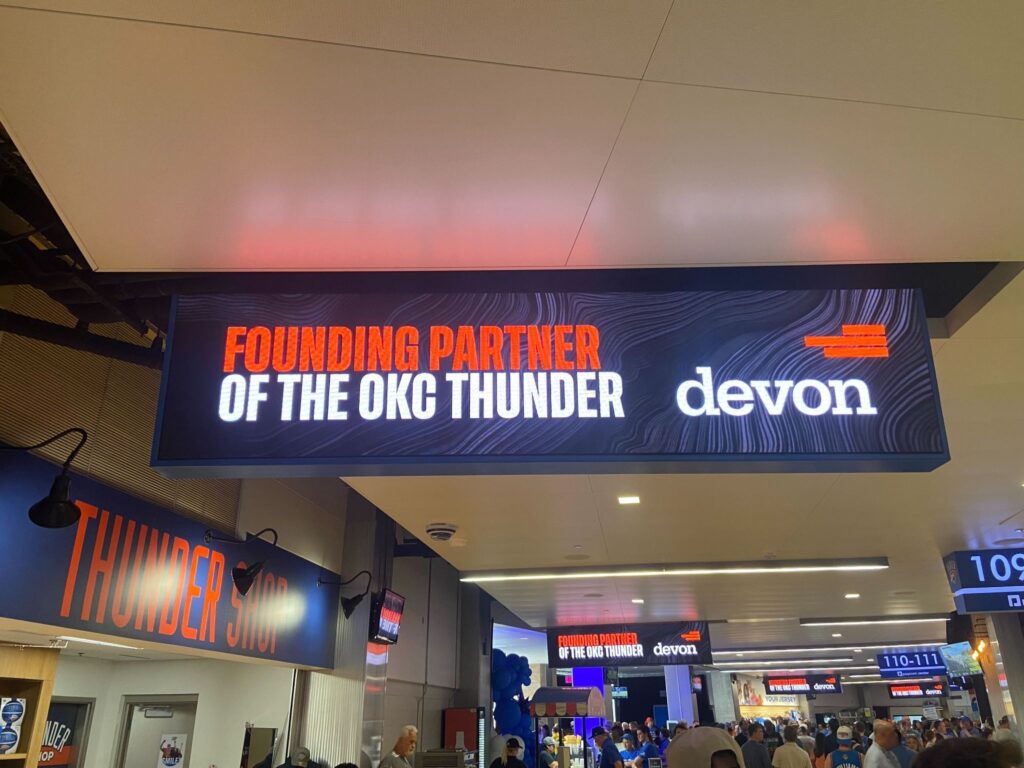
In Oklahoma City, you look up and see Devon Energy (DVN) calling itself a founding partner of the Thunder.
That’s Oklahoma.
Devon Energy is headquartered in Oklahoma City and is based in a state where oil and gas have shaped the economy, skyline, and culture for generations.
You feel it when you’re there.
Energy is not some abstract sector weight on a Bloomberg terminal.
In Oklahoma, energy has made people rich, and in darker chapters, it also created the kind of greed and violence that “Killers of the Flower Moon” forces people to confront.
That movie is brutally depressing, but it’s worth watching because it reminds you that Oklahoma’s energy story is not just about pipelines and oil wells.
It’s also about land, power, wealth, and the people who paid the price when oil became too valuable to ignore.
And then there’s Cushing…
Cushing, Oklahoma, is one of the most important places in the entire crude oil market.
It’s the delivery point for West Texas Intermediate crude oil futures, and its pipeline and storage infrastructure helped make it one of the great oil hubs in North America.
So when I’m sitting there watching the Thunder, staring at Devon Energy ads, thinking about Cushing, and watching Oklahoma City lose a Game 7 in front of a packed house, the same thought kept coming back to me.
Leadership matters.
You need your best players on the court.
Chet Holmgren is supposed to be one of Oklahoma City’s stars. The Thunder have committed a significant amount of money to him, and he is a major part of what this team is supposed to become over the next decade.
The organization’s 2026-27 payroll is projected to surge after major extensions for SGA, JDub, and Chet, with the group’s deals worth up to $800 million combined.
But in Game 7, when the lights were brightest, Chet disappeared.
He scored four points, which cannot happen.
Not when you’re facing Wembanyama, who is already one of the most terrifying defensive players on Earth.
Not when your team needs you, and you’re being paid and counted on to be one of the guys.
Game 7 was a reminder that talent is not enough.
When the moment arrives, your best players have to produce.
The same is true in markets.
A Bull Market Needs Its Stars To Show Up
And right now, they are.
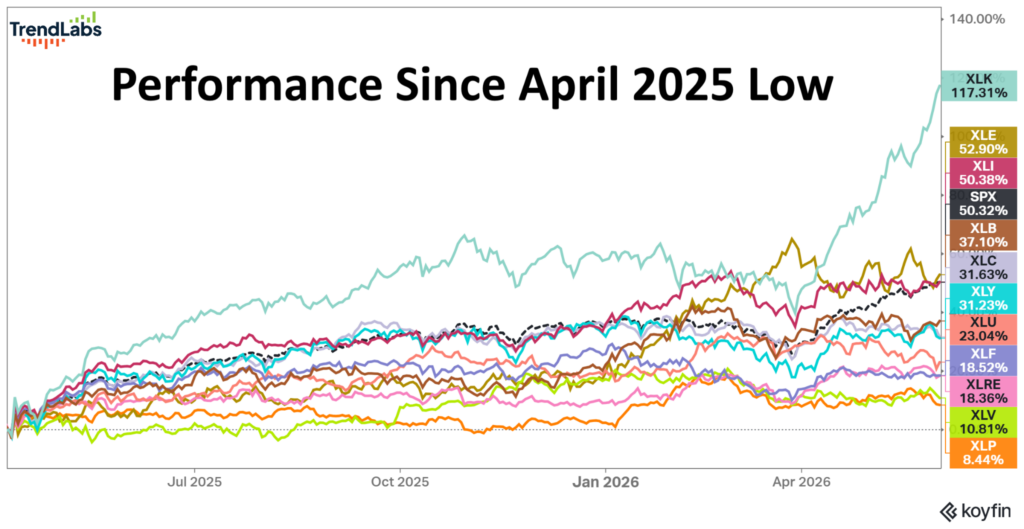
Since the April 2025 low, the S&P 500 is up more than 50%.
That’s happened because the right groups are doing the heavy lifting.
Technology is up nearly 120% since that low, more than doubling the return of the second-best sector, which happens to be energy.
Industrials are also near the top of the board, while the worst players, like consumer staples, healthcare, and real estate, are stuck at the bottom.
This is what it looks like when you have your stars on the court:
This is also what a bull market looks like when it’s functioning properly.
You don’t want the market dragged higher by defensive sectors as investors hide.
And what we have today is the opposite.
Technology is still the clear star.
Energy is right behind it.
And the economically sensitive groups are showing up, while the defensive groups are underperforming.
Everybody Wants To Overthink It
This is where people get themselves into trouble.
They look at technology up nearly 120% and say it has to be over.
They look at energy ripping and say it can’t keep going.
They look at the S&P 500 up more than 50% from the April 2025 low and start hunting for reasons to be bearish because the move feels too obvious, too extended, or too good to trust.
But markets don’t care how people feel.
They care about leadership.
And right now, the leadership is exactly where it should be.
The best players are producing and rotating capital into the groups that matter most.
Oklahoma City lost because one of its key stars didn’t give them enough.
Markets work the same way.
When the stars show up, you win.
When they disappear, you don’t.
Right now, the market’s stars are still showing up.
Stay sharp,
Sam Gatlin
Analyst, TrendLabs