At TrendLabs, we don’t spend a lot of time worrying about what should happen. We’re interested in what is happening. That’s literally why it’s called “TrendLabs.”
Our job is to identify trends, recognize them before everybody else, and then figure out how to exploit them for our own selfish profits.
The market doesn’t care about your politics. It doesn’t care about mine, either. The market is simply a collection of people making decisions.
Some people have more influence than others. Some people have more money than others. Some people have more power than others.
Our job is to figure out who matters and what they’re doing.
Back in July 2025, when the government announced it was taking a major stake in MP Materials (MP), several of us were discussing it in real time.
It wasn’t about whether it was fair or appropriate. We were asking a much simpler question: Do you really think this is the last time we’re going to see something like this?
Of course not.
Once the government starts directly participating in strategic industries, why would we assume they’re one and done? That doesn’t make any sense.
The more I thought about it, the more I realized that what we’re really watching is the emergence of a new institution.
I call it “White House Capital.”
And there are three ways to participate.
What Trump Buys. What the Government Buys. What Their Friends Buy.
The framework is simple.
You can buy what Trump buys. You can buy what the government buys. Or you can buy what the people around them buy.
That’s White House Capital.
Let’s start with Trump.
Back in February, Trump publicly told people to go out and buy a Dell Computer. Shortly thereafter, we bought DELL stock. Then in May, Trump disclosed that he owned DELL himself.
The stock exploded higher, and we booked gains of more than 100% in roughly two months.
You can call that “luck” if you want. I’m calling it “trend recognition.”
If one of the most powerful people on Earth is publicly promoting a company, privately owning the company, and actively pushing policies that support the broader theme surrounding that company, I at least want to know about it.
I certainly don’t want to be fighting it.
The same logic applies to other names Trump owns like Nvidia (NVDA), Apple (AAPL), Amazon (AMZN), Oracle (ORCL), and Broadcom (AVGO).
These all sit inside themes this administration has repeatedly emphasized: artificial intelligence, technology leadership, infrastructure, and American competitiveness.
Whether you like those themes is beside the point. They’re happening.
The second bucket is even easier. Just follow what the government is buying.
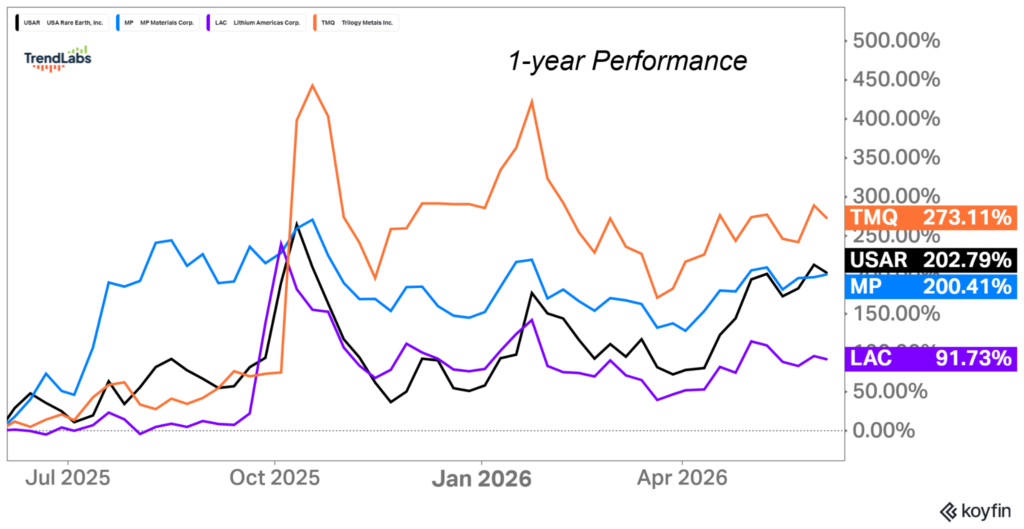
The government isn’t exactly being subtle about what it cares about. Rare earths, lithium, critical minerals, strategic supply chains, and national security have all become clear priorities.
MP Materials became the poster child for this theme, but it’s not the only one.
Lithium Americas (LAC), Trilogy Metals (TMQ), and USA Rare Earth (USAR) all operate in areas that appear increasingly important to policymakers.
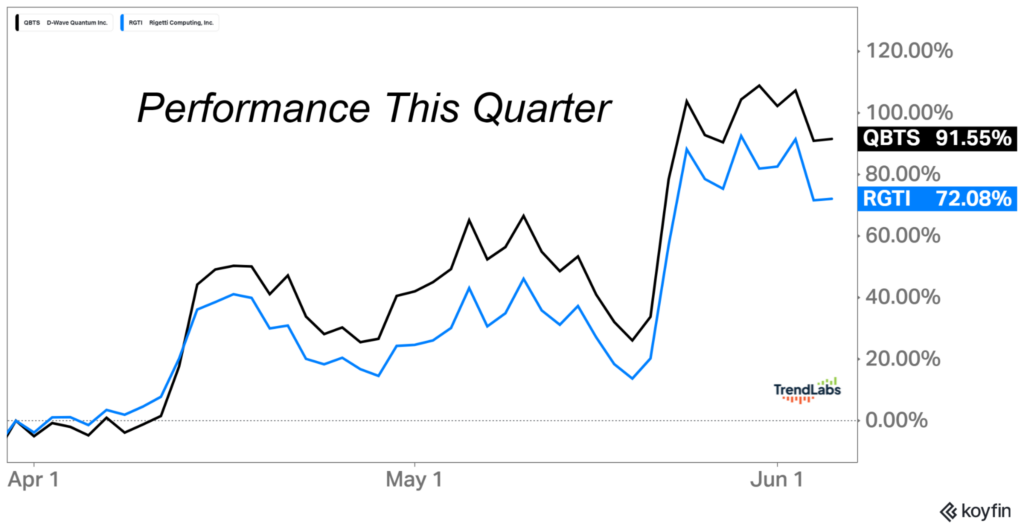
The same thing is happening in quantum computing.
Rigetti Computing (RGTI) and D-Wave Quantum (QBTS) all sit at the intersection of technologies that government agencies and policymakers continue to emphasize.
I don’t know whether quantum computing changes the world next year or 10 years from now.
What I do know is that the government thinks it’s important. That alone is enough information for me to pay attention.
Then comes the third bucket: the people around them.
These are the beneficiaries, the second-order effects. The companies connected to the people connected to the administration.
This is where things get interesting.
You have members of the Trump family becoming increasingly involved in areas like digital assets, Bitcoin mining, infrastructure, and emerging technologies.
You have Jared Kushner operating one of the largest private investment platforms in the world through Affinity Partners.
You have family offices, strategic investors, political allies, and business partners all pursuing opportunities in many of the same industries receiving increased attention from policymakers.
That doesn’t mean every investment is connected. It doesn’t mean every stock in these themes is automatically a winner.
But it does mean that as investors, we should pay attention when influential networks of capital, political power, and strategic priorities begin pointing in the same direction.
Names like Unusual Machines (UMAC), American Bitcoin (ABTC), and Hut 8 (HUT) fit into that conversation.
Notice how all of these themes – drone technology, Bitcoin mining, AI infrastructure, data centers, power generation, and digital assets – start bleeding into one another.
That’s not an accident. That’s where the opportunities are.
The lines are blurry because the relationships are blurry.
Politics bleeds into policy. Policy bleeds into capital allocation. Capital allocation bleeds into markets.
And markets, as they always do, begin discounting those relationships long before most people are willing to acknowledge them.
That’s why this third bucket may ultimately become the most important one to watch.
More Shenanigans Are Coming
One of my favorite observations about markets is that people spend far too much time arguing with reality.
Reality doesn’t care. Reality just keeps showing up every day.
The government invested in MP Materials. Reality.
The government is prioritizing domestic supply chains. Reality.
The government is prioritizing artificial intelligence. Reality.
You can spend all day telling me why it shouldn’t be happening. Some of those arguments may even be right. But that’s not what we do here.
We’re not political analysts. We’re market participants.
If I see a powerful participant throwing weight behind an industry, I don’t want to be short that industry. That’s just common sense.
Maybe MP Materials was just a one-off event. Maybe there were no more deals, no more investments, no more partnerships, and no more government-backed winners.
You could have made that bet last year if you wanted.
I’ve been making the opposite bet.
And I’m still betting there are more shenanigans coming.
More investments. More strategic initiatives. More public-private partnerships. More government involvement in industries deemed strategically important.
If that’s true, I want to know where the money is going before everybody else does.
Because at the end of the day, that’s all we’re really doing here.
We’re observing human behavior, identifying trends, and trying to profit from them.
White House Capital is a trend.
I’m treating it like one.
Stay sharp,
JC Parets, CMT
Founder, TrendLabs