
It’s still a bull market, and we’re still looking for stocks to buy.
Our basic bet is that stock prices are going higher from here. We’re “long,” is how they put it on Wall Street.
When you’re long, one day you might be a seller.
Some people – a lot of people, actually – don’t believe in this bull market.
Their basic bet is that stock prices are going lower from here. They’re “short,” is how they say it on Wall Street.
And they’re borrowing shares and using leverage to express their bearishness.
We track the data – it’s called “short interest.” When those kinds of bets get extreme, we get interested.
Because the people who are short are guaranteed future buyers.
Let’s talk about why that’s significant right now.
There Are More Shorts Than Usual
One of the most important things happening beneath the surface of this market has nothing to do with interest rates, tariffs, elections, or whatever headline happens to be dominating the news cycle today.
The median short interest in the S&P 500 is currently the highest it’s been in more than 15 years:
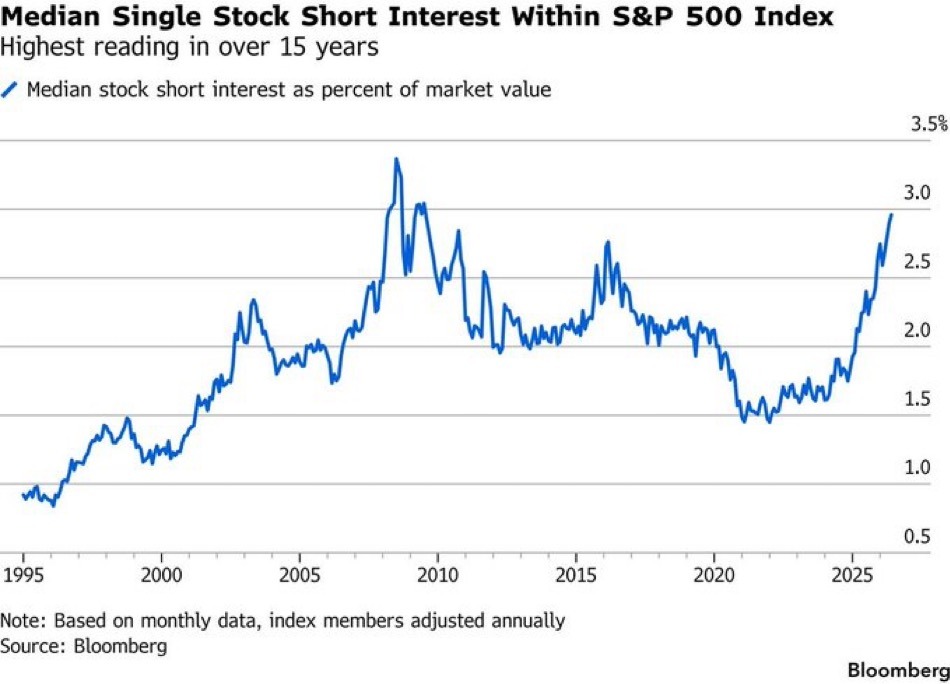
Think about what that means.
It doesn’t mean stocks have to go down. It doesn’t mean the bears are right.
It simply means there are more people betting against stocks than we’re used to seeing.
And when there are more people short, there are more people vulnerable.
Short sellers eventually become buyers. That’s the deal they make when they enter the trade.
The higher the level of short interest, the larger the potential pool of future buyers.
So when stocks start moving higher, especially in areas where investors are heavily positioned the wrong way, those shorts can become forced participants in the rally.
That’s exactly the type of environment we’re in today.
Squeezes Are Already Happening
You don’t have to look hard to find evidence.
Software stocks just had their best month ever. Unprofitable technology companies have been exploding higher.
Some of the best-performing stocks in the market are the exact names that many investors were convinced had no business going up.
The problem with being short isn’t just that you can be wrong. The problem is that when you’re wrong, your losses can accelerate quickly.
A stock that rises 20%, 30%, or 50% against a short position doesn’t just create pain. It creates buying pressure as traders rush to cover positions and reduce risk.
That buying pressure pushes prices even higher, which creates more covering, which attracts momentum buyers, which creates even more demand.
That’s how squeezes work.
And when short interest is elevated across the market, those squeezes become more common.
This isn’t some temporary phenomenon. It’s the natural consequence of a market that’s carrying an unusually large amount of bearish positioning.
As long as that positioning remains in place, the fuel remains available.
Follow the Fuel
If you’re going to short stocks in this environment, be careful.
There are plenty of stocks going down. In fact, there are always stocks going down.
But the names carrying the highest short interest deserve extra attention because they’re the ones with the greatest squeeze potential.
More importantly, pay attention to the “short ratio,” often referred to as “days to cover.”
That’s calculated by taking the total number of shares sold short and dividing it by average daily trading volume.
The result tells us how many trading days it would take for all short sellers to cover their positions.
A stock with a short ratio of 20 would require roughly a month of average trading volume for all the shorts to get out. A stock with a short ratio of 30 would require about a month and a half.
That’s where things get really interesting.
When I see a stock with a massive days-to-cover ratio, I don’t automatically buy it. But my ears perk up. If the technicals line up and the trend is improving, that short positioning becomes a tailwind.
In fact, that’s exactly how we approach opportunities in The Divergence.
We start by looking for stocks that are most vulnerable to a squeeze and then identify the ones that are setting up properly.
The goal isn’t to fight the shorts. The goal is to put ourselves in position to profit from them.
Right now, there are simply more opportunities than usual.
The shorts aren’t going away anytime soon. They’ll keep betting against these stocks.
And we’ll keep looking for ways to make money when they’re forced to buy them back.
Stay sharp,
JC Parets, CMT
Founder, TrendLabs