
Founder’s Note: Grant Hawkridge knows how to take care of himself, and he knows how to share what he’s learned about that in a way that helps us take care of ourselves, too.
Whether it’s business or pleasure, he knows what he’s writing about.
Now here’s Grant with another great read for a Saturday… – JC
By Grant Hawkridge
G’day, Grant here again.
Every four years the World Cup rolls around and the whole world seems to stop and watch.
As an Australian, I’ll be cheering on the Socceroos.
What I’ve always found interesting about events like the World Cup isn’t necessarily the football itself. It’s how quickly people become convinced they know what’s going to happen.
Before the tournament starts, predictions are everywhere. Who will win. Who won’t. Which teams are overrated. Which teams are being overlooked.
By the time the opening match arrives, it feels like half the world already knows how the story is supposed to end.
Then the games begin.
A favorite gets knocked out. An underdog makes an unexpected run. A team nobody was talking about suddenly becomes the story of the tournament.
It happens every four years, and somehow we’re still surprised when reality refuses to follow the script.
The more I thought about it this week, the more it reminded me of investors.
Because markets have their own version of a four-year cycle.
And investors become just as convinced they know what’s coming next.
The Market’s Four-Year Tournament
One of the most widely followed studies in market history is the Presidential Cycle.
Investors have spent decades analysing stock market returns based on the four years of a presidential term. The post-election year. The mid-term year. The pre-election year. The election year.
The goal is simple. Find patterns that might help us understand where we are in the cycle and what could happen next.
And to be fair, there are some interesting patterns:
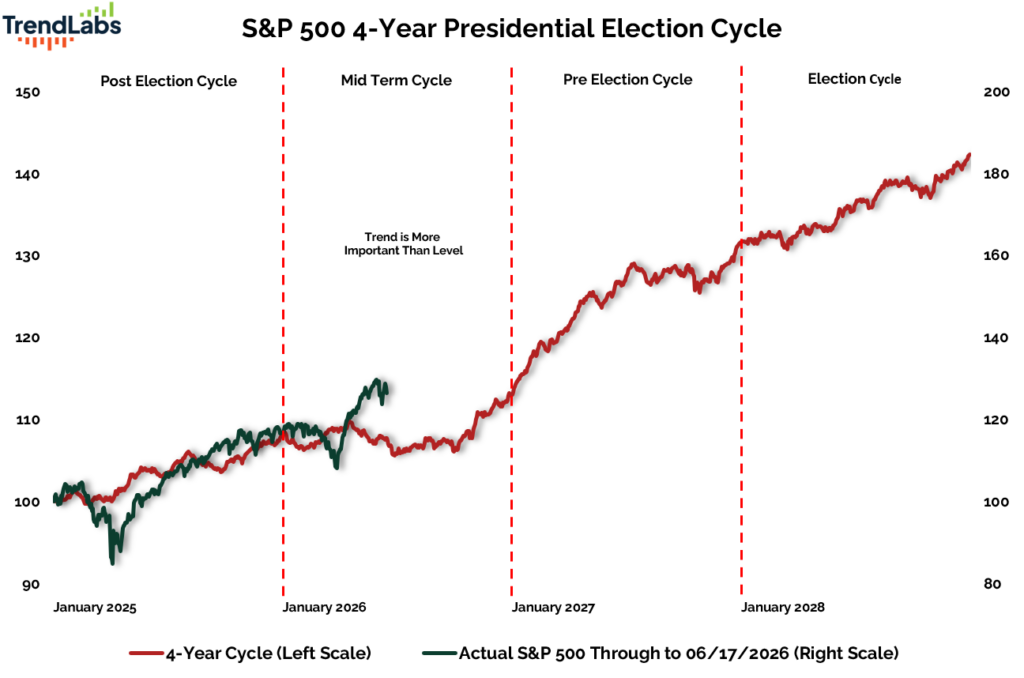
Historically, the Midterm Year has been the weakest year of the four-year cycle.
The third year has been the strongest.
Those tendencies have shown up often enough that they’ve become part of market folklore.
Most investors know them.
And every four years, as the Midterm Year rolls around, the same conversations start popping up again.
The reason investors pay attention is obvious. We’re all looking for something that helps us better understand the environment we’re operating in. There’s nothing wrong with that.
The problem starts when people confuse a tendency with a prediction.
Because that’s exactly what happens with cycles.
A study that was originally designed to provide context suddenly becomes a forecast.
Investors stop asking what has happened before and start assuming they know what happens next.
That’s where things get dangerous.
The Weakest Part of the Weakest Year
The reason this topic caught my attention now is because we’re currently in what has historically been the weakest stretch of the weakest year.
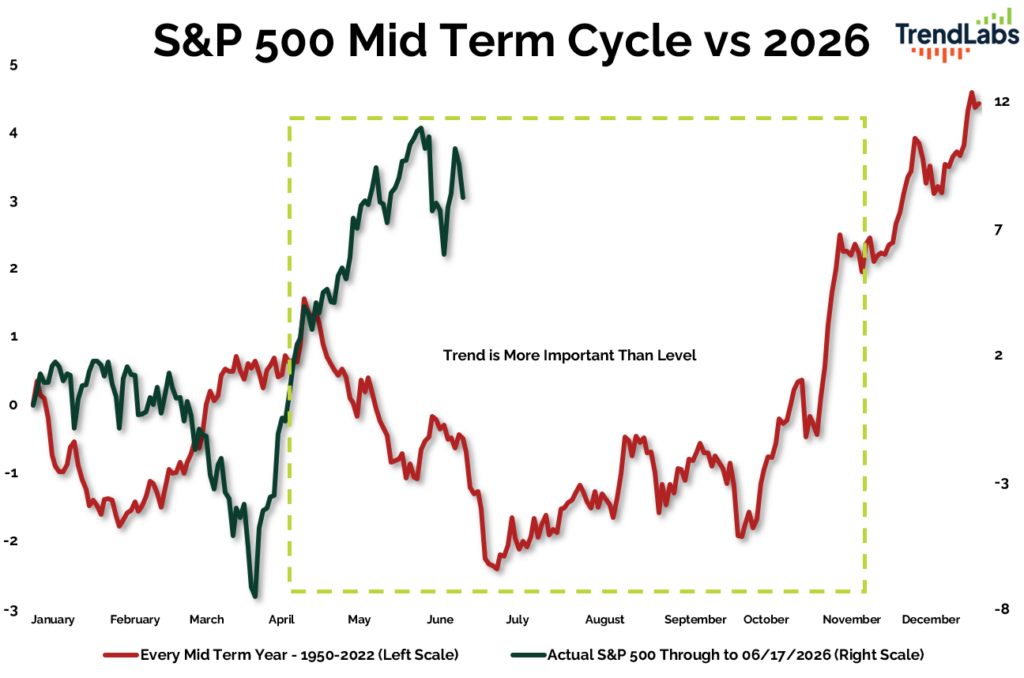
On paper, that’s not exactly the type of chart that gets bullish investors excited.
If you wanted to build a cautious case for the market, this would be one of the first places you’d start.
And to be fair, there are plenty of reasons to be cautious.
There always are.
Turn on the news for five minutes and you’ll find a fresh list.
Depending on which article you read, we’re either heading for a recession, avoiding a recession, heading for higher inflation, lower inflation, higher rates, lower rates, or something completely different.
The list never seems to end.
And that’s what makes the current market environment so interesting to me.
Because despite all of that, the market itself continues telling a very different story.
The Trend Hasn’t Received the Memo
If you’d asked most investors a few years ago what a market dealing with wars, inflation shocks, aggressive rate hikes, growing government debt, and constant recession forecasts would look like, I doubt many would’ve described a market sitting near all-time highs.
Instead, the S&P 500 continues to sit in a primary uptrend:
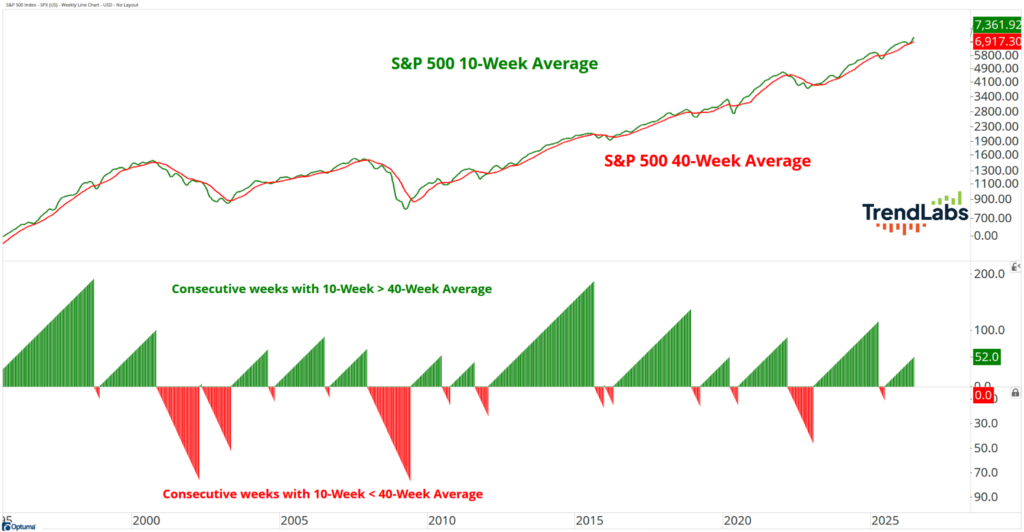
The chart above is about as simple as trend analysis gets.
The green line is the 10-week moving average of the S&P 500. The red line is the 40-week moving average of the S&P 500.
Price remains above both moving averages. The 10-week moving average remains above the 40-week moving average. Both moving averages continue to slope higher.
More importantly, that relationship has remained intact for more than a year.
That’s not what a market under significant pressure typically looks like.
Now, does that mean stocks can’t pull back? Of course not.
In fact, if history is any guide, the current part of the Presidential Cycle would suggest investors should probably expect a little more volatility than they’ve become accustomed to.
But volatility and bear markets aren’t the same thing.
One of the biggest mistakes investors make is assuming that because a market should be struggling, it eventually has to.
Markets don’t work that way. They don’t care what should happen. They only care about supply and demand.
And, right now, demand continues to outweigh supply.
That can change. Eventually it will change. Every bull market ends at some point.
But one of the lessons I’ve learned over the years is that bull markets rarely end because somebody found a seasonal chart.
They usually end when the underlying trend starts deteriorating.
And I’m struggling to find much evidence of that.
That’s really the lesson I keep coming back to.
The Presidential Cycle is useful. The tendencies are worth understanding.
But it’s not a crystal ball. It’s just context. Nothing more.
The World Cup works the same way.
Before every tournament, analysts make predictions. Fans make predictions. Betting markets make predictions.
Some of those predictions turn out to be right. Many don’t.
Because once the matches begin, reality takes over. Markets aren’t any different.
History tells us what has tended to happen. Price tells us what’s actually happening.
And if those two things disagree, I’ll usually trust price.
That’s why I continue to respect the cycle while paying far more attention to the trend.
For now, I’m looking forward to switching the screens off for the weekend.
I’m heading down to Rosebud, Victoria with a few mates for a weekend of golf, good food, and a couple of nice bottles of wine.
Markets will still be here on Monday.
So, I hope you’re able to spend some time this weekend doing whatever helps you recharge, whether that’s with family, friends, on the golf course, or simply taking a break from the noise.
Have a great weekend!
Happy hitting🏌️⛳,
Grant Hawkridge
Quantitative Analyst, TrendLabs