A few weeks ago, I was having dinner with Dan Ives and asked him a question I’ve been asking people for years.
When do I get my robot?
Not a robot in a factory. Not a robot in a warehouse. Not a robot building cars. I mean a real robot in my house.
Something that can make coffee, take out the trash, pull weeds, clean up after itself, and handle the dozens of little tasks that somehow consume more time than they should.
For most of my life, the answer was always some version of “maybe someday.”
This time it wasn’t. Dan’s answer was three years.
Whether it’s exactly three years isn’t really the point. The point is that nobody laughs at the question anymore. The conversation has changed.
Household robots have gone from science fiction to a serious discussion among some of the smartest people in technology. And as soon as I stopped thinking about the robots themselves, I started thinking about the stocks.
That’s where I think a lot of investors are getting this wrong.
When a new trend emerges, most people immediately look for the ETF. Robotics is a perfect example.
Investors see videos of humanoids folding laundry, carrying boxes through warehouses, and doing things that looked impossible just a few years ago. Then they buy the robotics ETF, and they assume they’re getting exposure to the trend.
The problem is that investing rarely works that way.
The largest robotics ETF in the world, BOTZ, still hasn’t recovered its highs from 2021:
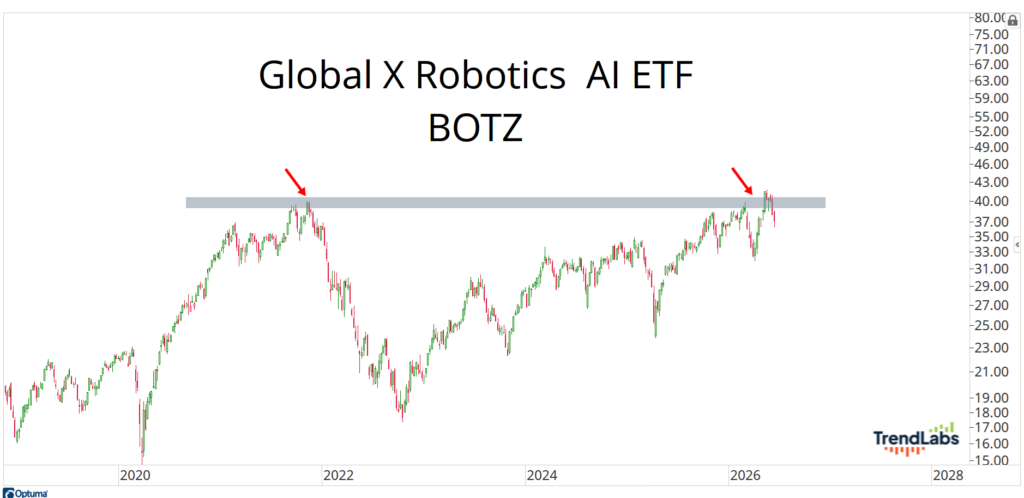
Meanwhile, many of the stocks tied directly to automation, industrial intelligence, semiconductors, sensors, and robotics infrastructure are already making new highs.
That’s an important clue because it tells us the market isn’t simply buying “robotics.”
It’s rewarding very specific parts of the robotics ecosystem.
The Robot Stack
When most people think about robots, they focus on the finished product. Honestly, I’m guilty of this too.
We picture a humanoid walking around the house, delivering packages, making coffee, or helping with chores. But that’s a little like looking at a car and only paying attention to the paint job.
What actually matters is everything underneath the hood.
Every robot needs a body. It needs a way to move through the physical world and interact with its environment. It needs a nervous system that allows it to gather information and respond to changing conditions.
And, eventually, it needs a brain capable of processing information and making decisions on its own.
That’s the framework I’ve started calling “The Robot Stack.”
Instead of trying to predict which company will build the most popular robot, I’m more interested in the companies supplying the components that every robot will need regardless of whose logo ends up on the front.
The body includes companies like Rockwell Automation (ROK) and Teradyne (TER). Most investors don’t think of these companies when they hear the word “robotics,” but they provide much of the infrastructure that makes automation possible in the first place.
The nervous system includes companies like Microchip Technology (MCHP) and Texas Instruments (TXN). These are the sensors, controllers, and chips that allow machines to understand what’s happening around them and react appropriately. A robot doesn’t care whose logo is on the chip. It just needs the chip to work.
Then there’s the brain. That’s where companies like NXP Semiconductors (NXPI) and Ambarella (AMBA) enter the picture. These companies are providing the computing power that allows machines to process information, make decisions, and adapt to changing conditions in real time.
These are very different businesses. But they’re all helping solve the same problem. That’s what makes this framework so compelling.
No matter which company ultimately wins the race to build the most successful humanoid robot, every robot will still need a body, a nervous system, and a brain.
The Robot Is the Last Step
One of the reasons I like this framework is because it reminds me of the early days of smartphones.
Imagine trying to predict which company would dominate smartphones before the revolution really got underway. Maybe you would’ve picked the winner. Maybe you wouldn’t have.
But one thing would’ve been obvious: Every smartphone was going to need processors, sensors, memory, software, and communications technology.
The same logic applies here.
I have no idea whose logo will eventually be on the robot making my coffee every morning. I don’t know who will dominate warehouses, hospitals, factories, or homes.
What I do know is that factories are becoming more automated, warehouses are becoming more intelligent, and machines are increasingly performing tasks that used to require people.
More importantly, for the first time in my life, some of the smartest people in the world are talking about household robots as a near-term reality rather than a distant fantasy.
That’s why I think we’re still early.
Most investors are focused on the robot itself. I’m more interested in everything that has to happen before the robot ever shows up.
Because that’s usually where the biggest opportunities are hiding.
And this story is just getting started.
This Week in Everybody’s Wrong
On Monday, we handed out a grade to Wall Street for the biggest IPO in the history of the stock market.
It was an A+, but it was only the opening ceremony.
The real game has started, though, and here’s how we’re watching it.
On Tuesday, we talked about this week’s FOMC meeting and what Kevin Warsh means for markets.
Here’s the thing: Nobody cares who the Fed chair is.
What we’re seeing is ordinary market behavior being dressed up as something extraordinary.
Companies keep asking for money, and markets are more than happy to provide it.
On Wednesday, we answered the following question:
What happens when Wall Street becomes convinced it’s funding the future?
On Thursday, I explained why we still care so much about the first stock market index ever created.
It comes down to another simple question.
Are people moving things around or not?
On Friday, markets in the U.S. were closed in observance of Juneteenth.
That’s a holiday with a specific and noteworthy meaning.
We took the opportunity to celebrate the heart and soul of America, from a stock market perspective.
On Saturday, Grant Hawkridge shared some thoughts about the biggest sporting event on Earth.
What can we learn about markets from the World Cup?
Plenty, it turns out, especially when Grant’s on the case…
Have a great Sunday.
We’ll see you Monday morning…
Stay sharp,
JC Parets, CMT
Founder, TrendLabs