
Investors have made a decision. And it’s a pretty big one.
They’ve decided they don’t need to own energy stocks.
Not a little less energy, and not just a smaller position than they used to have.
They’ve practically eliminated the entire sector from their portfolios.
We don’t have to guess about this. We can just look at what they own.
Energy represents just 3% of the S&P 500. It’s only 2% of the Dow Jones Industrial Average, where just one of the 30 companies is an energy stock.
And in the Nasdaq 100? Zero.
Meanwhile, technology makes up roughly 40% of the S&P 500. The second-largest sector, financials, is only about 11%.
Think about that for a second.
For every $100 invested in the S&P 500, roughly $40 goes into technology companies, just $3 into energy.
That’s not an accident. Investors have made a conscious choice about where they want their money.
And energy isn’t invited to the party.
What’s particularly interesting is that energy used to be one of the biggest sectors in America.
It represented more than 20% of the S&P 500 at one point. Then it fell all the way to around 2%.
Now it’s back to 3%.
So here’s my question: Do you really want to bet that energy is going to become even less important from here?
Because that’s effectively the bet investors are making.
And it’s certainly not the bet I want to make.
How Can Nobody Own Something That’s Going Up?
We had a great question during our live session for members of The Divergence on Wednesday.
Someone asked how it’s possible that nobody owns energy stocks if they’re making new all-time highs:
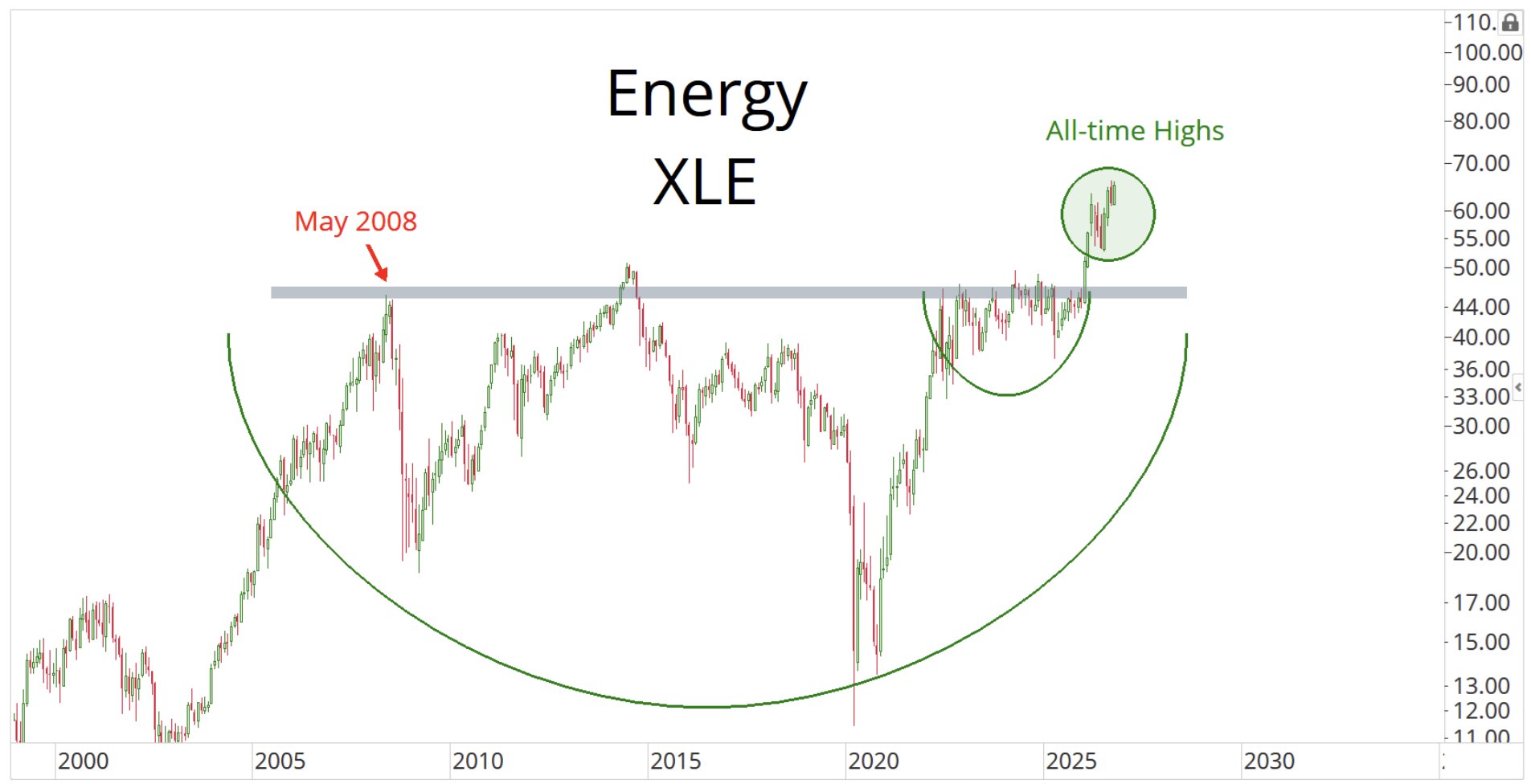
It’s a fair question.
After all, somebody has to own these stocks. And somebody has to be buying them for prices to keep going higher.
But here’s what I think people are missing.
Energy is tiny compared with the rest of the stock market.
Exxon Mobil (XOM), the biggest American energy company, is worth roughly $700 billion. Chevron (CVX) is worth somewhere in the $400 billions.
Those sound like enormous numbers. And they are.
But compared with the giant technology companies that dominate the stock market, they’re not particularly large.
There are only a handful of energy companies worth more than $100 billion. In other parts of the market, a $100 billion company barely gets anybody’s attention.
So energy stocks can keep making new highs without becoming a meaningful part of most investors’ portfolios.
There’s nothing contradictory about that.
Remember, when we say energy is 3% of the S&P 500, we’re talking about its share of the total value of all 500 companies.
If the technology companies are worth trillions and trillions of dollars, energy can rise quite a bit and still represent a tiny slice of the pie.
It’s like owning a shopping mall where almost every store sells computers and phones, while the only gas station is tucked away in the corner of the parking lot.
That gas station could be having its best year ever. It could be making more money than it ever has. But, compared with the rest of the mall, it’s still tiny.
That’s basically what’s happening in the stock market.
And when I say energy, I’m talking specifically about oil and gas, not solar panels and not nuclear power plants.
Not whatever new technology somebody is promising will change the world in 20 years.
I’m talking about the stuff we use every day to move people, transport goods, heat homes, and keep the economy running.
Investors have decided they don’t need much exposure to those businesses.
I think that’s a mistake.
Who Are You Going To Blame?
Here’s where this gets even more interesting.
I believe we’re in the middle of a commodity supercycle.
That’s just a fancy way of saying we’re in a long period when things like oil, natural gas, copper, and other raw materials tend to become more valuable.
These cycles don’t usually last a year or two. Historically, some of the big ones have lasted 10 or even 20 years.
We’re only a little more than five years into this one.
Now, could this turn out to be the shortest commodity supercycle ever? Sure. Anything is possible.
Could energy go from 3% of the S&P 500 down to 2%, or even 1%? Of course it could.
But is that really the bet you want to make?
You want to bet that this commodity cycle is already almost over?
That oil and gas companies are going to become even less important to the stock market?
That the rest of the world is going to need less energy as economies grow, populations expand and electricity demand increases?
You can make that bet.
I’m just not interested.
In fact, I think we’re looking at one of the more interesting opportunities in the entire stock market.
And the reason is simple. Almost nobody has meaningful exposure to it.
I think oil and gas prices are going much higher over the coming years.
And I think many of these energy stocks are going to be worth a whole lot more than they are today.
If I’m right, something funny is going to happen.
The same investors who spent years ignoring energy are going to start complaining about how expensive everything has become.
They’ll blame the government. They’ll blame the wars. They’ll blame the oil companies. They’ll blame the ETFs and the people who manage their retirement accounts.
Everybody will have somebody to blame.
Except themselves.
Because the opportunity has been sitting right in front of them this whole time.
Nobody is stopping investors from buying energy stocks. Nobody is forcing them to put 40% of their S&P 500 money into technology and only 3% into energy.
Those are choices.
And choices have consequences.
I’m not suggesting everyone should sell their technology stocks tomorrow and put all their money into oil companies. That’s ridiculous. Technology can continue doing great, and so can energy.
But I do think investors should understand what they own, what they don’t own, and what they’re betting on whether they realize it or not.
Because if energy becomes a much larger part of the stock market over the next decade, a lot of people are going to wish they’d paid more attention when it was only 3%.
And they’ll probably have a million excuses for why they missed it.
Just remember, nobody made that decision for them.
So here’s the question I want you to ask yourself.
What choice are you going to make?