
If your team is losing, yelling at the scoreboard probably isn’t going to help. It’s just telling you what happened. You might want to look at the players.
We’re seeing the stock market version of this again.
The biggest stocks are outperforming the average stock, and somehow that’s being presented as evidence that something’s wrong.
Yahoo! Finance says it’s “an ugly problem.”
Barron’s is making great-looking covers about a “divided market” and the many stocks that are “struggling”:

Technology is leading, the S&P 500 is rising, and we’re supposed to be upset about it.
Back in January, we discussed why comparing the equal-weight S&P 500 with the regular market-cap-weighted S&P 500 doesn’t give you the simple market warning people think it does.
Nine months later, apparently we need to go through the math again.
The argument goes something like this: The average stock isn’t keeping up with the biggest stocks. Therefore, the rally is unhealthy. Therefore, you should be worried.
Before we start hiding canned beans in the basement, shouldn’t we look at what these portfolios actually own?
Both indexes hold the same companies. They just put different amounts of money into them.
The regular S&P 500 gives the biggest companies the biggest weights. The equally weighted version gives each company roughly the same allocation.
So, if one index owns a lot more of the stocks going up, you’d expect it to do better.
That doesn’t mean the other stocks are falling. It means one portfolio owns more of the winners.
In this case, that difference has a lot to do with technology.
That’s the part that matters most, especially when the sector doing the heavy lifting has a much bigger seat at one table than the other.
If you own more of what’s going up, your portfolio will usually do better than a portfolio that owns a lot less of it.
I realize this isn’t as exciting as predicting financial collapse.
But we have to start somewhere.
Apparently, We’re Doing Fractions Today
Technology represents roughly 40% of the market-cap-weighted S&P 500. Think of that as about $40 out of every $100 invested in the index sitting in one sector.
Technology makes up just 18% of the equally weighted S&P 500, less than half its weight in the market-cap-weighted index.
Nvidia (NVDA) gets about the same starting allocation as a utility company. Microsoft (MSFT) gets about the same as a much smaller industrial business.
Nobody gets extra money just for being enormous.
In the market-cap-weighted S&P 500, the biggest companies have the biggest influence. That’s how the index works.
So, when technology leads, its huge weighting gives the index a big advantage. No other sector comes close.
For perspective, financials are the second-largest sector at just 11% of the index.
Whether you like technology stocks or not, their weight in the index doesn’t change.
Here’s a simple example. Imagine one portfolio puts $40 of every $100 into technology, while another puts $18 into it.
If technology rises 10% and everything else stays flat, the first portfolio gains $4. The second gains $1.80.
Did the second portfolio lose money? No. Did most stocks have to fall for it to underperform? Also no.
It simply owned less of the thing that went up.
Now, imagine watching that happen and deciding the stock market must be sick.
You’re blaming the scoreboard for keeping score.
Sector rotation is a big part of this comparison. Company size and the performance of individual giants matter, too.
But you can’t skip those differences and pretend the ratio is simply counting how many stocks are going up.
If you want to know how many stocks are advancing, count them. If you want to know how many are above their moving averages, measure that.
Those are direct questions about participation.
The RSP/SPY ratio answers a different question: Which weighting method is doing better?
Congratulations, You Lost Less Money
Here’s where the popular explanation really gets awkward.
Look at the late 1990s. The market-cap-weighted S&P 500 outperformed the equal-weight version while the stock market was climbing.
Then the dot-com bubble burst, and equal-weight took the lead while stocks were getting crushed:
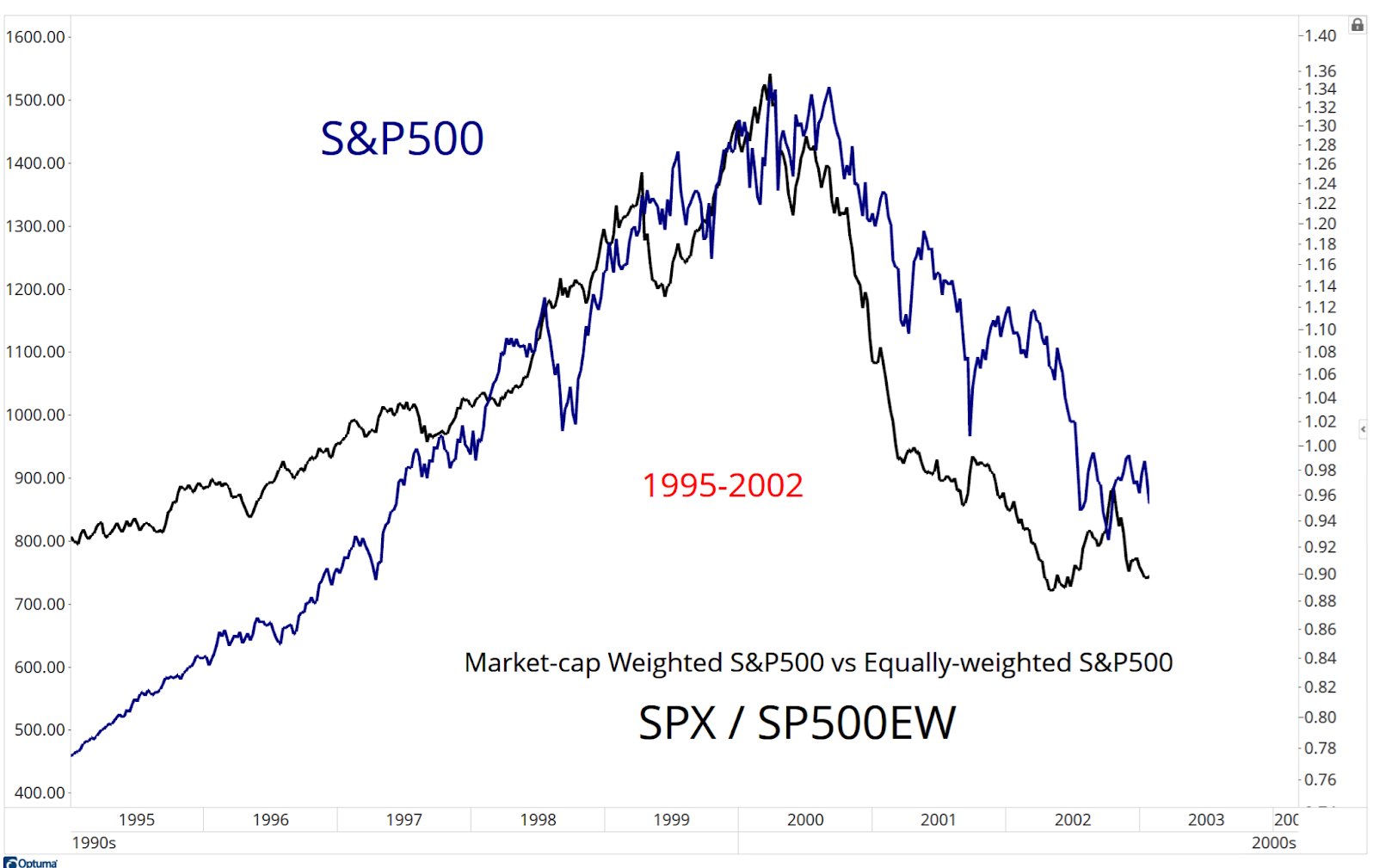
Notice the direction of the ratio in this chart.
It’s market-cap-weighted divided by equal-weight, so a rising black line means market-cap-weighted is outperforming.
During the late-’90s advance, that line rose alongside the market. During the subsequent bear market, it fell as equal-weight held up better.
Was that equal-weight outperformance a reason to celebrate? Depends how much you enjoy losing money!
If one portfolio falls 30% and another falls 20%, the second one outperformed. But both still lost money.
You can’t pay the bills with “at least we beat the other guy.”
Look at the chart below. The black line compares the market-cap-weighted S&P 500 (SPY) with its equal-weight counterpart (RSP).
When the black line rises, market-cap-weighted is outperforming. When it falls, equal-weight is outperforming. The blue line is the S&P 500 itself:
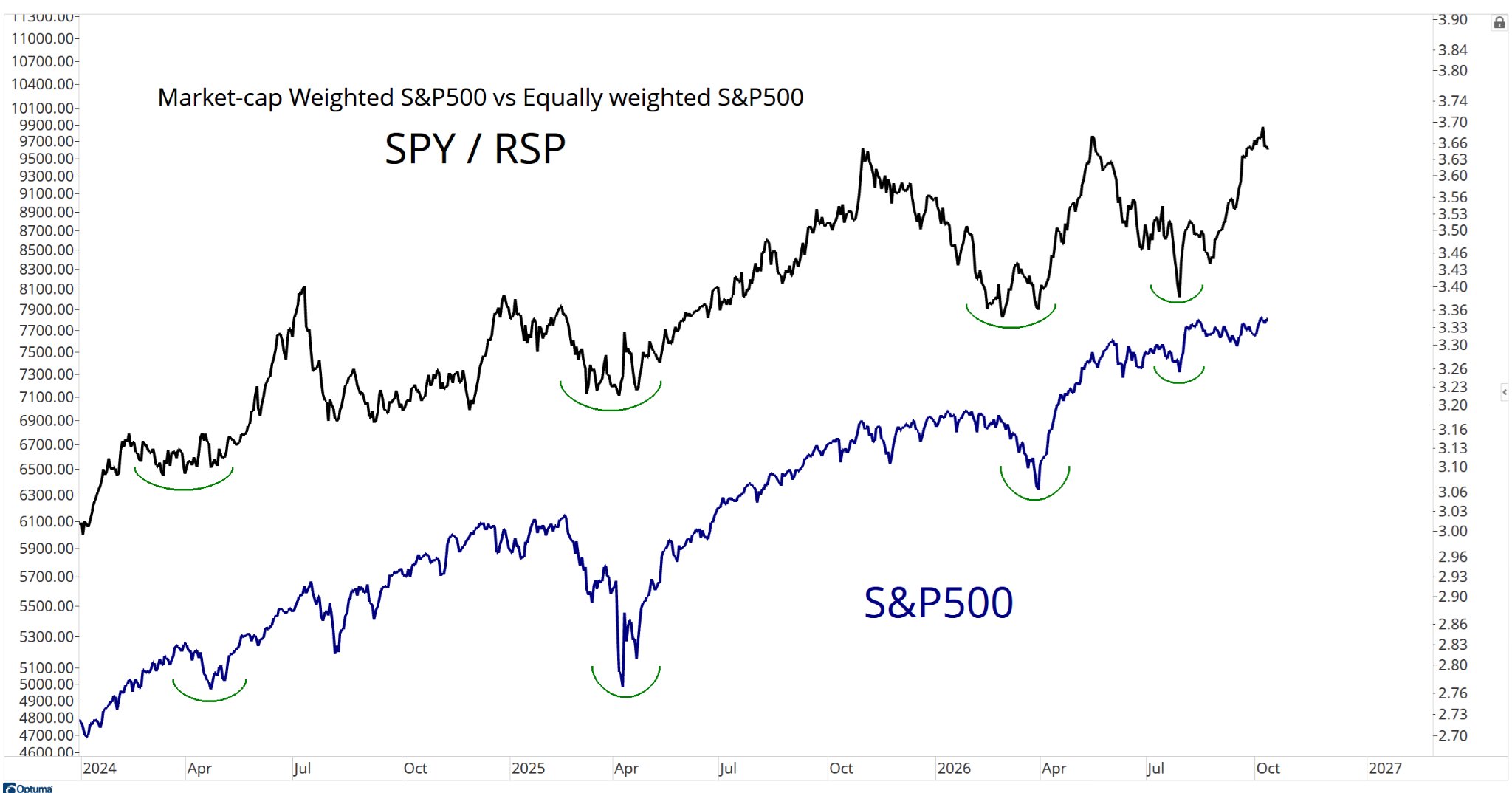
Notice what happens around those turns. When the black line bottoms and starts rising, stocks tend to do better.
The index with more technology regains the lead, and the broader market moves higher.
Technology doing well is somehow supposed to scare us? That’s actually what you want to see.
It’s when those leaders start losing ground that I pay closer attention.
If the black line is falling because the biggest technology stocks are selling off, equal-weight can “outperform” while investors lose money in both indexes.
Congratulations, I guess.
That doesn’t mean every decline in the black line spells trouble. Other sectors can take the lead while stocks keep rising.
But technology falling apart is a very different story from industrials and financials getting stronger. You have to look at what’s driving the move.
You guys come here for a reality check.
Technology leading and stocks going up is a pretty good outcome for people who own stocks. The average stock doesn’t need to beat the leaders for you to make money.
Before somebody tells you this ratio is bad news, make sure they understand what they’re comparing.
And make sure you’re not being asked to celebrate losing less.