
I’ve been paying Verizon (VZ) and AT&T (T) bills for most of my adult life.
For as long as I can remember, these were the companies that connected us to the rest of the world.
They built the networks, put up the towers, and sent us a bill every month for the privilege of using them.
We didn’t have much of a choice.
But last week, SpaceX made another move into the telecommunications business, acquiring additional wireless spectrum as part of its plans to connect ordinary cell phones directly to satellites.
For those of you who don’t know what wireless spectrum is, think of it as invisible real estate in the sky.
You need access to certain frequencies to send signals back and forth between phones and networks.
SpaceX (SPCX) wants more of that real estate.
While the company already has a satellite internet business, Starlink, the bigger ambition is to connect the phone in your pocket without relying entirely on the cell towers we’ve been using for decades.
Now, this isn’t happening tomorrow.
There are still technical hurdles, regulatory approvals, and plenty of work to do before Starlink could replace your regular cell phone service.
But imagine being able to get a signal almost anywhere on Earth.
No more driving through the mountains wondering why you have four bars one minute and absolutely nothing the next.
That sounds pretty good to me.
And apparently, investors in the old phone companies aren’t too excited about the competition.
But here’s the funny part.
Verizon and AT&T didn’t suddenly become terrible stocks last week. They’ve been terrible stocks for a very long time.
Just look at these two charts:
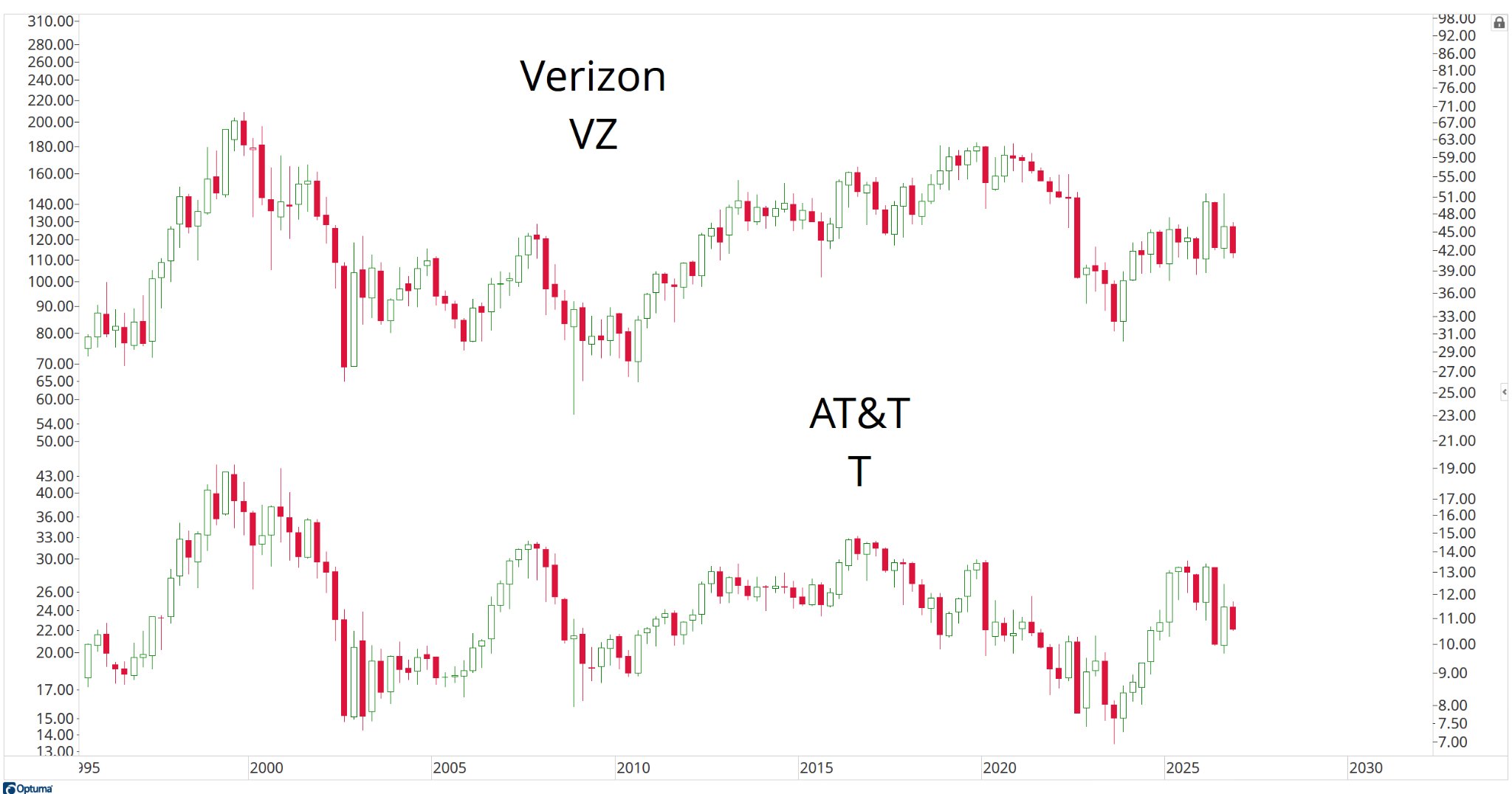
These are two of the biggest, most recognizable companies in America.
Their products are in almost every household. They have millions of customers sending them money every month.
And their stocks have spent most of the past 30 years going sideways.
Think about how much the world has changed since 1995.
We went from dial-up internet and flip phones to carrying supercomputers around in our pockets.
We can watch live television on airplanes, make video calls from the beach, and ask artificial intelligence to write computer programs for us.
And, somehow, these two stocks are still hanging around levels they first reached decades ago.
Now, compare that with the rest of the stock market:
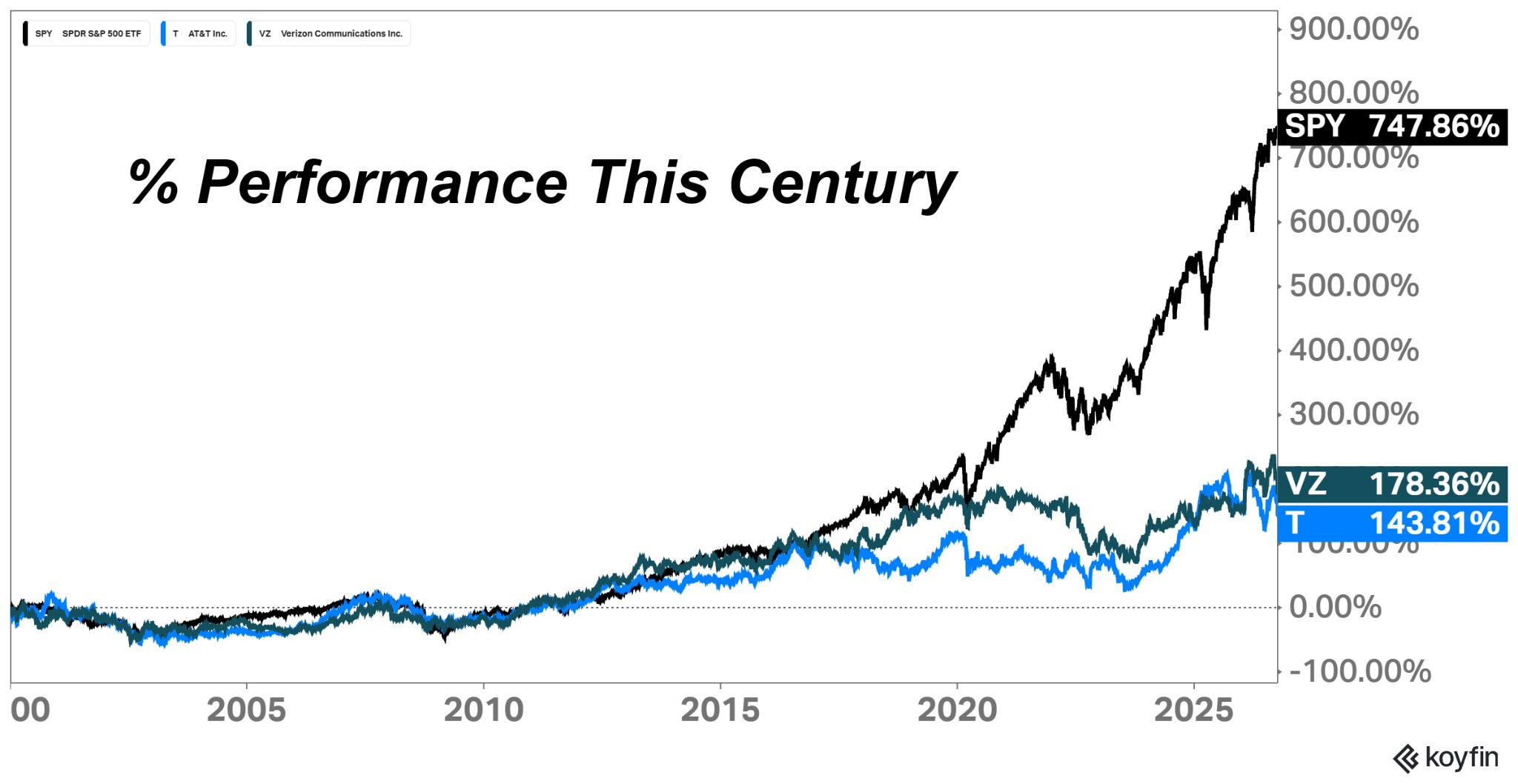
Since the beginning of this century, the S&P 500 ETF (SPY) has gained almost 750%.
Verizon is up about 178%. AT&T has gained roughly 144%.
Put another way, $10,000 invested in the S&P 500 would be worth about $85,000 today, before accounting for dividends.
That same $10,000 invested in Verizon would be worth about $28,000. AT&T would be worth about $24,000.
And that’s before we even get into what else you could have done with that money over the past 26 years.
But the difference is still remarkable.
Now, after all those years of underperforming, a rocket company wants to compete for their customers.
You really can’t make this stuff up.
Play With the Toys
We bought a lake house for the family, and one of the first things we needed was internet access.
Now, this isn’t some cabin in the wilderness where you need a helicopter to get groceries. We had perfectly normal internet options available.
I could have called the cable company and scheduled an installation like everybody else.
But I wanted to play with the toys.
So I bought Starlink.
And let me tell you something. Wow.
It’s awesome.
The whole thing works through an app. It’s fast, it’s reliable, and I haven’t had a single problem with it since we got it.
Not one.
I didn’t buy Starlink because I needed satellite internet. I bought it because I wanted to see what all the fuss was about.
I get it.
Last week, I wrote about why I think it’s so important to Play With the Toys.
I even became a software developer myself, which is something I never thought I’d be saying.
The point isn’t that everybody needs to learn how to write code.
It’s that you can’t fully appreciate how much the world is changing if you’re not willing to try some of this stuff yourself.
Starlink is a perfect example.
I don’t own a Tesla. I have plenty of friends who do, and they absolutely love their cars. Some of them won’t shut up about how much they love their Teslas.
But I’ve never owned one, so I can’t tell you what it’s like to drive one every day.
Starlink is different.
I’ve been using it. I love it. And I would absolutely recommend it.
So when I hear that SpaceX wants to bring that same technology to the phone in my pocket, I’m paying attention.
If I could get the same experience I have at the lake house on my cell phone, instead of paying Verizon or AT&T every month, I’d switch in a heartbeat.
Now, maybe the technology isn’t ready yet. Maybe it’ll take years before the service can compete with the big carriers.
I have no idea.
But I know what my experience has been with Starlink, and I know what I’d like to see happen next.
That’s worth a whole lot more to me than listening to some guy on TV explain what he thinks consumers might want.
I’m an actual customer.
The Market Has Been Telling Us for Years
Here’s what I find most interesting about this whole story.
Everybody wants to talk about what SpaceX is going to do to Verizon and AT&T.
But what about what Verizon and AT&T have already done to their shareholders?
We don’t have to guess about that.
Look at this next chart:
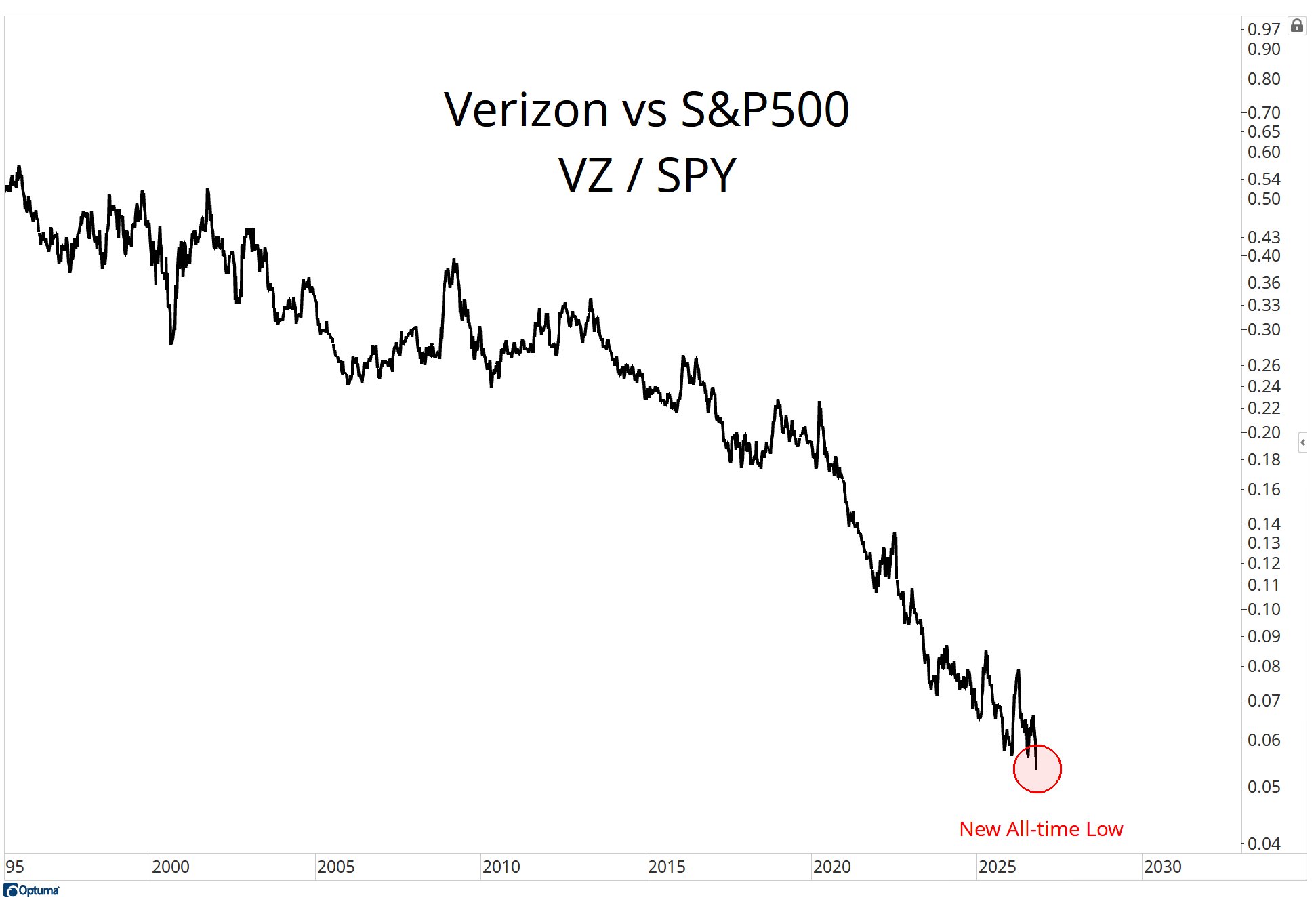
This is Verizon compared to the S&P 500. It’s a simple calculation. We divide the price of VZ by the price of SPY.
When the line goes up, VZ is doing better than the market. When it goes down, VZ is doing worse.
As you can see, this line has been going down for my entire career.
Verizon is now making new all-time lows relative to the S&P 500.
That’s not a prediction about what SpaceX might do five years from now.
That’s what’s already happened.
You could have bought VZ 30 years ago, collected your dividends, and watched the rest of the stock market leave you behind.
And that’s before Elon Musk decided he wanted your phone bill.
Meanwhile, SpaceX continues to attract attention and capital. We were just talking about this in A Whole Lot of Money Sloshing Around.
There’s an enormous amount of money looking for the next generation of winners.
And the stock market doesn’t seem particularly interested in waiting around for the old guys to figure things out.
Now, does that mean SpaceX is going to put Verizon and AT&T out of business?
Probably not.
These are enormous companies with valuable networks, millions of customers, and businesses that aren’t going to disappear overnight.
But there’s a big difference between a company being around for another 30 years and its stock being a good investment for the next 30 years.
That’s the part people seem to forget.
I don’t know exactly what the cell phone business will look like 10 years from now.
I don’t know whether SpaceX will become the biggest phone company in the world, or whether the traditional carriers will figure out how to compete.
But I do know that Verizon has been losing ground to the stock market for decades.
And I know that I love my Starlink.
Sometimes, you don’t need a complicated forecast to see what’s happening right in front of you.
You just have to look.