
Will bonds blow up?
That’s the question on the latest cover of The Economist.
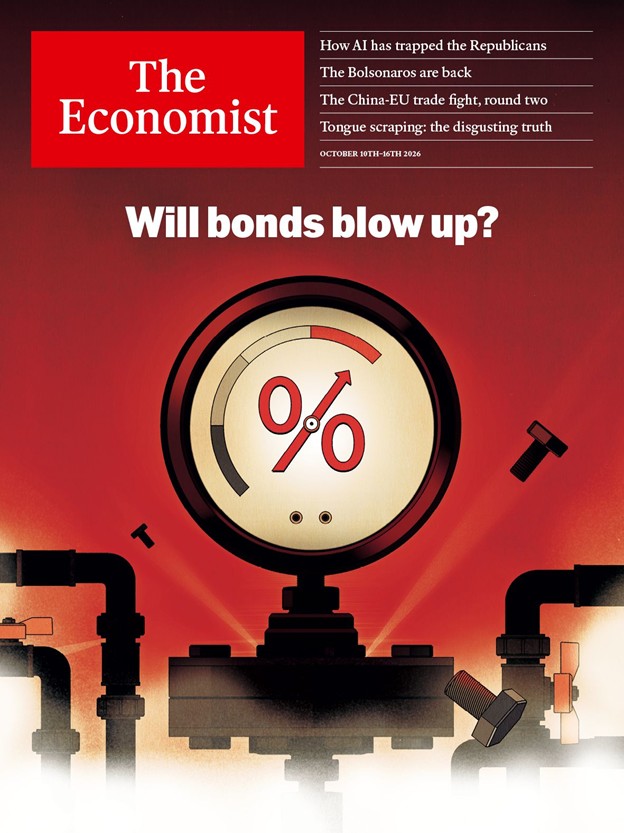
As somebody who’s spent more than 20 years collecting financial magazine covers, I have to tell you, this one is beautiful.
Absolutely beautiful.
I’ve been looking for an opportunity to buy bonds for a while now. I haven’t pulled the trigger yet, but the setup has been getting more interesting.
And then these guys show up with this cover?
Come on.
There’s actually a famous rule in journalism that makes this even better.
It’s called “Betteridge’s Law of Headlines,” named after British journalist Ian Betteridge, who popularized it back in 2009.
The rule is simple. Any headline that ends with a question mark can usually be answered with one word.
“No.”
The idea is that if the publisher knew the answer was “yes,” they probably wouldn’t be asking the question in the first place. They’d just tell you.
This isn’t some new internet thing. Journalists have been making this observation for decades.
Back in 1916, newspapers across New York were declaring Charles Evans Hughes the next president of the United States.
But the New York World wasn’t so sure. They put a question mark at the end of their headline.
Turns out, Woodrow Wilson won.
So when The Economist asks, “Will Bonds Blow Up?”
According to Betteridge, probably not.
And based on what I’ve seen from magazine covers over the years, I’m inclined to agree.
The Greatest Contrarian Indicators of All Time
I have one of the largest collections of financial magazine covers I’ve ever seen.
And I’m not exaggerating. I’ve been collecting these things for decades.
Time, Fortune, Forbes, Businessweek, The New Yorker, and more issues of The Economist than I can count.
If somebody out there has a better collection, I’d love to see it. I’ll show you mine if you show me yours.
The reason I’ve spent so much time collecting these covers is simple.
Some of the greatest turning points in financial markets have come around the same time that a major magazine decided to put the prevailing trend on its cover.
Sometimes it’s Bitcoin. Sometimes it’s gold. Sometimes it’s crude oil. Sometimes it’s the stock market.
Sometimes, like today, it’s bonds.
We’ve written about this before.
Remember when The Economist warned that financial markets could topple the economy?
They put an upside-down skier on the cover, buried in the snow, with his skis turned into giant red arrows pointing lower.
It was incredible artwork. And what happened next?
Stocks went a lot higher.
Or how about when Bloomberg Businessweek put a giant bubble on its cover, complete with a little pin ready to pop it?
Very creative.
We’ve also seen The New Yorker get involved, including that wonderful illustration of Donald Trump drinking oil straight out of a barrel.
We discussed several of these in Creative Covers. Profitable Trades.
But here’s what makes these covers so useful.
Think about everything that has to happen before a magazine ends up on the shelf at the airport.
First, the journalists have to recognize what everybody is talking about. Then somebody has to decide that the subject is important enough to put on the cover.
Then they have to write the story. Then somebody has to edit it.
Then the artists have to come up with an illustration. The editors have to approve it. The magazine has to be printed and distributed.
And, finally, after all of that, somebody walks into an airport bookstore and sees it sitting there.
That’s a long process.
Meanwhile, the stock market doesn’t wait for the art department.
Prices have been moving the entire time.
By the time a trend becomes so obvious that it deserves the cover of a major magazine, there’s a pretty good chance that much of the move has already happened.
And that’s where things get interesting.
The journalists aren’t necessarily wrong about what’s been happening. In fact, they’re often exactly right.
They’re just late.
Take a look at TLT, which owns long-term U.S. Treasury bonds.
Prices peaked back in 2020 and have spent years getting crushed.
Now, they’re breaking below an area that supported prices for more than two decades:
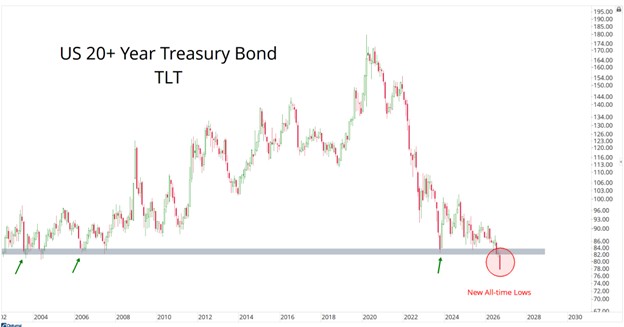
And now we’re asking whether bonds will blow up?
Where have you guys been?
This doesn’t mean bonds can’t go lower. But the damage isn’t something we’re waiting for.
Look at the chart. It already happened.
When it comes to making money in markets, being right about yesterday isn’t particularly helpful.
The Best Fades in the Business
I love journalists. Seriously. I think they’re great.
I’m not just saying that because they’ve helped me make money in the stock market for more than 20 years.
Although that certainly doesn’t hurt.
I’m saying it because journalists are some of the best people in the world at figuring out what everybody’s talking about.
That’s their business.
They find out what people are worried about, what they’re excited about, and what keeps them up at night.
Then they give those people more things to read about. It’s a great business. Good for them.
But there’s an important difference between being good at telling people what everybody’s talking about and being good at making money in the stock market.
Those are two completely different skills.
One of the first things I learned on Wall Street was that you don’t always need to find the smartest person in the room.
Sometimes it’s easier to figure out who’s consistently on the wrong side of a trade. Then you just do the opposite.
Don’t trade. Just fade.
We’ve talked before about the four basic groups I like to fade, and journalists are one of my favorites.
Not because they’re stupid, and not because they’re bad people. Certainly not because they’re bad at their jobs.
Quite the opposite. They’re excellent at their jobs.
Their job is to recognize what people want to read about and give them more of it. They’re in the business of attracting readers, selling magazines, and keeping people entertained.
We’re in a different business. We’re trying to make money.
That’s an important distinction because the people writing these stories generally aren’t professional traders.
They don’t spend their days managing risk, deciding where to buy, or figuring out when they’re wrong.
Why should they? That’s not what they’re getting paid to do.
So when a major magazine puts a dramatic warning on its cover, I don’t look at it the same way the average reader does.
The average reader might see “Will Bonds Blow Up?” and think, “Oh no. I better stay away from bonds.”
I see it and think, “Wait a minute. Has everybody already sold?”
That’s the question.
Not whether the journalists are right about rising interest rates. They might be.
The question is whether those problems are already reflected in prices.
Remember, markets don’t care about what everybody knows. They care about what’s going to happen next.
When everybody already agrees on what’s going to happen next, that’s usually when I start getting interested in the other side.
We’ve seen this play out with Bitcoin, with stocks, with oil, and with gold.
We have another opportunity to watch it happen in bonds.
Which brings me to a trade I’ve been thinking about for a while.
I Want To Buy Bonds
I’ve been talking about buying bonds.
I’ve been watching them. I’ve been looking at different ways to express the trade. I’ve been waiting for the right opportunity.
But I haven’t pulled the trigger yet.
And now The Economist shows up with this cover?
You can’t make this stuff up.
There are several ways to make money in bonds, depending on what you’re trying to accomplish.
One of my good buddies is looking at putting a million dollars into a two-year U.S. Treasury note.
That’s basically lending the federal government a million bucks for two years.
In exchange, the government pays you interest and promises to give you your million dollars back when the note matures.
For example, if the interest rate were 5%, that’s roughly $50,000 a year.
Over two years, you’re looking at about $100,000 in interest.
Not bad.
Put $10 million to work at that same rate, and you’re talking about roughly a million dollars in interest over two years.
Again, not bad.
Of course, the actual amount depends on the yield when you buy, and you need to hold the Treasury until it matures to know what you’re getting back. If you sell early, the price can move against you.
But that’s one way to play it.
For someone who wants to collect interest without worrying about every little move in the bond market, I can certainly understand the appeal.
That’s probably not how I’m going to do it.
I’m much more interested in what happens if bond prices start going up.
Remember, when interest rates fall, existing bond prices generally rise.
And the longer the bond has until it matures, the more sensitive its price tends to be to changes in interest rates.
That’s where things get fun.
Take a look at this chart comparing two different ways to own long-term Treasury bonds:
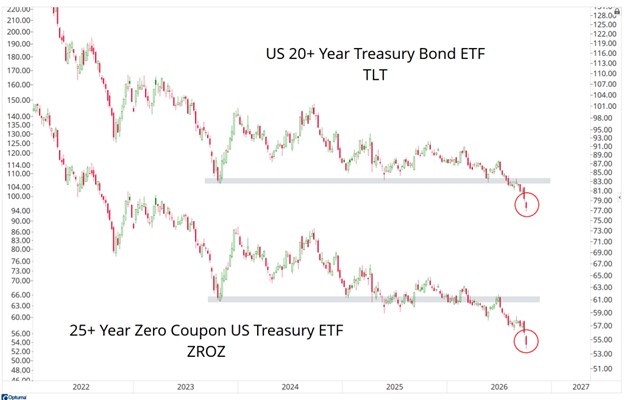
The first is TLT, an exchange-traded fund that owns long-term U.S. Treasury bonds.
You can buy TLT just like you would buy a stock.
If long-term Treasury bond prices rise, TLT generally rises with them.
The other is ZROZ, which owns long-dated zero-coupon U.S. Treasury bonds.
These are a little different.
Unlike regular bonds, zero-coupon bonds don’t send you interest payments along the way. You buy them at a discount, and they pay their full face value when they mature.
Because of how they’re structured, long-dated zero-coupon bonds are particularly sensitive to changes in interest rates.
When rates fall, they can really move. And when rates rise, they can get crushed.
That’s why I like looking at these two together.
They give us two different ways to watch the same basic idea, with ZROZ generally making the bigger percentage moves.
Now, there’s another way to play this: call options on TLT.
These give you the right to buy TLT at a certain price before a certain date. If the ETF makes a big move higher, those options can increase dramatically in value.
For me, the choice is probably going to come down to TLT, call options on TLT, or possibly ZROZ.
The options on TLT are generally much easier to trade than options on ZROZ, which is another reason I’m leaning in that direction.
But here’s the important part: I haven’t bought anything yet.
And I don’t want anybody confusing an interesting setup with an actual trade.
We still need the market to confirm what we’re seeing.
I want to see bond prices stop falling. I want to see buyers show up. And I want to see evidence that the trend is starting to turn.
The magazine cover doesn’t tell us exactly when that’s going to happen.
It just tells us what everybody has come to believe.
Right now, apparently, everybody is worried that bonds are going to blow up.
That’s useful information.
I’ve been watching this trade develop for a while. The setup was already interesting before the magazine showed up.
Now we have one more reason to pay attention.
So thank you, The Economist.
Another great cover.
Another excellent job capturing the mood of the crowd.
And potentially another great opportunity to do the exact opposite.
I’ll let you know when I pull the trigger.
This Week in Everybody’s Wrong
On Monday, we used Bitcoin to illustrate a bigger point about stocks and financial markets in general.
People still chase things after they go up, they still panic when prices fall, they still sell too early, buy too late, and wish they had another chance when they miss a move.
What we’re studying here is human behavior.
On Tuesday, we talked about Brazil.
The Bovespa just did something it almost never does.
And when markets suddenly start doing things they almost never do, I pay attention.
On Wednesday, we explained how the bond market can give us important information about stocks.
Credit spreads, for example, can confirm that what’s happening with equities makes sense.
Right now, it looks like markets are getting better at separating winners and losers.
On Thursday, we observed that everybody’s arguing about whether AI is a bubble or if this or that company should really be worth $5 trillion or $6 trillion.
Meanwhile, what we’re seeing is historic risk appetite.
So we’re looking for opportunities to 5X, 10X, even 100X, our money.
On Friday, we welcomed a cool new acronym for another special clique of companies.
Everybody on Wall Street is excited again. But here’s what matters…
Who’s on the list, who’s missing, and what does that tell us about where money is flowing?
On Saturday, Grant Hawkridge took us on another deep dive beneath the surface of one of the world’s most important equity indexes.
Everything we do is based on evidence.
And we all need to know this kind of information about the underlying health of the stock market.
Have a great Sunday.
We’ll see you Monday morning…