
There really isn’t a better way to describe what’s happening in the market today.
Companies are coming to Wall Street asking for enormous piles of money, and Wall Street is giving it to them.
Not millions of dollars. Tens of billions of dollars at a time.
SpaceX (SPCX) is the latest example. Elon Musk’s extraterrestrial outfit raised $75 billion when it went public in June, making it the largest IPO ever.
Two weeks later, they came back and raised another $20 billion in debt.
Now, they’re reportedly looking for another $40 billion, much of it to buy Nvidia (NVDA) chips and continue building out their AI infrastructure.
Think about that for a second.
They just raised $95 billion, they’re coming back for another $40 billion, and Wall Street is apparently willing to give it to them.
This is important because when money is tight, this stuff doesn’t happen.
When investors are scared and trying to protect what they have, companies don’t casually walk into the market asking for another $40 billion.
But they keep asking, and investors keep writing the checks.
SpaceX isn’t alone, either. We’ve been talking about it for months.
Alphabet (GOOGL) raised $85 billion in the largest secondary offering ever, Nvidia recently raised $25 billion, and SK Hynix (SKHY) raised $26.5 billion in the largest ADR listing ever.
There have been a lot of “largest evers” lately.
That tells us something.
Everybody Wants Your Money
Everybody’s financing everybody right now.
Companies want your money. AI companies definitely want your money. And investors seem perfectly happy to hand it over.
Meanwhile, I don’t know if you heard, but the S&P 500 and Nasdaq both closed Tuesday at the highest levels in American history.
Both of them are at all-time highs while companies are simultaneously raising record amounts of money.
These are not things you normally see in downtrends.
I’m not saying all stocks have to go up tomorrow because SpaceX is raising another $40 billion. That’s not how this works.
I’m just looking around the room and describing what I see, and what I see is a tremendous appetite for risk.
Stocks are making record highs. Companies are raising record amounts of money. Investors are rewarding them for doing it.
And some of the largest companies in the world have become so big that the numbers almost sound fake.
Google is worth more than $4 trillion. Apple (AAPL) is pushing toward $5 trillion. Nvidia is pushing $6 trillion.
These are humongous companies, guys.
“Trillion” used to sound like a made-up number. Now, we’re throwing it around before breakfast.
Maybe there’s a good reason investors keep funding all of this. Maybe these AI toys actually work.
I’ve been telling you guys to play with the toys, and I’m playing with them, too. I’ve been vibe coding while I chart.
I’m building things today that I wouldn’t have had the slightest idea how to build a year ago, and I’m doing it because AI is allowing me to do things I couldn’t do before.
Apparently, I’m still early. We recently talked about how only 2.2% of U.S. households are paying for AI.
What are the other 97.8% doing?
Seriously, what are you people doing?
Hang Out With Winners
There’s something else I like about SpaceX right now, and it has nothing to do with rockets, AI chips, or how many billions of dollars they’re raising.
It’s the stock itself.
Look at where SpaceX is trading relative to what we call its Genesis Line. That’s just the volume-weighted average price since the stock started trading.
It sounds complicated. But the idea couldn’t be simpler: It tells us roughly what the average buyer has paid for the stock since it went public.
If the stock is above that line, the average buyer is making money. If it’s below that line, the average buyer is losing money.
That’s it.
Your parents probably told you when you were a kid that you should hang out with winners. It turns out that’s pretty good advice for stocks too.
When a stock is below its Genesis Line, you’re hanging around with a bunch of losers.
I don’t mean the people are losers. I mean they’re literally losing money.
That’s important, because people behave differently when they’re losing money.
Every time the stock rallies back toward where they bought it, some of them are thinking, “Thank God. Just get me out of this thing.” That creates selling pressure.
But when a stock is above its Genesis Line, the opposite is happening.
The average buyer is making money. People aren’t sitting around desperately waiting to get back to even.
They’re winning.
That’s a much better neighborhood to hang out in.
That’s what we’re seeing in SpaceX today:
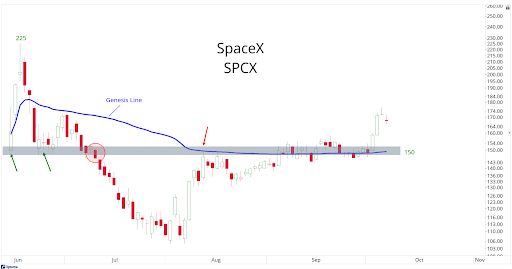
SPCX is above its Genesis Line, the average buyer is making money, the company keeps asking investors for more money, and investors keep giving it to them.
And this fits perfectly with everything else we’re seeing.
Money is available. Investors are willing to take risk.
Companies are asking for enormous amounts of capital, they’re getting it, and the market continues to reward them.
That won’t last forever.
One day, somebody’s going to come asking Wall Street for $40 billion, and Wall Street is going to say “no.”
Or maybe they’ll get the $40 billion and the stock will fall anyway. Then, another company will lower its estimates.
Another financing won’t get done. A stock that used to go up on good news will suddenly go down on good news.
That’s how these things change. It’s a process.
Eventually, stocks will stop making new highs. More of them will start breaking below their Genesis Lines.
The average buyer will start losing money instead of making money.
Analysts will start lowering estimates instead of raising them.
Companies will discover that investors aren’t quite as excited to hand over billions of dollars as they were a few months earlier.
I’ll be watching for all of it.
But that’s not what I see today.
In fact, that process doesn’t even appear to have started yet.
Let everybody else argue about whether this is a bubble, whether AI is overhyped, or whether a company should really be worth $5 trillion or $6 trillion.
I’m going to keep watching what investors are actually doing with their money.
Right now, they’re handing it over. Lots of it.
So we’re going to keep looking for stocks to buy, particularly in technology and the areas where investors continue to reward risk-taking.
And I’m going to keep pointing out these giant financings when they happen, because eventually the money will stop sloshing around.
When it does, I want us to notice.
Until then, I’d rather hang out with the winners.