
A few weeks ago, the biggest IPO in history finally arrived.
Times Square was covered in SpaceX billboards. CNBC couldn’t stop talking about it. Wall Street lined up to buy it.
Then something interesting happened.
Less than two weeks after raising $85 billion from investors, SpaceX went back to Wall Street and borrowed another $25 billion.
That’s a lot of money.
Actually, it’s almost hard to even picture.
If someone handed you $85 billion today, your next phone call probably wouldn’t be to borrow another $25 billion.
But that’s exactly what SpaceX did.
The remarkable part wasn’t the borrowing.
It was the demand.
Institutional investors reportedly offered the company roughly $90 billion for that bond deal. SpaceX only took $25 billion.
We’ve been talking about this theme for weeks now. There is an enormous amount of money sloshing around the financial system.
Nvidia just borrowed $25 billion after investors wanted to lend them far more than they asked for.
Alphabet raised the largest secondary offering in history, pulling in another $80 billion.
Money is everywhere.
That doesn’t necessarily mean stocks should be bought.
The Only Line That Matters
When SpaceX came public, we introduced something we call the Genesis Line.
It isn’t complicated.
It’s simply the anchored volume-weighted average price (AVWAP) from the first day the stock began trading.
Think of it this way.
Imagine every single person who’s bought SpaceX since the IPO. Some bought the first minute. Others bought last week.
The Genesis Line tells us the average price investors have paid for their shares, adjusted for how much stock actually traded.
Why does that matter?
Because markets are really just people.
When a stock trades above its Genesis Line, the average investor owns shares at a profit.
People making money usually aren’t in a hurry to sell.
When a stock trades below its Genesis Line, the average investor is losing money.
Those investors often become sellers every time price rallies back toward where they bought.
That’s why so many of the best long-term winners spend most of their lives above this line.
And why so many disappointing IPOs never do.
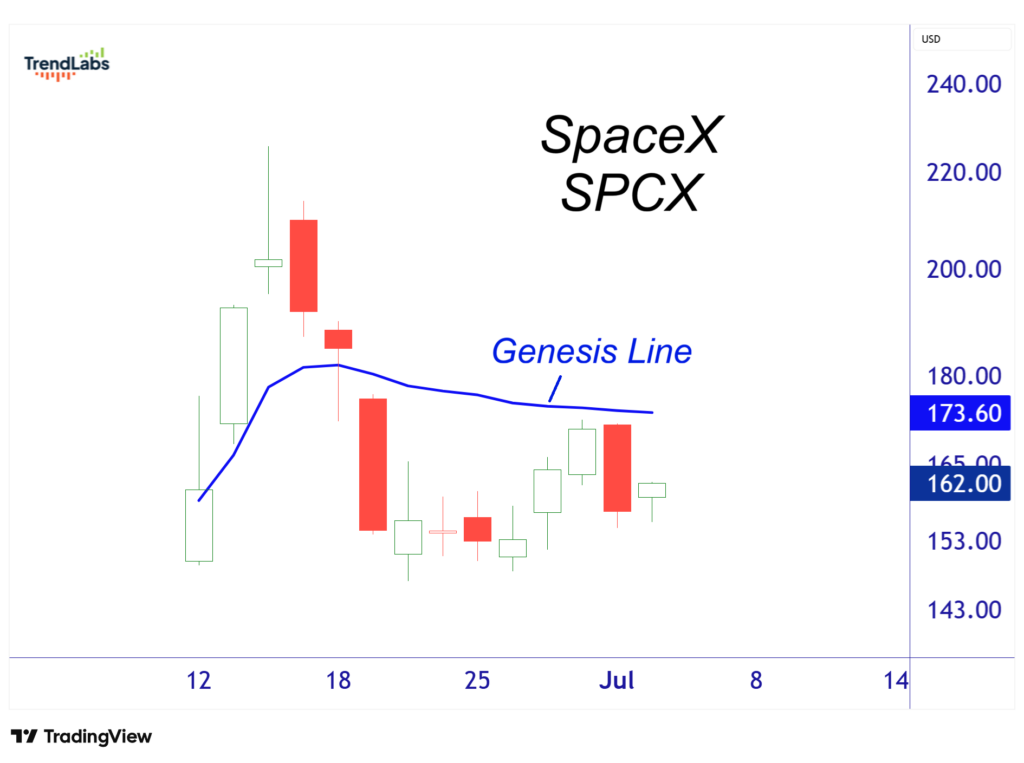
As of today, SpaceX remains below its Genesis Line.
That’s far more interesting to me than any headline.
Don’t Confuse Headlines With Trends
This week, SpaceX will become one of the newest members of the Nasdaq-100.
Normally, companies have to wait much longer. This time, Nasdaq changed the rules.
Whenever markets start changing rules, I pay attention.
That doesn’t mean something bad is about to happen. It doesn’t mean something good is about to happen, either.
It just means people are excited.
Even though SpaceX is worth more than $2 trillion, it’ll initially make up less than 1% of the Nasdaq-100.
That’s because less than 5% of its shares actually trade publicly. Most shares remain locked up with insiders and early investors.
Over time, as more shares become available, its weight inside the index will likely grow.
Index funds will buy billions of dollars worth of SpaceX simply because the rules tell them to.
That’s interesting. But it’s not a reason to own the stock.
Eventually, SpaceX will probably join the S&P 500, maybe someday even the Dow.
Those are fun milestones. But they’re not what drives returns.
The market doesn’t care how many headlines a company gets.
It doesn’t care how many billions it raises.
It doesn’t care whether an index committee changes the rules.
The only thing that pays us is buying something…
…and later selling it for a higher price.
For now, the first line I’m watching isn’t on the balance sheet.
It’s the blue one on the chart.
Stay sharp,
JC Parets, CMT
Founder, TrendLabs