Every great story has a beginning, a middle, and an end.
The funny thing about investing is that everybody remembers the beginning and the end. Almost nobody remembers the middle.
Ask someone about the great gold bull market of the 1970s and they’ll probably tell you the same thing: Gold went absolutely crazy.
They’re right.
But that’s only half the story.
The Part Everyone Remembers
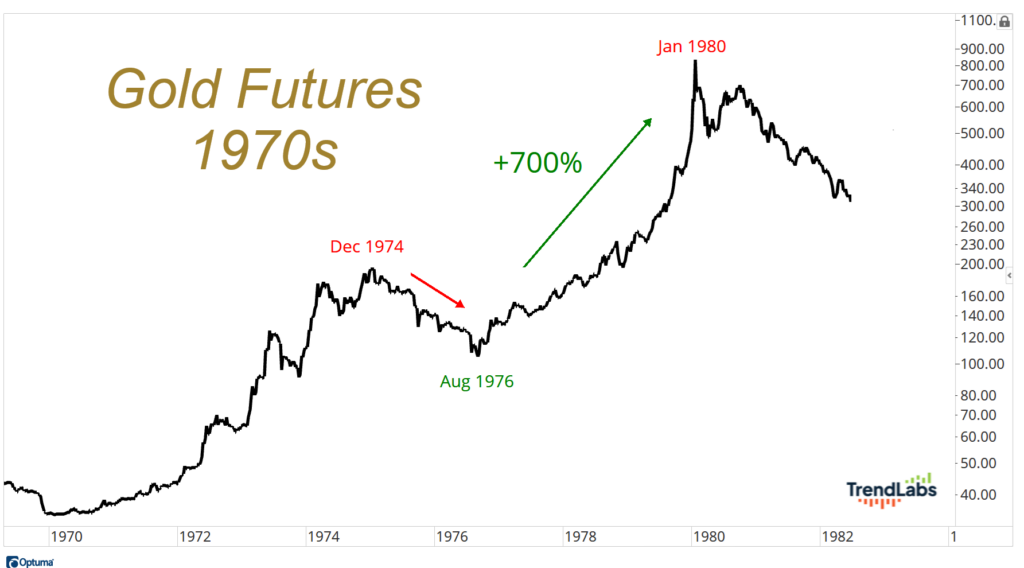
From the beginning of 1970 through the end of 1974, gold climbed from about $35 an ounce to roughly $185. That’s a gain of more than 400%.
Imagine buying something for $100 and watching it grow into more than $500 in just a few years.
That’s the kind of move we’re talking about.
Then the movie took a turn almost nobody remembers.
Gold didn’t keep climbing. It spent nearly the next two years falling.
From late 1974 through the summer of 1976, gold lost more than 40% of its value.
After a run like that, you can understand why so many investors thought the bull market was finished.
A decline that deep doesn’t feel like a normal pullback. It feels like a mistake.
Except it wasn’t.
From the 1976 low to the peak in early 1980, gold rallied more than 700%:
Today, everybody remembers the spectacular ending.
Very few remember what had to happen first.
Maybe the Middle Is the Hardest Part
This spring I wrote a post, “Is This 1974 All Over Again?”, where I compared today’s gold market with the correction investors lived through fifty years ago.
If you haven’t read that one yet, it’s worth a look because it explains why the comparison caught my attention in the first place.
This note isn’t about whether history repeats itself.
It’s about why investors keep reacting the same way whenever a strong trend finally takes a breather.
Today’s gold market isn’t the 1970s. The backdrop has changed in countless ways.
Technology is different. Markets are faster. Information travels around the world in seconds instead of days.
People, however, haven’t changed very much.
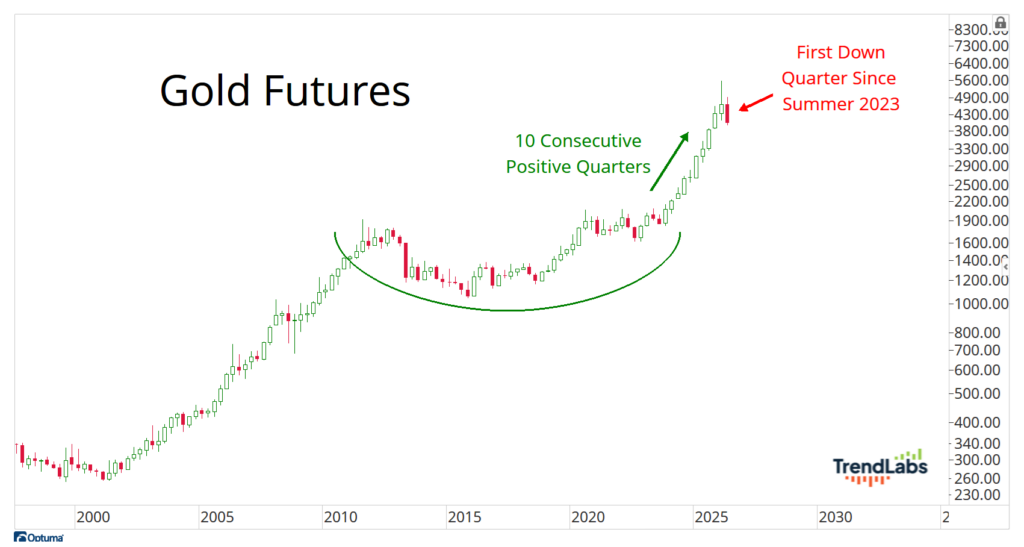
Since the major low in October 2022, gold rallied more than 240%. That’s an incredible move in a little over three years.
Now prices are correcting, and the conversation has changed almost overnight.
Suddenly people want to know if the top is already in, if they missed the move, or if the whole thing is over.
Maybe.
What I do know is that strong trends have a funny way of making everyone uncomfortable before they resume.
One Quarter Doesn’t Change the Story
Here’s a fun fact I bet almost nobody at your Fourth of July barbecue knows.
Gold just finished its first down quarter since the summer of 2023.
That sounds dramatic until you realize what happened before it.
Gold had just put together 10 consecutive quarterly gains. Ten.
Think about your favorite baseball team winning 10 straight games. If they lose the next one, nobody suddenly decides they’re a terrible team.
One loss doesn’t erase everything that came before it.
Markets work the same way.
Does one down quarter mean this secular bullish trend is over?
Maybe.
It also might mean absolutely nothing.
The point isn’t that gold has to follow the path of the 1970s. Markets don’t owe us reruns.
The lesson is much simpler than that.
When we look back at great bull markets, we mostly remember the exciting beginning and the spectacular ending.
We forget the frustrating stretch in the middle that convinced perfectly rational people to quit just before the next big move.
We’ll only know in hindsight whether this correction was the end or just another chapter.
That’s how every great bull market works.
This Week in Everybody’s Wrong
On Monday, we recognized Google parent Alphabet (GOOG) as it finally joined the world’s most important stock market index.
It feels like Alphabet should’ve been in the Dow Jones Industrial Average already.
Indeed, Papa Dow has been the home for leadership for 130 years.
On Tuesday, we saw something we haven’t seen since President George W. Bush was in the White House.
There’s a lot of fear out there right now.
Maybe this chart will change how you think about the market.
On Wednesday, we talked about the biggest crypto story of 2026.
It has almost nothing to do with Bitcoin.
On Thursday, we took a look at the AI story from a different perspective.
Sometimes the biggest opportunities aren’t the companies building the technology, but the industries learning to use it.
On Friday, we asked another simple question.
When was the last time you actually typed somebody’s digits to give them a ring, have a real, live conversation?
Here’s why SpaceX might not be a rocket company after all.
On Saturday, Grant Hawkridge shared his perspective on America as we celebrated our 250th birthday.
Grant’s been all over this land, and he understands how it works.
Come for freedom, independence, and global leadership, but maybe skip the coffee…
Have a great Sunday.
We’ll see you Monday morning…
Stay sharp,
JC Parets, CMT
Founder, TrendLabs