
Every bull market has doubters.
A new study by Allianz found that 62% of Americans think a major recession is right around the corner. Only one in four believe now is a good time to invest.
You can see that fear everywhere.
Some investors think stocks have already gone too far. Others are convinced the economy is about to roll over. Turn on financial television for five minutes and you’ll hear plenty of reasons to be worried.
But the market is telling a different story.
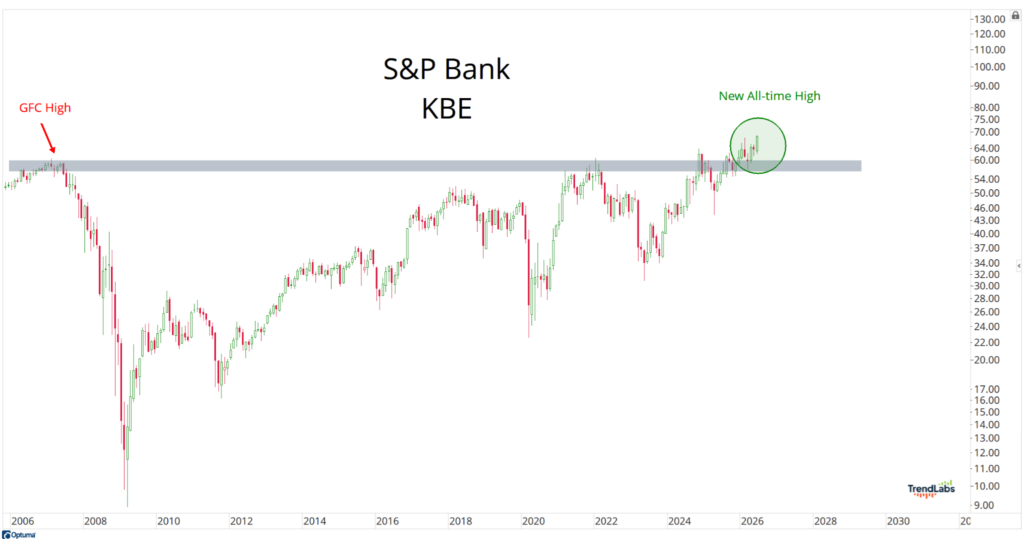
The S&P Banks Index just closed at a new all-time high.
That might not sound like much.
But this is one of those charts that can completely change how you think about the market.
This Breakout Took Almost 20 Years
Here’s why.
The last time the S&P Banks Index traded at these levels was January 2007.
That was nine months before the S&P 500 peaked and the Global Financial Crisis began.
Think about everything that’s happened since then.
The housing market collapsed. Bear Stearns disappeared. Lehman Brothers failed. Hundreds of banks shut their doors. The economy fell into the deepest recession in generations.
Then came a pandemic, inflation, and the fastest interest-rate hiking cycle in decades.
Through all of it, banks never managed to surpass their 2007 peak.
Until now:
Most people don’t realize markets spend far more time moving sideways than they do moving higher.
That’s because old investors who bought near the previous peak often spend years waiting for one thing: the chance to finally get their money back. Every time prices return to those old highs, many of them sell.
Eventually, those sellers disappear.
Once they do, supply dries up. That’s when the biggest moves often begin.
That’s why at Trendlabs, we pay so much attention to long-term breakouts.
The longer they take to develop, the more meaningful they tend to be.
Banks Don’t Just Follow the Economy. They Help Drive It
Banks aren’t like restaurants, airlines, or software companies.
They sit at the center of the economy.
When a family buys a home, there’s usually a bank involved. When a business wants to expand, it often needs financing. When companies raise money, banks are usually part of the process.
Banks help money move through the economy.
When they’re healthy, lending expands. Businesses invest. Consumers spend.
When banks struggle, the opposite tends to happen.
That’s why it’s so difficult to have a lasting bull market without healthy banks.
And that’s what makes this breakout so important.
If the economy were truly on the verge of recession, banks would be one of the last places you’d expect to see historic strength.
Instead, they’re doing exactly that.
The Market Keeps Building Its Case
The banks aren’t making this argument alone.
Industrials are trading at record highs.
Small-cap stocks have already been making new all-time highs.
Now, banks have joined them after spending nearly 20 years building one of the biggest bases in the market.
Markets don’t ring a bell at major turning points.
But they do leave clues.
One of the market’s most economically sensitive groups just broke out to new all-time highs for the first time in almost two decades.
That’s not the kind of evidence you’d expect if the economy were rolling over.
It’s the kind of evidence you’d expect much earlier in a bull market than most investors realize.
Stay sharp,
JC Parets, CMT
Founder, TrendLabs