Google’s parent company, Alphabet (GOOG), officially joins the Dow Jones Industrial Average today.
Most people don’t care.
In fact, if you ask younger investors which stock market index matters most, they’ll probably tell you the S&P 500. That’s what institutions benchmark against. That’s where trillions of dollars are invested. The Dow is old news, right?
That’s exactly what I used to think.
Early in my career, I ignored the Dow too. I thought it was outdated. Thirty stocks couldn’t possibly tell me much about a market with thousands of publicly traded companies.
Then one of my mentors, Ralph Acampora, gave me a piece of advice that completely changed the way I look at markets.
I’ve been following that advice ever since.
Every week, I go through all 30 Dow components one by one. It’s one of the first things I do, because I’ve learned something over the years.
If you get the direction of these 30 stocks right, you’ll probably get the market right.
People love to argue that the S&P 500 is more important. They’re not wrong.
But pull up a chart of the S&P 500 since inception and overlay the Dow Jones Industrial Average. To almost everyone reading this, they’ll look nearly identical. They tell the same story about American business.
The Dow isn’t trying to own every stock.
It’s trying to represent America’s greatest businesses.
That’s why today’s change matters.
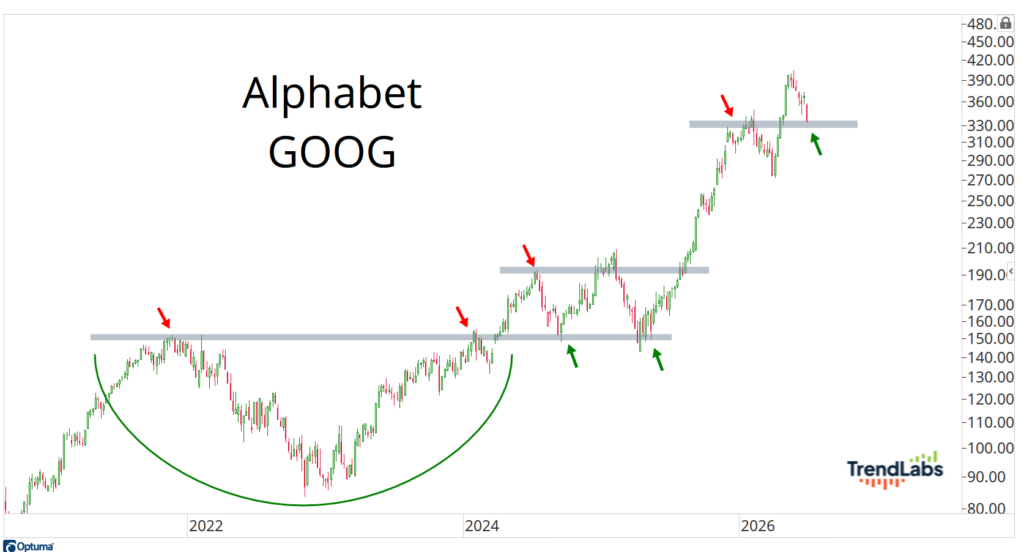
The Dow Has Always Changed With America
One of the funniest reactions I’ve seen today is people saying, “Wait… Google wasn’t already in the Dow?”
It feels like Alphabet should’ve been there years ago. But that’s happened throughout history.
When the Dow was created in 1896, one of the original companies was General Electric (GE). Today we think of GE as an industrial company. Back then it was one of the most exciting technology companies on Earth.
Electricity was changing the world. Thomas Edison was a celebrity. Owning GE was like owning one of today’s biggest innovators.
Then came International Business Machines (IBM).
Long before personal computers and smartphones, IBM dominated the computer industry. It was the modern technology company before anyone even used the word “tech.”
Alphabet’s addition is another reminder that this index is constantly evolving.
One interesting twist is that Google isn’t even officially classified as a technology company anymore.
In 2018, S&P moved Alphabet into the communication services sector alongside companies like Meta Platforms (META) and Netflix (NFLX) because that’s a better reflection of what the business actually does today.
Markets evolve. Businesses evolve.
The Dow evolves with them.
That timing is interesting because we just talked about the Magnificent 7 making fresh 52-week lows vs the S&P 500.
Leadership is always changing. The headlines usually notice after the market already has.
The Lesson Isn’t To Buy Google
One mistake investors make is assuming every Dow change is a buy signal.
History says otherwise.
In 2020, the Dow removed Exxon Mobil (XOM) and added Salesforce (CRM).
At the time, that seemed “obvious.” Technology was unstoppable. Oil was dead.
Then Exxon Mobil soared more than 400% over the next several years while energy became one of the market’s strongest groups.
Salesforce has lost 40% of its value since its inclusion into the Dow.
That’s the market reminding us that consensus isn’t always right.
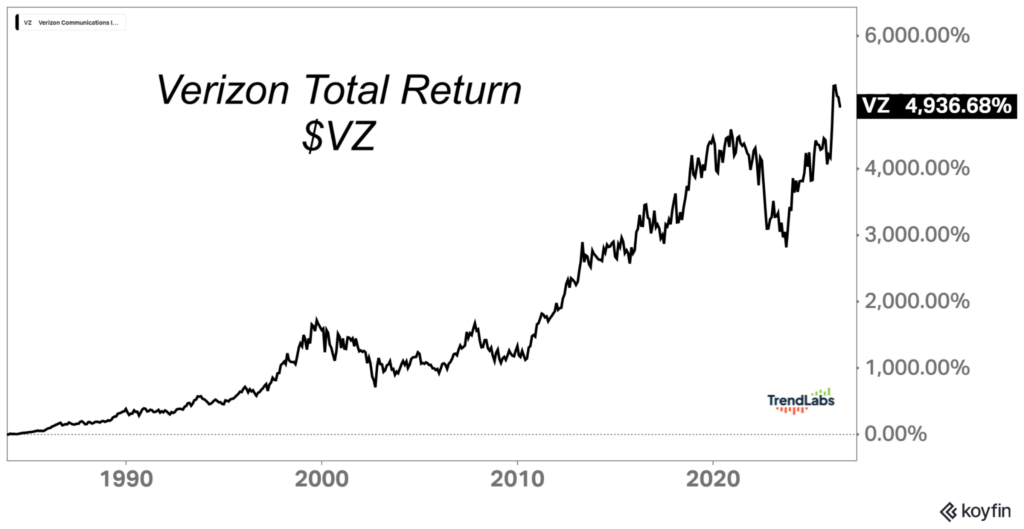
Today, Verizon Communications (VZ) leaves the Dow after more than four decades.
Most people will shrug. I wouldn’t.
I’m not telling you to run out and buy Verizon. What I am saying is that investors often ignore companies simply because they’re no longer exciting.
Verizon’s stock hasn’t exactly lit the world on fire, but once you include its dividend, the total return tells a much different story:
This isn’t really a story about Google.
It’s a story about paying attention.
The Dow Jones Industrial Average has spent more than 125 years adapting to the American economy.
Every addition and every removal tells us something about where leadership has been and where people believe it’s going next.
Sometimes those decisions are early. Sometimes they’re late. Sometimes they’re spectacularly wrong.
But they’re always worth watching.
I learned a long time ago that ignoring the Dow was a mistake. Now it’s one of the first things I study every week.
If you’ve never paid attention to the Dow before, today’s a pretty good day to start.
And if there’s one lesson I’ve carried with me from Ralph Acampora through every market cycle, it’s this:
Stay sharp,
JC Parets, CMT
Founder, TrendLabs