On Friday, we talked about history being made in the market.
Do you realize you’re also seeing the future unfold right now?
If you do, you’re well ahead of almost everybody.
How many people knew in the mid-1990s that the internet was going to change everything?
Most people didn’t think much about smartphones when they first showed up, either.
Looking back, big changes like that seem obvious. Living through them, they rarely do.
I think something similar may be happening in financial markets.
This week, trading volume in tokenized stocks exploded to more than $220 million a day:
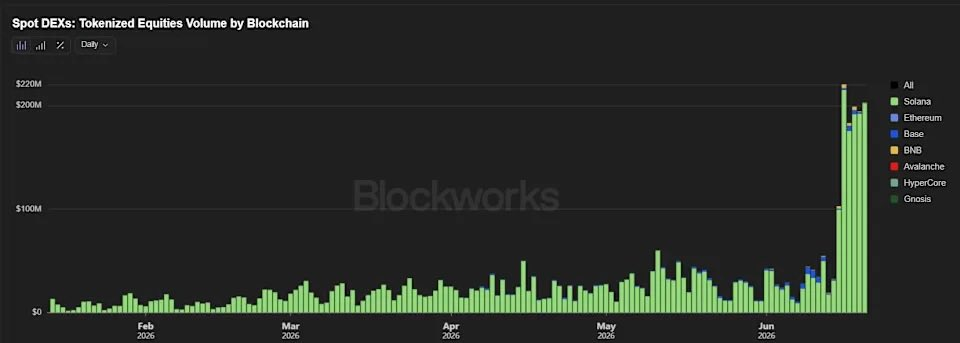
That’s a huge jump in a short period of time.
For most of the year, daily volumes generally ranged between $20 million and $60 million.
What’s particularly interesting is that most Americans don’t even know these markets exist.
In fact, most Americans can’t access them. The growth we’re seeing is largely coming from investors and traders elsewhere around the world.
That’s why I find this so fascinating.
Not because of the technology itself. Because of what the technology is trying to accomplish.
Building a Better Market
Most people assume the stock market already works instantly. You click a button, you buy a stock, and you move on with your day.
But, behind the scenes, there’s a lot more happening than most investors realize.
Ownership records need to be updated. Trades need to be processed. Assets need to be transferred. Different firms need to reconcile their records and make sure everybody agrees on what happened.
The system works. Obviously, it works.
But it isn’t always fast, it isn’t always cheap, and it certainly isn’t always transparent.
That’s why I’ve been so interested in tokenization for years, long before anyone cared about the trading volume.
The easiest way to think about it is to compare the old system to the new one.
Today, if you want to buy Apple (AAPL), you open a brokerage account, you buy shares through your broker, and you trade during stock market hours.
In a tokenized world, you could open a digital wallet, you could buy a token representing Apple, and you could trade it around the clock on a blockchain.
In theory, both should rise and fall with the value of Apple. The stock isn’t really the innovation.
The innovation is everything happening around it.
Instead of markets closing at 4 p.m. Eastern Time trading can continue at night, over weekends, and through holidays.
Instead of requiring a traditional brokerage account, investors around the world may be able to access the same assets more easily.
Someone with only $10 can buy a small piece rather than saving up for a full share.
Transactions can settle faster, ownership records can update almost instantly, and much of the information investors spend their lives chasing can potentially be viewed in real time.
That’s the part that gets me excited.
The stock itself isn’t changing. The plumbing underneath it is.
When people hear words like “blockchain,” “crypto,” and “tokenization,” they tend to focus on the technology. I think that’s a mistake.
The real question is much simpler: What if financial markets could work better?
Our team spends a tremendous amount of time gathering ownership data, short interest data, positioning data, and fund flow data.
Anyone who works with this information knows how frustrating the process can be. Different sources. Different formats. Missing information. Reporting delays.
Then, after all that work to gather it, the data is often already stale.
The promise of tokenized markets isn’t really about cryptocurrency.
It’s about creating a financial system that’s faster, cheaper, and easier to understand than the one we have today.
Will it work exactly the way people expect? Probably not. Nothing ever does.
But it’s hard for me to believe investors will suddenly lose interest in markets that are faster, cheaper, and more transparent.
The Question Investors Should Be Asking
The easiest mistake is assuming this recent surge in trading activity is a one-time event.
Maybe it is.
Maybe it’s simply the next step in a trend that’s been quietly building for years.
The question I keep coming back to is whether demand for better financial markets goes away. I don’t think it does.
If anything, I think demand for those things only grows over time.
That’s why I spend less time thinking about whether tokenization survives and more time thinking about who benefits if it does.
One company that continues to stand out is Bank of New York Mellon (BNY):
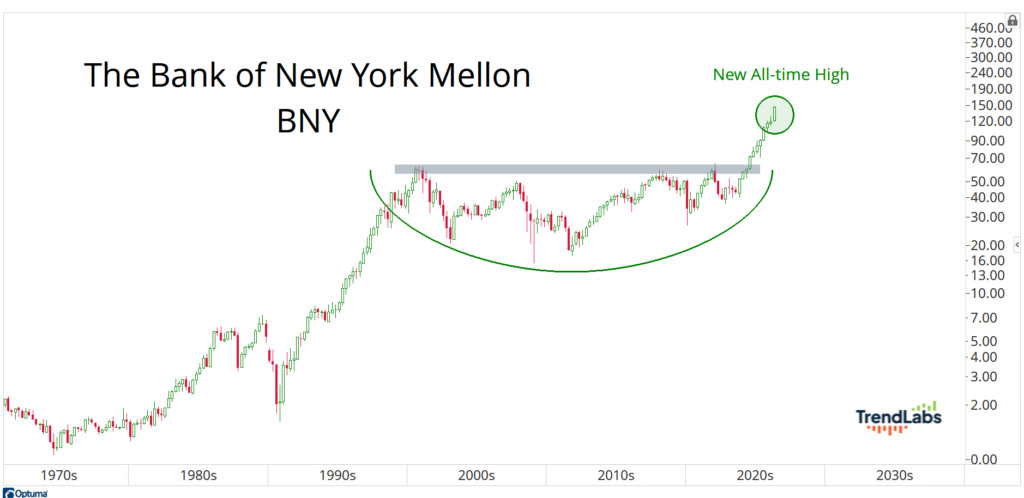
One thing “tokenization” does not mean is that traditional financial institutions are going to disappear.
History suggests things are rarely that simple.
New technologies often create new winners, but they also create opportunities for existing companies that successfully adapt.
If pension funds, mutual funds, ETFs, and other large institutions eventually own tokenized stocks and bonds, somebody will still need to keep track of everything.
Somebody will still need to provide custody, reporting, administration, compliance, and settlement services.
That’s what Bank of New York Mellon does.
Maybe tokenization disrupts that business. Or maybe it makes the company even more important.
Either way, I think that’s the question investors should be asking.
Because if trading volume in tokenized stocks can jump from tens of millions of dollars a day to more than $220 million in a single session, perhaps the question isn’t whether tokenization becomes a larger part of financial markets.
The more important question is which companies are positioned to benefit if it does.
This Week in Everybody’s Wrong
On Monday, we wondered why the U.S. dollar isn’t following the script right now.
We need to talk about a widely accepted assumption investors have held for decades.
What does the dollar wrecking ball mean to the bull market?
On Tuesday, we reminisced about my early days in this business and Alan Greenspan.
He passed away this week at 100 years old, but he’s still shaping markets and the economy.
We’ll never forget my first Fed chair.
On Wednesday, we looked at what might be the most important chart on your screen this week.
One of the world’s biggest semiconductor markets just fell 10% in a single session.
They’re calling it “Black Tuesday” in South Korea.
On Thursday, we talked about the Magnificent 7.
They’re still lagging, you know, and if you’re still waiting around for them to take leadership again, you’re missing out on some serious opportunities.
They happen to be hiding in plain sight, right here in America.
On Friday, we took a pause to appreciate some real history happening in the stock market right now.
It’s the craziest bet in Wall Street history.
And it’s completely unraveling in real time.
On Saturday, Sam Gatlin brought us back to the Midwest for a little more local color and a lot more information about the current market landscape.
Last time it was Oklahoma, the NBA, and the energy sector.
This time it’s Kansas, tornados, and the U.S. dollar.
Have a great Sunday.
We’ll see you Monday morning…
Stay sharp,
JC Parets, CMT
Founder, TrendLabs