Founder’s Note: A few weeks ago, Sam Gatlin took us to Oklahoma City and inside the gym for Game 7 of the NBA’s Western Conference Finals.
It’s good local color, with some great insights on energy.
Sam’s back with another note from the Midwest.
This one seems a little more ominous, though… – JC
By Sam Gatlin
It’s pouring in Kansas as I sit here and write.
After a long drought, we’re finally getting real rain. Depending on which gauge you trust, some places have picked up several inches recently, with a few local counts closer to six.
Around here, that matters.
Rain can be the difference between making money from our farming operations and losing it.
Rain feeds the milo, corn, soybeans, sunflowers, and cotton.
And it brings the pastures back to life, giving the cattle something green to chew on again.
We’ll gladly take every drop. But on the Plains, good storms come with a tradeoff.
Sometimes they spin.
You can go weeks begging for rain, then one afternoon the sky turns, the wind shifts, the sirens go off, and everybody suddenly remembers exactly where the basement is.
If you’ve lived in Kansas long enough, tornado season becomes part of you.
And that’s because you know the smell in the air, what the clouds look like, and when a regular thunderstorm starts acting a little too ambitious.
The tornado I’ll never forget happened in Greensburg, Kansas, back in May 2007, months before the Global Financial Crisis began.
This was an EF5 tornado that destroyed most of the town.
An EF5 is the highest and most intense rating a tornado can receive, and accounts for less than 0.1% of all tornadoes worldwide.
In other words, it’s the kind of storm that leaves a mark on everyone close enough to remember it.
I was young at the time, but I remember it being a huge deal.
Friends of mine lost everything they owned, and some even lost loved ones.
This just goes to show that most storms pass, some do real damage, and a few change everything.
Sitting here watching these storms roll through Kansas, I can’t help but think about a different kind of storm building in the market.
That storm is the U.S. dollar.
The Wind Just Changed
Not every dollar rally matters.
But every now and then, the dollar starts moving in a way that looks different.
This is when the whole setup begins to feel less like a harmless summer storm and more like a tornado watch.
That’s where we are now.
JC wrote this week about how stocks are still acting well, participation remains broad, and yet the U.S. Dollar Index just closed at a new 52-week high.
And this is unusual…
For years, the dollar has acted as a safe haven.
And that means it tends to fall when capital moves back into stocks, commodities, emerging markets, and everything else tied to global growth.
A stronger dollar doesn’t automatically mean stocks have to fall.
This is especially true in environments like the late 1990s, when global capital wanted U.S. stocks, U.S. technology, and U.S. dollars all at the same time.
That can happen again, but it doesn’t mean a stronger dollar is harmless.
While stocks may rise alongside the dollar, many other assets don’t handle dollar strength nearly as well.
And that’s where the risk is today.
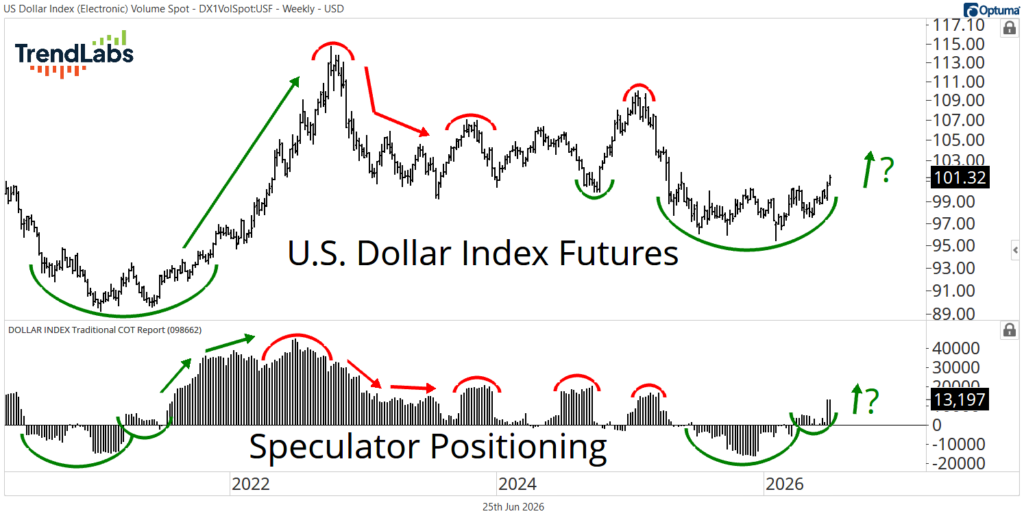
The setup today with the U.S. Dollar Index futures looks a lot like what we saw coming out of the 2020 and 2021 lows.
That’s when the dollar carved out a massive reversal pattern, while CFTC data showed speculator positioning moved from deeply negative territory back above zero.
That was the tell….
Speculators had been leaning the wrong way, then positioning started to turn, and then price broke out.
What followed was a face-ripping rally that lasted through most of 2022, which was fueled by speculative buying.
Now we have a similar setup taking shape.
Does that guarantee another 2021-2022 dollar ripper?
Of course not.
But if you’re asking where the tornado scenario lives, this is it.
The Damage Path
The first signs are already showing up in the currency market.
Currencies like the euro, the Polish zloty, the British pound, and others are breaking down to new lows.
And the fundamental backdrop explains why we’re seeing the dollar strengthen.
Currencies are driven by many factors, but at the highest level, I like to focus on two big inputs: economic growth at home versus overseas, and monetary policy at home versus overseas.
Right now, the policy side of that equation favors the United States.
The Fed sounds more hawkish, European central banks are turning more dovish, and the market is beginning to price a wider gap between U.S. rates and overseas rates.
That is exactly the kind of condition that can keep a bid under the dollar.
And if the dollar keeps strengthening, the damage will not be evenly distributed.
Some stocks may be fine, and some may even benefit.
But precious metals, emerging markets, and other dollar-sensitive trades could have a much harder time.
And that brings us to gold.
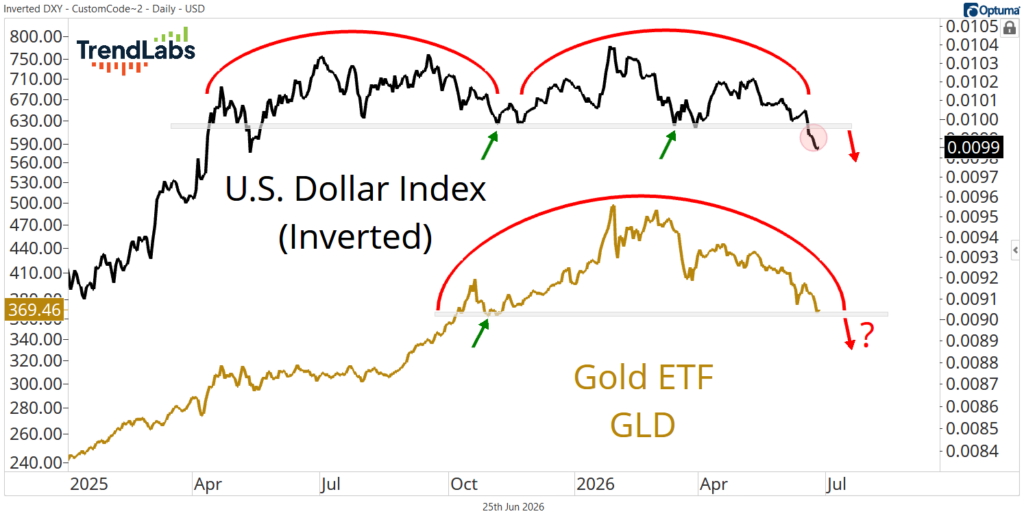
Gold has been one of the great winners of this cycle.
No question about it.
But right now, the chart looks horrible.
When you overlay the U.S. Dollar Index with gold, the problem becomes pretty obvious.
The gold line looks poised to follow the black line lower.
So if the dollar continues higher from here, I’m willing to bet that gold will go down in value.
This is where investors get themselves into trouble, because they ignore the storm forming today.
Gold has worked, precious metals have worked, and international stocks have worked.
But if the dollar is beginning a new primary uptrend, the market environment will be different.
And when the environment changes, we have to change with it.
This Is a Watch, Not a Siren
Here in Kansas, a tornado watch doesn’t mean your house is about to relocate itself to Missouri.
It means the conditions are there for something bad to happen, and you should probably stop pretending the sky looks normal.
That’s how I’m treating the dollar right now.
I’m not saying every risk asset is doomed, or this has to be a repeat of 2022.
What I am saying is that the dollar is breaking out, and precious metals are trading horribly.
Maybe this storm will pass, but if the dollar keeps ripping higher, it could trigger tornadoes across some of the market’s most crowded trades.
And if you wait until the sirens are already screaming, it’ll be too late to start looking for shelter.
Stay safe out there,
Sam Gatlin
Analyst, TrendLabs