
You’re watching history being made in the market.
Crypto treasury companies have reported more than $20 billion in unrealized losses in just a few months.
Strategy (MSTR) alone has reported about $14 billion in unrealized losses. BitMine (BMNR) isn’t far behind, with roughly another $10 billion.
If you’re wondering what a crypto treasury company actually is, the idea is pretty simple.
These companies decided that instead of using their cash to invest in their own business, they would use it to buy cryptocurrencies like Bitcoin or Ethereum.
That wasn’t enough.
Many of them also borrowed money or sold new shares of stock to raise even more cash. Then they used that money to buy even more crypto.
Over time, the business itself became less important than the size of its crypto holdings.
Investors weren’t really buying a software company anymore. They were buying a publicly traded company whose biggest asset, and biggest bet, was a cryptocurrency.
Maybe Bitcoin and Ethereum rally and those losses eventually disappear.
Maybe they don’t.
Either way, this is one of the most fascinating market experiments we’ve ever seen.
Before anyone sends me the email, yes, these are unrealized losses under the new fair-value accounting rules. If Bitcoin goes back to making new highs, those losses can shrink or disappear.
That’s not really the point.
The point is that we’ve never seen public companies this size deliberately transform themselves from operating businesses into giant leveraged bets on a single asset.
Outside of the financial crisis, it’s surprisingly difficult to find anything comparable.
History Doesn’t Have Many Answers
If you simply rank the biggest corporate losses ever reported, the names that show up are familiar. AIG. Fannie Mae. Freddie Mac. Lehman Brothers. WorldCom. Enron.
Mathematically, that’s the company Strategy keeps now. But those aren’t really the best comparisons.
Most of those businesses were at the center of the Global Financial Crisis or collapsed because of accounting fraud.
They weren’t making a giant bet on one asset. They were watching the financial system itself come apart.
That’s what makes this episode so unusual.
Strategy isn’t a bank. It isn’t an insurance company. It isn’t hiding losses through fraudulent accounting.
It’s a software company that voluntarily transformed itself into a leveraged bet on a single asset.
And it’s hard to find companies that have reported losses of this size over such a short period.
That alone should get your attention.
You’re Watching a Case Study
The dollar amount is impressive.
What’s even more unusual is how quickly these losses accumulated relative to the size of the companies.
Historically, those kinds of losses usually show up alongside bankruptcies, frauds, bank runs, or financial crises.
This is different.
Maybe Bitcoin and Ethereum rally back to new highs, and these paper losses become little more than a footnote.
That’s certainly possible. Markets have a funny way of humbling anyone who speaks in absolutes.
But maybe it doesn’t.
Either way, you’re watching one of the most fascinating market experiments any of us have ever seen. Grab your popcorn.
If you’ve spent enough time around me, you know I’m a history nerd. I love studying old market cycles, famous crashes, bubbles, panics, and manias.
When something truly unusual is happening, I think it’s worth stopping for a minute and recognizing it.
Most investors spend their careers reading about history after it’s over. We get to watch this one unfold in real time.
Now, I know what you’re thinking.
“That’s great, JC. I don’t need a history lesson. I need to make money.”
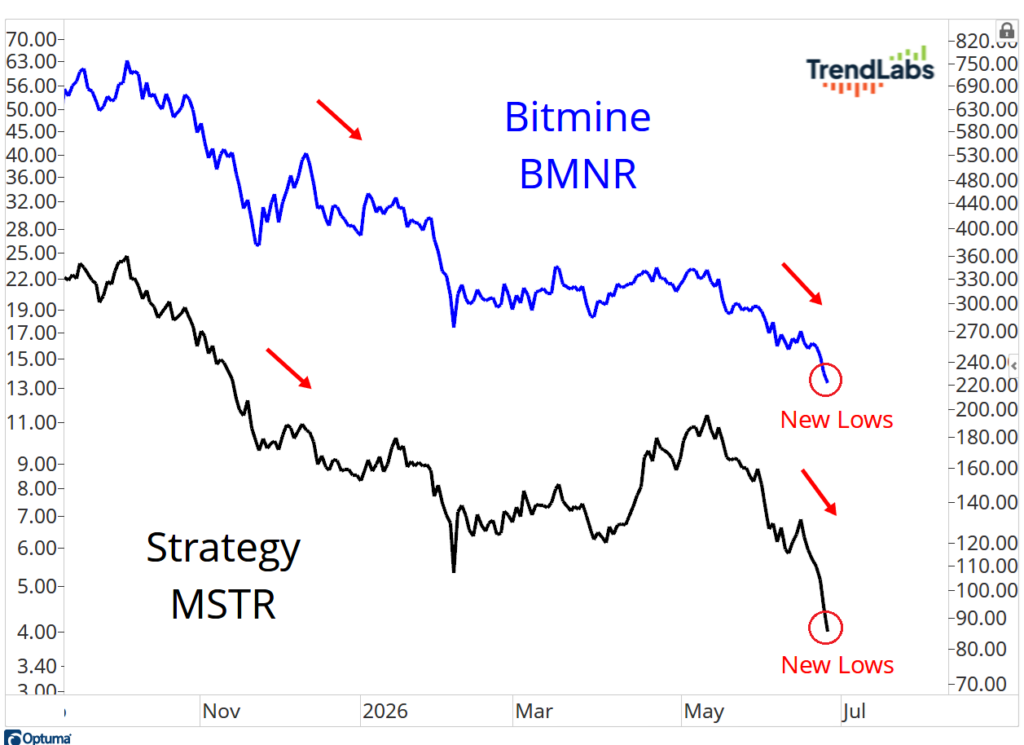
I get it. The good news is nobody says you have to own Bitcoin treasury companies. In fact, the trend there has been terrible.
Meanwhile, there are plenty of places where money continues to flow.
We’ve been pounding the table on biotech all year and just published another report on some of our favorite names.
We’ve been talking about The Heart and Soul of America, the industrials, manufacturers, infrastructure companies, and businesses quietly benefiting from this new leadership cycle.
Those are the areas where we’ve been putting our money to work.
That’s the lesson: You don’t have to participate in every spectacle.
Sometimes the smartest trade is simply paying attention, learning something you’ll remember for the rest of your career, then going somewhere else to make money.
History is fun.
Profits are better.
Stay sharp,
JC Parets, CMT
Founder, TrendLabs