
A couple of years ago, everybody figured the stock market had been reduced to just seven companies.
All that mattered was the “Magnificent 7”: Nvidia (NVDA), Apple (AAPL), Microsoft (MSFT), Amazon (AMZN), Alphabet (GOOGL), Meta (META), and Tesla (TSLA).
They were most of the biggest companies in America, and for a while it seemed like they were the only stocks anyone wanted to own.
They dominated headlines, attracted most of the investment dollars, and did much of the heavy lifting for the entire stock market.
For a while, that story had some truth to it.
But the stock market doesn’t care about yesterday’s news. It only cares about what’s happening today. That’s why we’ve spent most of this year calling them the “Lag 7” instead.
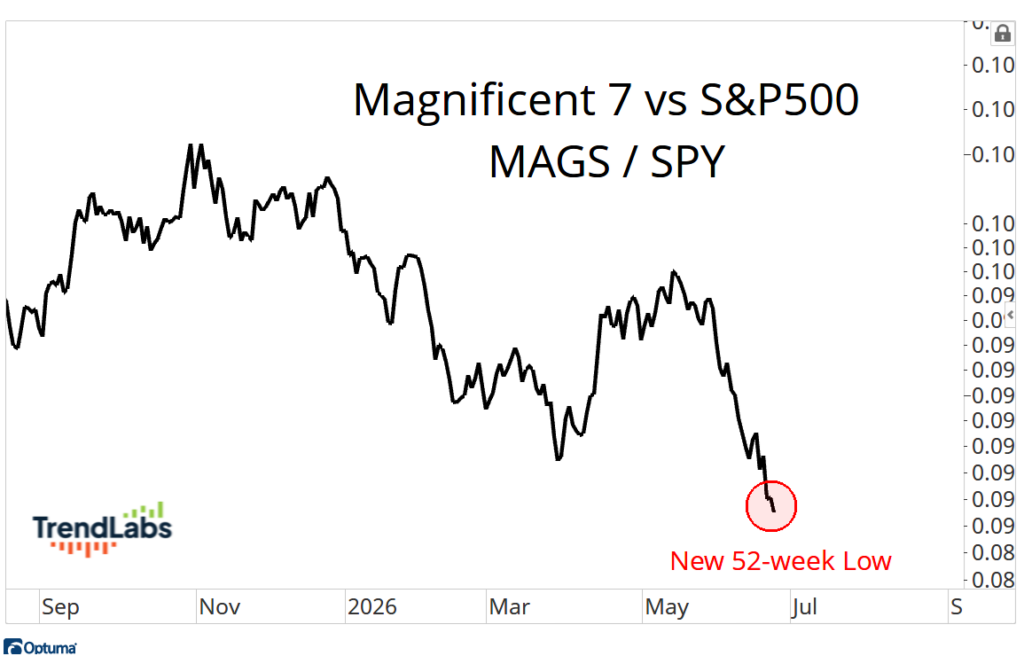
Today, while the S&P 500 continues making new all-time highs, those same seven stocks are making new 52-week relative lows.
In other words, they’re still going up, in some cases. But they’re no longer keeping pace with the rest of the market.
The story changed.
And the charts showed it long before most investors did:
The Market Answered the Question
Back in March, we wrote that eventually something had to give.
Either the Mag 7 would start leading the market again, or the rest of the market would eventually roll over and follow them lower.
Neither happened.
Instead, the market found new leaders.
While investors stayed focused on Nvidia, Apple, Microsoft, and the other former favorites, money flowed into different parts of the market.
Small-cap stocks began outperforming. Value stocks took leadership. Industrials, Financials, and many of the companies actually building America moved to the front of the line.
That shouldn’t sound unfamiliar.
Last week, I wrote about what I call the Heart & Soul of America, the companies building factories, making machinery, supplying infrastructure, moving freight, producing energy, and manufacturing the equipment that keeps the economy running.
Those stocks continue to act much better than most investors realize.
This is simply another way of seeing the same rotation.
The Russell 2000 Small Cap Index just hit another new 52-week high relative to the Magnificent 7.
So did the Russell 1000 Value Index:
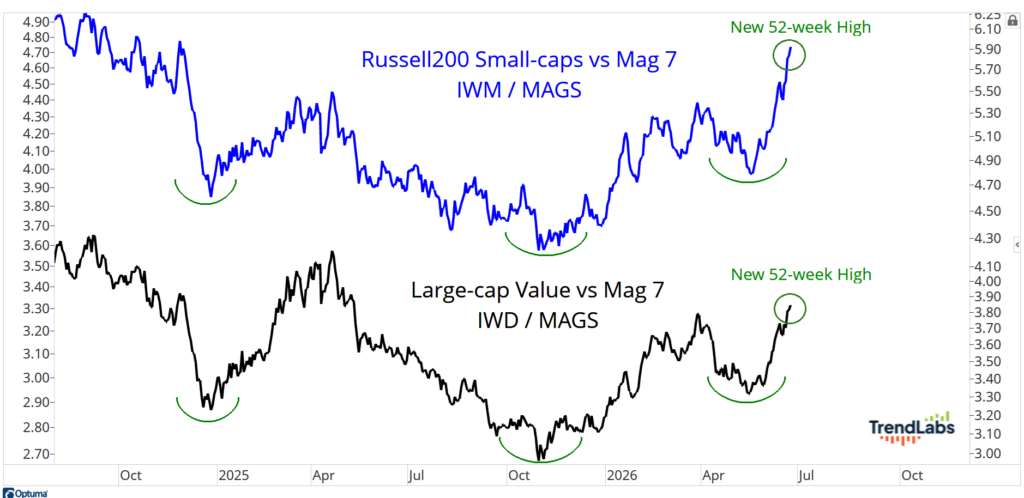
That’s what broadening leadership looks like.
The Lag 7 isn’t dragging the market higher anymore.
The rest of the market simply doesn’t need them.
Stop Investing in Yesterday’s Narrative
One of the easiest mistakes investors make is assuming yesterday’s winners will be tomorrow’s winners.
Sometimes they are. Often they aren’t.
Coming into this year, we said the biggest theme of 2026 would be broader participation. For too long, only a handful of giant technology companies had been doing most of the work. That was never likely to last forever.
So far, that’s exactly what’s happened.
This isn’t an argument against Nvidia, Microsoft, Amazon, or any of the other Mag 7 stocks. They’re incredible businesses, and I wouldn’t be surprised if several of them become even bigger companies over the next decade.
But a great company doesn’t automatically make a great stock.
The market is rewarding different things today than it was rewarding two years ago. If you’re still waiting for seven stocks to carry the entire market, you’re probably looking in the wrong place.
The biggest opportunities have become much broader than seven stocks.
And they’ve been hiding in plain sight.
Stay sharp,
JC Parets, CMT
Founder, TrendLabs