They’re calling it “Black Tuesday” in South Korea.
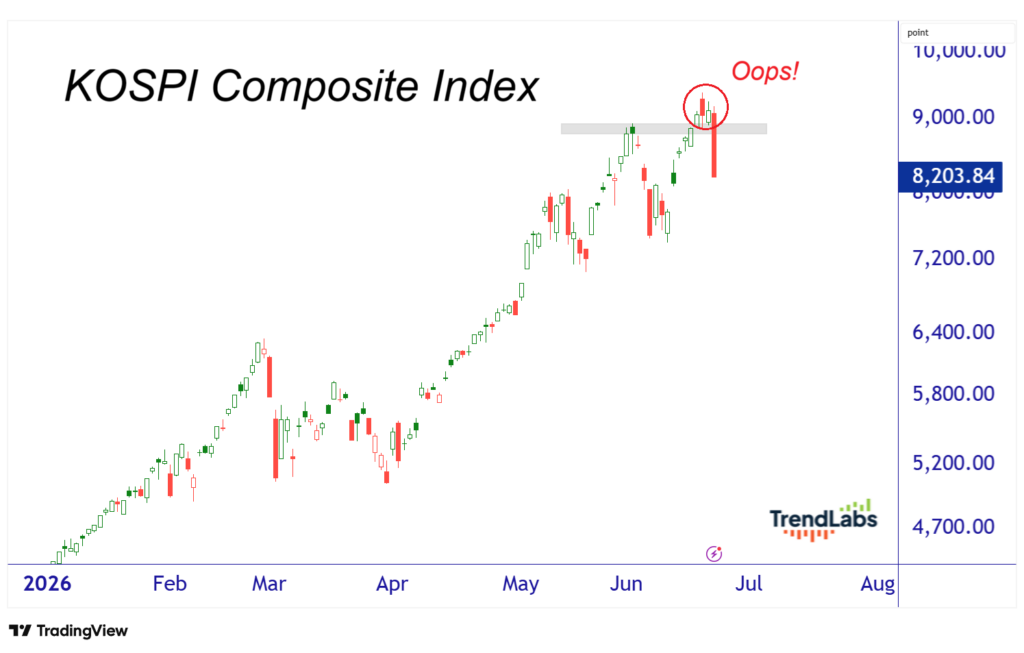
The KOSPI 200, South Korea’s equivalent of the S&P 500, suffered its worst day ever, falling nearly 10% in a single session.
Most American investors saw the headline and immediately moved on.
That’s a mistake.
Because if you want to understand what’s happening with stocks, South Korea is one of the first places you should be looking.
This isn’t really a story about South Korea.
It’s a story about technology.
One of the biggest misconceptions investors have is assuming all stock markets around the world tell the same story.
They don’t.
Different countries tend to specialize in different industries, which means certain markets give us valuable clues about specific corners of our own.
Peru and South Africa can tell us a lot about metals and mining stocks. European banks can provide a useful read on the health of the global banking system.
And South Korea? It’s one of the best places in the world to monitor semiconductors and technology hardware.
Its stock market is dominated by companies like Samsung Electronics and SK Hynix, two of the biggest beneficiaries of the AI boom.
Investors looking for exposure to memory chips, semiconductors, and hardware infrastructure have piled into these stocks for years.
The gains have been enormous. That’s one reason ETF products tied to DRAM and memory-chip companies have attracted so much demand.
For many investors, South Korea became one of the easiest ways to gain exposure to that entire theme.
It’s Not About Korea
What makes this week’s decline so interesting is that it didn’t happen in a vacuum.
At the same time Korean technology stocks were getting hit, semiconductor stocks in the United States were under pressure, too.
That’s not a coincidence.
The same forces that drove these stocks higher are now creating selling pressure. After the run we’ve seen in semis, memory, and AI infrastructure, a little profit-taking shouldn’t surprise anybody.
We’ve seen this movie before.
Back in March, the Korean market suffered an almost 20% decline in just two days. By April, it was already making new all-time highs.
Earlier this month, we saw another sharp correction that was quickly erased. Buyers stepped right back in and pushed prices to fresh highs.
So is this another temporary shakeout?
Or is something bigger starting to develop?
My take: The technology hardware and chips trade is due for at least some consolidation.
Whether that comes through lower prices or sideways chop, I’m not sure it matters much.
Follow the Rotation
Here’s the good news: Money doesn’t appear to be leaving stocks altogether.
It’s rotating.
While semiconductors struggled all through Tuesday’s session, software stocks quietly spent the day moving higher.
That distinction matters. Healthy bull markets often rotate leadership—they don’t lose it.
Investors sell one group of winners and move into the next. That’s different from the kind of broad-based selling you typically see before major market declines.
We’re already seeing some of that happen.
If weakness in South Korea continues, I’d expect continued pressure on semiconductors and technology hardware in the U.S. as well.
The lesson here isn’t really about South Korea. It’s about understanding what South Korea represents.
One of the world’s most important semiconductor markets just had a historic selloff.
Whether that turns into a buying opportunity or the start of a larger correction remains to be seen.
Either way, you should be paying attention.
It’s also a reminder that the stock market is a whole lot bigger than semiconductors.
While everyone’s staring at South Korea and the technology sector, there are plenty of other areas of the market telling their own story.
And some of the stocks tied most closely to building, manufacturing, lending, and investing here in the U.S. continue to act remarkably well.
I wrote recently about what I call the Heart and Soul of America.
Maybe South Korea is warning us about one part of the market.
The companies building America might be telling us something different entirely.
Stay sharp,
JC Parets, CMT
Founder, TrendLabs