We just watched a major country’s stock market crash. And almost no one noticed.
South Korea’s Kospi 200 fell 20% in two days last month. That kind of move usually dominates headlines. This time it barely registered.
Now, just weeks later, it’s back at new all-time highs.
That’s not normal.
South Korea is not some fringe market you can ignore. This is a top 10 country by total stock market capitalization, ahead of places like Germany, France, and Brazil.
So when a market that big gets hit that hard then turns right around and makes new highs, I pay attention.
Because the crash is one thing.
The recovery is the story.
Blink and You Miss It
Here’s a chart of the Kospi 200 Index (KSI), a basket of 200 of the most important companies trading in South Korea:
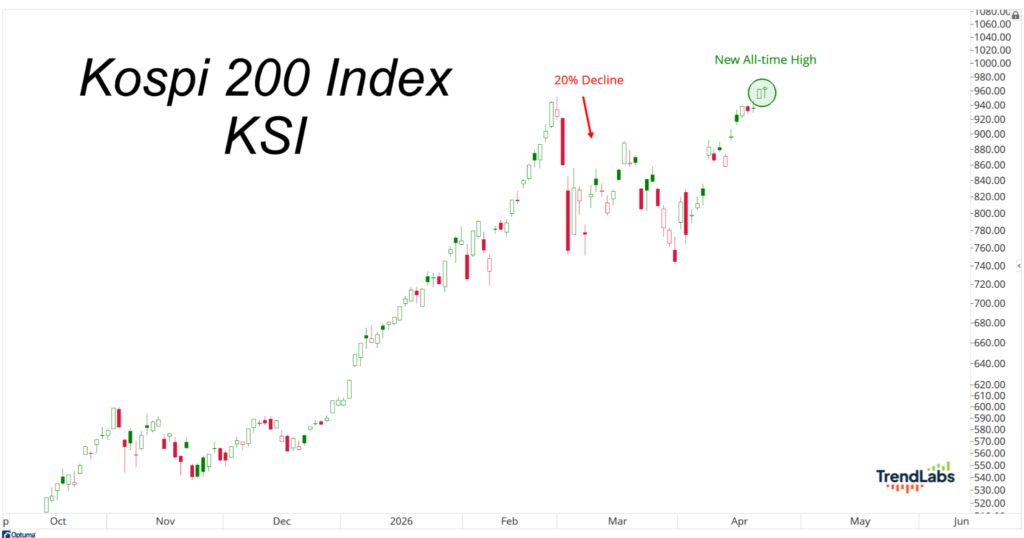
Focus on that two-day collapse last month – a 20% drawdown that, in most environments, would leave a mark for a while.
Not this time.
That crash was in March. We’re still in April, and prices are already hitting new all-time highs like nothing ever happened.
To be fair, this market had just gone on a massive run. From the April 2025 lows, Korean stocks nearly tripled in less than a year.
A 20% correction after a move like that is not unusual.
What stands out is the recovery.
What could have been written off as a blowoff top in a tech-heavy, speculative market turned into a brief interruption, a quick reset before price continued higher.
That’s not how weak markets behave.
It’s Really a Tech Trade
When you dig into what’s actually driving Korea’s stock market, it starts to look very familiar.
This is a technology-heavy index:
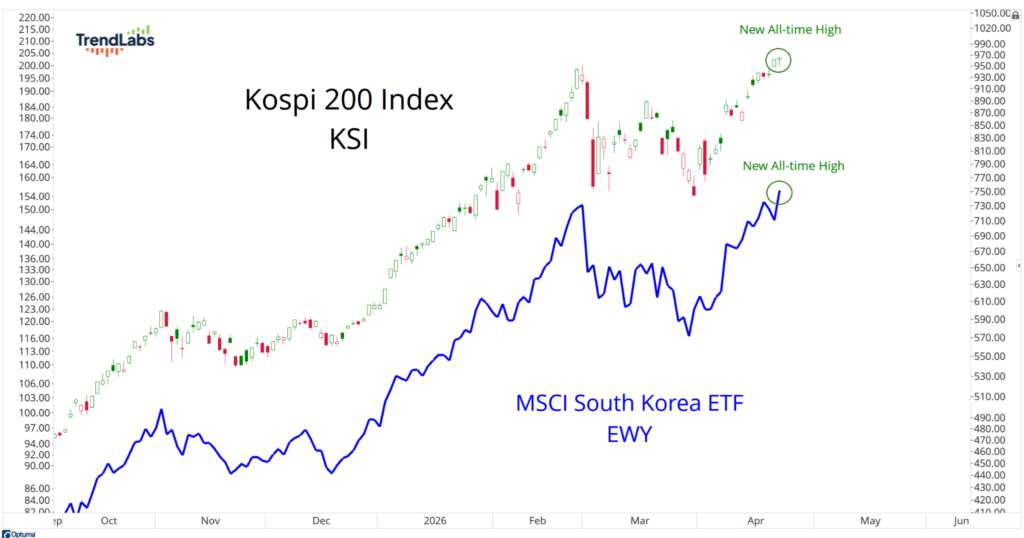
Samsung alone makes up roughly 22% of the iShares MSCI South Korean ETF (EWY). You can see it overlaid in blue against the broader index.
Right behind it is SK Hynix, one of the most important AI chipmakers in the world, now pushing toward a half-trillion dollar valuation.
They recently filed for an ADR, which means U.S. investors will soon be able to buy it directly on domestic exchanges. Up until now, the easiest way to get exposure has been through the ETF.
When you think about Korea, don’t think of it as some isolated market doing its own thing.
Think about global technology leadership. Think about semiconductors. Think about the same forces driving stocks higher here at home.
Yes, there are industrials and financials in the mix. But the engine is tech.
And that’s what makes this so important.
Because if this market can absorb a violent shakeout, reclaim new highs, and hold them, it tells you risk appetite is alive and well.
Which means this isn’t really about Korea.
It’s Not Even About Korea
A lot of investors will shrug this off. They don’t follow South Korea. Some probably couldn’t find it on a map.
That’s fine. Just don’t miss what it represents.
This is a top 10 equity market in the world, with heavy exposure to the same large-cap technology leadership that just ripped higher in the U.S.
So, no, this is not some isolated move happening off to the side. This is part of the same global tape.
If you want exposure, you can use EWY. It’s liquid and easy to access. But that’s not really the point.
For me, this is about evidence.
A market like this can fall 20% in two days and be back at new highs just a few weeks later. That’s not weakness. That’s demand.
That’s the kind of behavior you see in strong environments, not fragile ones.
Same data. Same charts.
You can ignore Korea.
But the market isn’t.
Stay sharp,
JC Parets, CMT
Founder, TrendLabs