
I’ve been trading Bitcoin and cryptocurrencies since 2013.
For most of that time, I’ve heard the same criticisms over and over again.
“Crypto never built anything.” “There’s no real use case.” “It’s just speculation.”
If you’ve followed my work for a while, you already know I’ve never seen it that way.
I’ve always thought people were asking the wrong question.
Instead of asking what crypto was replacing, I kept asking what it was teaching us.
From where I was sitting, it looked like crypto was building a faster, more transparent way to move assets around the world.
I didn’t know exactly how it would play out, but it seemed obvious that traditional finance wasn’t going to ignore those innovations forever.
It was eventually going to adopt them.
Now I think that’s exactly what’s happening.
Crypto Was Never the Destination
This week, Coinbase (COIN) announced that it’s bringing one-for-one backed tokenized stocks onto its platform.
In simple English, that means every digital token represents a real share of stock. The token isn’t replacing the stock. It is the stock, just on a different set of rails.
Why does that matter?
Think about sending an email instead of mailing a letter. The message is exactly the same. It just gets there much faster and with a lot less friction.
That’s the basic idea behind tokenization. The asset doesn’t change. The way it moves does.
Brian Armstrong said something that really caught my attention. He talked about giving billions of people around the world who don’t have brokerage accounts access to high-quality U.S. investments.
That’s a much bigger idea than simply putting stocks on a blockchain.
More investors means more potential buyers. More buyers generally means deeper, more liquid markets.
That’s usually good for the people who already own those assets.
Now flip that around.
American investors have never had easy access to many great companies around the world, either.
Tokenization doesn’t just open U.S. markets to the rest of the world. It opens the rest of the world to U.S. investors.
Markets become larger. Capital moves more freely.
That’s a very different future than the one most investors are imagining.
The Clock Is Running Out on Market Hours
Here’s the part that still amazes me.
People continue acting surprised that markets are moving toward 24-hour trading.
Really?
Did anyone honestly believe financial markets were going to keep opening at 9:30 a.m., closing at 4:00 p.m. and taking weekends off forever?
Every other part of our lives moved online years ago. We shop whenever we want. We stream movies whenever we want. We send money around the world in seconds.
Why would financial markets be the last industry that still keeps banker hours?
I’ve been expecting this for years.
Technology doesn’t care what time it is. Financial markets eventually won’t, either.
The goal isn’t to get everyone trading around the clock. It’s to remove unnecessary barriers.
If investors want to trade on a Sunday afternoon or react to news overnight, they should be able to.
And as more people have that choice, liquidity will naturally follow.
That’s exactly how most technological improvements work.
More access attracts more participants, and more participants make the system better for everyone.
Watch the Companies That Run the Markets
That’s why I’ve become so interested in the exchange stocks.
The companies that built the traditional financial system should have some of the best information in the world about where markets are headed.
They sit at the center of the financial system.
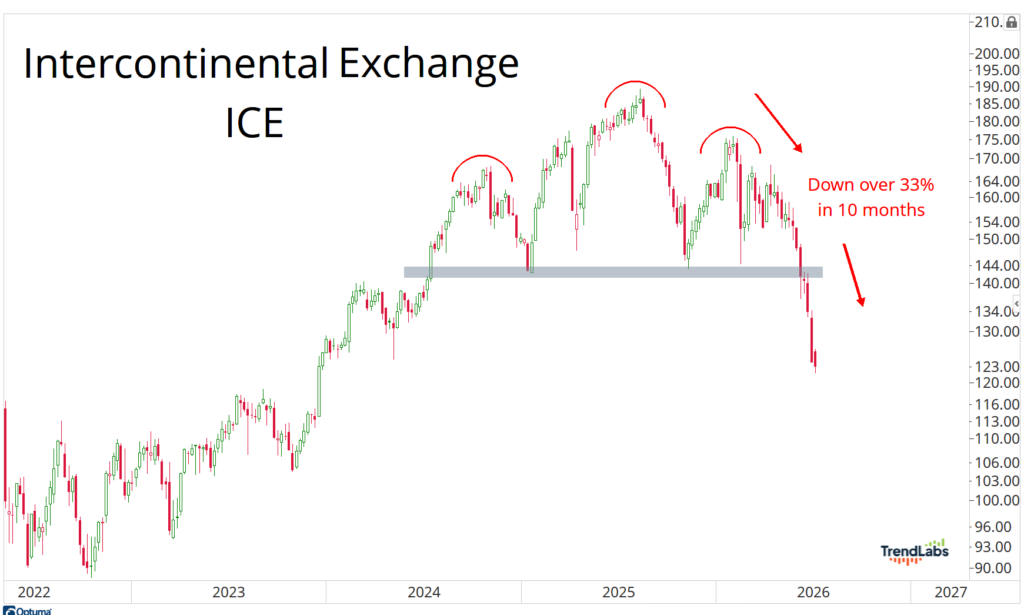
If anyone has a front-row seat to where trading is going over the next decade, it’s names like Intercontinental Exchange (ICE):
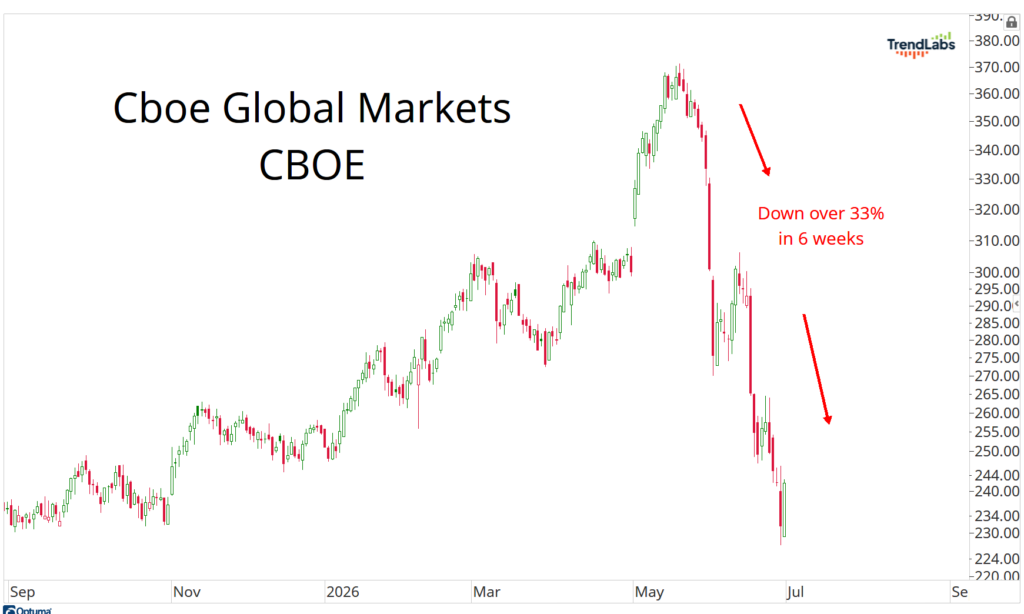
And Cboe Global Markets (CBOE):
And CME Group (CME):
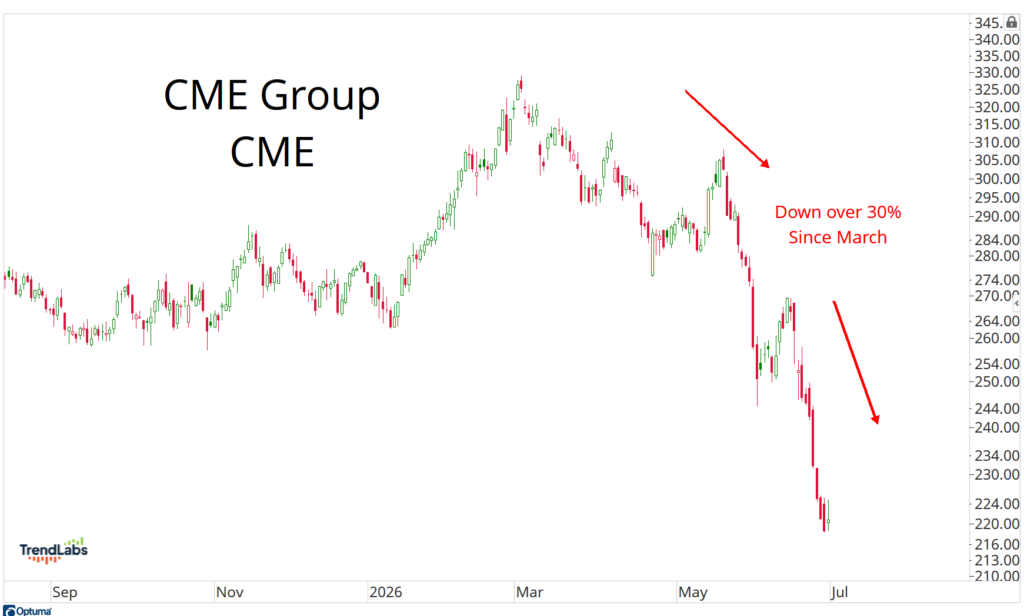
Now look at the recent destruction in those charts.
I’m not telling you they prove anything. I’m asking the question.
Is the market already pricing in a future where trading looks very different from today? A future with tokenized assets, instant settlement and markets that never close?
Or is it possible the market believes all of this is coming much faster than most investors expect?
At the same time, it’s worth paying attention to who’s embracing these ideas. This isn’t just happening inside crypto anymore.
Companies like Bank of New York Mellon (BNY) are investing in the infrastructure to make tokenized financial markets possible.
That’s why I keep coming back to the same conclusion.
Everybody spent the last 15 years arguing about whether crypto would replace Wall Street.
I think that’s backwards.
Crypto wasn’t replacing Wall Street. It was showing Wall Street what it could become.
If that’s true, we’re probably still much earlier in this transition than most investors realize.
The opportunity may not be choosing between crypto and traditional finance.
It may be recognizing that the line separating them is disappearing.
And that’s why I can’t stop watching the exchange stocks.
If tokenization arrives faster than investors expect, the companies sitting at the center of today’s financial system may be among the first places the market tells us.
Everybody keeps asking what crypto built.
I think we’re about to find out.
Stay sharp,
JC Parets, CMT
Founder, TrendLabs