I was talking to a friend of mine this week who runs a business and manages a bunch of people.
We were talking about AI and how much we’re both using it.
At this point, I use these tools every single day. So do a lot of the people around me.
Then he said something that stuck with me.
“You can tell.”
He was talking about the people on his team. He can tell who’s using AI and who isn’t.
The difference is starting to show.
And it’s not an age thing, either. Sometimes it’s the younger guys using it the most. Sometimes it’s the older guys.
From what I’m seeing, age doesn’t seem to matter much at all.
What matters is whether you’re playing with the toys.
That’s what I call them, “the toys.”
Apparently, most people still aren’t playing with them.
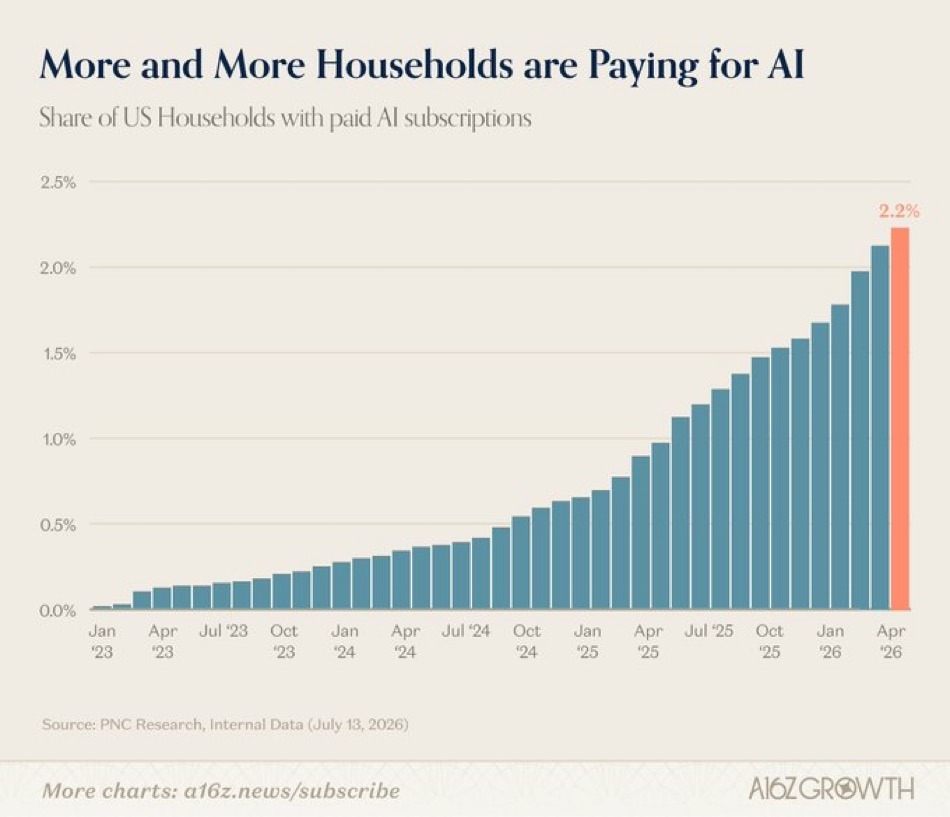
Andreessen Horowitz, or a16z, has been putting out some really good charts lately.
They have access to a ton of data, and they’ve been doing a great job visualizing it and sharing it with everybody.
This one stopped me: Only about 2.2% of U.S. households are paying for AI.
That’s crazy to me.
I understand that plenty of people are using free versions. I did that myself for a long time.
But we’re talking about a technology that could be one of the biggest changes we see in our lifetimes, and only a tiny percentage of households are willing to pay for the best versions of these tools.
Why?
I don’t think people are dumb.
I don’t think the technology is too difficult either.
In fact, that might be my favorite part about AI. If you don’t know how to use it, you can literally ask AI how to use it.
Tell it what you’re trying to accomplish.
“I want to do this. I have no idea how. Help me.”
And then start.
That’s basically what I did.
I’m Apparently a Software Developer Now
Last week I vibe-coded an MCP.
A year ago, I wouldn’t have even known what that sentence meant.
I don’t know the first thing about software development. I’m not an engineer. I never learned how to code.
I’m a market technician.
I like baseball. I like wine. I like hanging out with my family. And I like looking at markets and trying to find good ideas that can make us money.
That’s my world.
But now I’m sitting at home building a “model context protocol.”
MCP is an open standard created by Anthropic that lets AI applications and large language models connect to external data sources and tools.
I sent something I built to a friend of mine who actually is a software developer. He’s been doing this professionally for decades.
He wrote back:
“Congratulations. You’re a software developer now about as much as I’m a market technician.”
Hahaha.
Fair enough.
But that’s also the whole point.
He can build things now that used to require teams of people and huge amounts of time. And I can build things that I never would have attempted before because I wouldn’t even know where to start.
Another friend of mine has spent close to a decade working on a data visualization project.
Years of work.
Lots of frustration. Lots of development. Lots of time and money.
Earlier this year, he told me something I’ll never forget.
With AI, they accomplished in about six months what had taken them years before.
Think about that.
That’s not some theoretical prediction about what AI might do someday.
It already happened.
And this is where it gets really interesting for us as investors.
I’m using these tools to do research faster. I’m using them for idea generation.
We’re building scans. We’re organizing huge amounts of information. We’re testing things.
We’re finding connections that would have taken much longer to find before.
That doesn’t mean AI makes the investment decisions for me. That’s still my job.
But if I can look at more information, test more ideas and get to the important stuff faster, why wouldn’t I?
Imagine two investors.
They have the same experience. They work equally hard. They’re equally curious.
But one of them has tools that allow him to research ten ideas in the time it takes the other guy to research one.
Who do you think is going to see more opportunities?
That’s what matters to me.
The goal isn’t to use AI because AI is cool.
The goal is to use better tools to help us make better decisions.
The Gap Is Starting To Show
There’s a bigger lesson here that goes way beyond markets.
Think about something you’ve always wanted to build.
Maybe you didn’t know how. Or you didn’t have the money to hire someone. Maybe you thought you weren’t technical enough.
What about that idea that’s been sitting in your head for five years and you never did anything with?
Try building it now.
Seriously.
Play with the toys.
You can do an unbelievable amount of this stuff sitting on your couch with a laptop. You can do a surprising amount of it from your phone.
And you don’t need to become an AI expert.
I’m certainly not one.
I just know that there are a lot of people counting on me. My family is counting on me. My team is counting on me. And if you’re reading this, in some small way, you’re counting on me too.
My job is to go out there, find good ideas and bring a different perspective to the table.
I take that responsibility seriously.
So if there are tools that can help me do that job better, I need to learn how to use them.
And I don’t just want my team doing it for me.
I want to play with this stuff myself.
Because the more I understand the tools, the better I can communicate with the people on my team who are building with them every day.
You might say this doesn’t apply to your business.
Maybe.
But I’d challenge that assumption.
Ask the machine.
Tell it what you do all day. Tell it which parts of your job take too long. Tell it what annoys you. Tell it what you wish existed.
Then ask:
“Can you help me build something that fixes this?”
See what happens.
Because for the first time, I’m seeing the other side of this in real life.
It’s not just that the people using AI are getting faster.
The people who aren’t using it are starting to stand out.
My friend can already see it on his team.
So can I.
For traders and investors, this is an incredible new set of tools for finding ideas, doing research, and understanding markets.
For everybody else, it might be something even bigger.
It’s an opportunity to build things you never thought you could build.
You don’t have to understand how all of it works.
I certainly don’t.
Just play with the toys.
This Week in Everybody’s Wrong
On Monday, we put a simple name on something we’ve been talking about for a while.
“Inflation anxiety.”
Here’s how the thing everybody says is a headwind becomes a tailwind for stocks.
On Tuesday, we clarified a key question hanging over the market right now.
When someone says higher rates are bad for stocks, which stocks are they talking about?
On Wednesday, we broke down the war trade that didn’t work.
By the time everybody can explain why a stock should go up, the market may have already had that conversation months ago.
That’s the lesson for us as investors.
On Thursday, we talked about rising interest rates.
Yes, we may need to get used to investing in a different environment.
No, opportunities won’t disappear.
On Friday, we asked a simple question.
What does one down month for the Dow Jones Industrial Average actually mean for the stock market?
As is almost always the case, all we need is a little more context.
On Saturday, Sam Gatlin expanded on a lesson he learned from one of our mentors, Louise Yamada.
Sam studied some history, and he saw what can happen when a multi-decade base resolves higher.
Here’s looking at you, coffee futures…
Have a great Sunday.
We’ll see you Monday morning…
Stay sharp,
JC Parets, CMT
Editor, Everybody’s Wrong