
I was hanging out with John Roque this week in New York City, and he brought up something that puts all this talk about interest rates into perspective.
If you don’t know John, he worked at Soros Fund Management and was a technical analyst at Lehman Brothers before that.
He’s spent decades studying markets and their history.
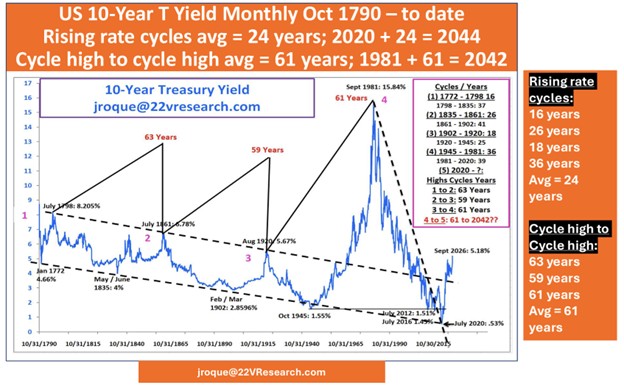
His point was simple: We could still be in a long-term rising interest rate cycle well into the 2040s.
Yes, the 2040s.
While everybody’s arguing about what the Federal Reserve might do at its next meeting, John is looking at what could happen over the next couple of decades.
He gets there by looking at how long past rising-rate cycles have lasted. Apply those historical lengths to this cycle, and the calendar can take us into the 2040s.
That’s a possibility, not an expiration date stamped on the bond market.
An average tells us what happened before. It doesn’t tell us exactly what happens next.
But it raises a question I think investors should spend more time considering:
What if the low interest rates so many people are waiting for don’t come back anytime soon?
A Whole Generation Got Used To Falling Rates
An interest rate is simply the price you pay to borrow money.
When that price falls, buying a house gets easier. Companies can borrow more cheaply to build factories, hire people, or expand their businesses.
When that price rises, the same loan costs more.
For roughly four decades, beginning in the early 1980s, the broad direction for interest rates was down.
There were plenty of increases along the way, but borrowing generally became cheaper over time.
That helped businesses and supported investment prices.
Forty years is a long time.
You could start a career, raise a family, and retire while spending almost your entire adult life in that environment.
After a while, it’s easy to assume that’s just how the world works. Rates go up for a little while, something breaks, and rates come back down.
John is asking us to consider a different possibility.
Maybe that 40-year stretch ended. Maybe we’re now living through a cycle that runs in the other direction.
That doesn’t mean rates rise every day, every year, or at every Fed meeting.
Think about walking uphill. Parts of the trail are flat. Some even take you downhill for a while.
But, an hour later, you’re still much higher than where you started.
Interest rates can fall for months, even years, within a much longer rising trend.
And the rate the Fed sets is only one rate. Longer-term borrowing costs are also shaped by investors buying and selling bonds.
A Fed rate cut doesn’t guarantee cheaper mortgages.
Stop Waiting for the Old Market To Come Back
What I take away from John’s chart is that we may need to get used to investing in a different environment.
For decades, falling interest rates helped investments along. Borrowing got cheaper.
Businesses could refinance old loans at lower rates. Buyers could afford more house with the same monthly payment.
If that long trend has reversed, we can’t count on the same help.
But rising rates don’t mean stocks have to fall for 20 years. Companies can still grow, make money and reward their shareholders.
The opportunities don’t disappear. We just might find them in different places.
That’s where I want to spend my time as an investor.
Which stocks are going up? Which industries are attracting money? Who’s doing well with borrowing costs right where they are?
If a stock keeps making new highs while everybody’s complaining about interest rates, I want to look at it.
If something I own keeps falling, “the Fed will eventually cut” isn’t a good enough reason to keep owning it.
We don’t need to know where interest rates will be in 2045 to see what’s working today.
John could be right about the next 20 years. He could be wrong.
Either way, I’d rather own the stocks that are doing well in this market than sit around waiting for the last one to come back.