
My friend Dylan Tanen showed me a chart this week that stopped me in my tracks.
It was a chart of aerospace and defense stocks.
Think companies that make military aircraft, missiles, and other equipment governments buy when they’re preparing for conflict.
If you told someone a war was about to get much bigger, buying those stocks would sound like a pretty reasonable idea.
On Saturday, February 28, the U.S. and Israel attacked Iran, and Iran’s supreme leader was killed. Iran retaliated.
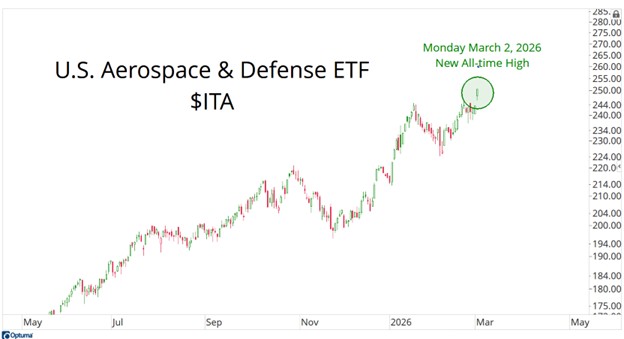
By Monday morning, the news was impossible to miss. When the stock market opened, aerospace and defense stocks jumped to new all-time highs.
That made sense on paper. War was escalating, so investors bought the companies they thought would benefit.
But take a look at what happened before that Monday. These stocks had already been climbing for months:
Investors didn’t wake up that morning and discover that trouble was brewing in the Middle East.
Plenty of them had already bought the theme.
So Who Was Left To Buy?
This is the part Dylan wanted me to see.
March 2 looked like the perfect day to own defense stocks if you were reading the news.
On the chart, it was the day they made a big jump after a long run.
Imagine hearing that a snowstorm might hit next week. You buy a generator while everyone else is still checking the forecast.
By the time the storm arrives, your neighbor wants one, too, but so does everyone on the block.
The storm is real. That doesn’t mean buying a generator at the most crowded moment is a great deal.
Markets work like that all the time.
Investors don’t wait for certainty. They buy what they think is coming. Once the event happens, the question changes.
It’s no longer, “Could this happen?” It’s, “What happens next, and who hasn’t bought already?”
The defense fund did make a brief new high during the summer, so I don’t want to pretend March 2 was its final peak.
But look at where it is now:
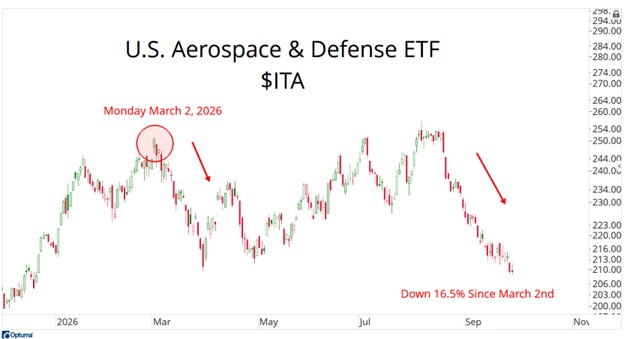
Despite all the war headlines since then, it’s about 16.5% below its March 2 level.
The Headline and the Price
There’s an old saying on Wall Street: “Buy the rumor, sell the news.” This is what it looks like in real life.
People bought defense stocks while they expected trouble. When the trouble arrived, the stocks jumped.
But the news alone couldn’t keep them going.
That doesn’t mean the war wasn’t serious, and it doesn’t mean a falling stock price tells us what will happen next in Iran.
The fighting and its human cost are real. A chart of American companies can’t tell us otherwise.
What the chart can tell us is how investors are reacting.
If the story on TV keeps getting scarier, but the stocks that are supposed to benefit aren’t going up, I want to pay attention to that.
Maybe the market expected much of it already. Maybe investors think the effects on these companies will be smaller than the headlines suggest.
We don’t know which explanation is right just from one chart.
But we do know this: “War escalates, buy defense stocks” sounded obvious on Monday, March 2.
Dylan’s chart shows why the obvious trade is worth checking before you make it.
By the time everybody can explain why a stock should go up, the market may have already had that conversation months ago.
That’s the lesson for us as investors.
Don’t just ask what the headline means. Ask what the market is doing with the headline.
If supposedly great news can’t make something go up, or supposedly terrible news can’t make it go down, that’s information.
Sometimes, the reaction to the news tells us a lot more than the news itself.