
For the past few years, investors have been obsessed with interest rates.
The Federal Reserve raised rates. Treasury yields jumped. Borrowing became more expensive.
And the assumption was pretty simple: Higher interest rates = bad for companies.
That makes sense.
If it costs companies more money to borrow, they have less money left over for everything else.
Except there’s a problem. That’s not what actually happened.
This chart from the Financial Times stopped me in my tracks:
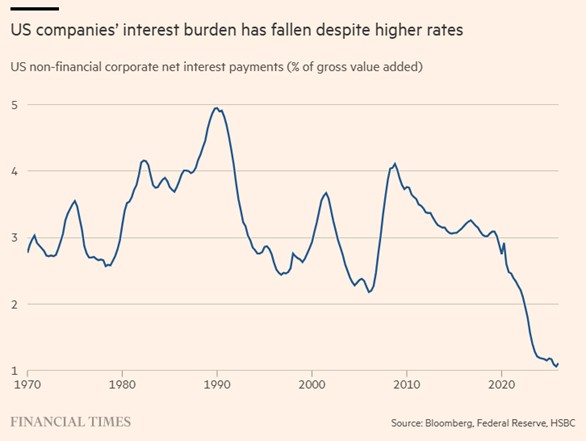
It shows net interest payments for U.S. non-financial companies as a percentage of the value they produce.
Despite the biggest increase in interest rates in decades, the interest burden on corporate America has collapsed to around the lowest level in the history of the data.
How is that possible?
Companies Borrowed When Money Was Cheap
Think about buying a house in 2021. Maybe you got a 30-year mortgage at 3%.
Then interest rates went through the roof. Mortgage rates went to 6%. Then 7%.
But what happened to your mortgage payment?
Nothing. You still had your 3% loan.
Corporate America did basically the same thing.
Companies borrowed enormous amounts of money when interest rates were near zero. Much of that debt came with fixed interest rates.
So when the Fed started raising rates in 2022, companies didn’t suddenly start paying today’s rates on all their old debt.
They kept paying the rates they’d already locked in.
The Fed has estimated that roughly 80% of the outstanding debt of publicly traded U.S. non-financial companies is fixed-rate.
But that’s only half the story.
Here’s where it gets interesting.
While companies were still paying yesterday’s low interest rates, they suddenly started earning today’s high interest rates.
Imagine a company borrowed $10 billion at 3%.
That’s $300 million a year in interest expense.
But suppose the company also has $5 billion sitting in cash and short-term investments.
When interest rates were near zero, that cash earned almost nothing.
Now, imagine it’s earning 5%. That’s $250 million a year coming back the other way.
The company pays $300 million in interest and collects $250 million.
Its net interest expense is only $50 million.
Higher interest rates actually helped.
That’s the important word in this chart.
Net.
Not Everyone Is Living in the Same World
This doesn’t mean high interest rates are good for every company.
Far from it.
A company with tons of cash and old fixed-rate debt is in a different position from a company that constantly needs to borrow money.
The first company might have debt costing 3%, while its cash earns 5%.
That’s a beautiful situation.
The second company might have floating-rate loans or debt coming due that needs to be refinanced.
Its old 3% loan might become a 6% loan.
That’s not so beautiful.
Eventually, some of that cheap debt Corporate America borrowed years ago will mature.
Companies will have to refinance it.
If rates are still much higher when that happens, their interest costs can rise even if the Federal Reserve doesn’t raise rates another penny.
That’s why higher rates can take years to work their way through the economy.
There’s another piece of this, too.
Corporate America has continued to grow.
This chart isn’t simply measuring the number of dollars companies spend on interest.
It’s comparing net interest payments with the value companies produce.
So if corporate income grows faster than interest expense, the burden gets smaller.
Put all of those things together, and you get the chart above.
Interest rates soared. The interest burden collapsed.
What This Means for Investors
This is where the chart becomes useful.
We spend a lot of time talking about interest rates as if there’s one rate that hits every company equally.
There isn’t.
A company with billions of dollars in cash and long-term debt locked in at 3% can live comfortably in a 5% interest-rate world.
It might even benefit from it.
Meanwhile, a company with a lot of floating-rate debt or a wall of maturities coming due could be in real trouble in that same environment.
That means the level of interest rates isn’t nearly as important as the exposure to those rates.
And that exposure is different for every company.
So, when someone says higher rates are bad for stocks, that doesn’t really tell us much.
Which stocks?
Which companies actually need to refinance? Which companies locked in cheap money years ago?
Which ones are sitting on piles of cash earning more interest than ever?
Those are the questions that matter.
And this chart tells us something even bigger about the market today.
Corporate America, as a whole, has handled higher rates remarkably well.
Interest rates went up dramatically, yet the net interest burden fell to one of the lowest levels we’ve ever seen.
That’s not a theory. That’s what happened.
Eventually, more of that cheap debt will mature. If rates stay high, refinancing could become a bigger problem.
But that’s something to watch for in the future.
It isn’t what the data is telling us today.
Right now, the remarkable part isn’t how high interest rates are.
It’s how little corporate America is paying for them.