
There are certain phrases that just make sense the first time you hear them.
“Inflation anxiety” is one of them.
Piper Sandler Chief Investment Strategist Michael Kantro has been using that phrase to describe something interesting happening in the stock market.
His point is pretty simple: Stocks are scared of higher interest rates again.
That wasn’t always the case.
For much of the past few decades, falling interest rates could actually be a warning sign.
Rates often fell when the economy was getting into trouble. People were losing jobs, companies were making less money, and investors were getting nervous.
The Federal Reserve would lower interest rates to try to help.
So, when rates were going up, that could actually be good news. It might mean the economy was doing well.
But that relationship has changed.
Since around 2022, when the yield on the 10-year Treasury has gone up, the average stock has tended to struggle. When that yield has come down, stocks have breathed a little easier.
Kantro calls this “inflation anxiety”:
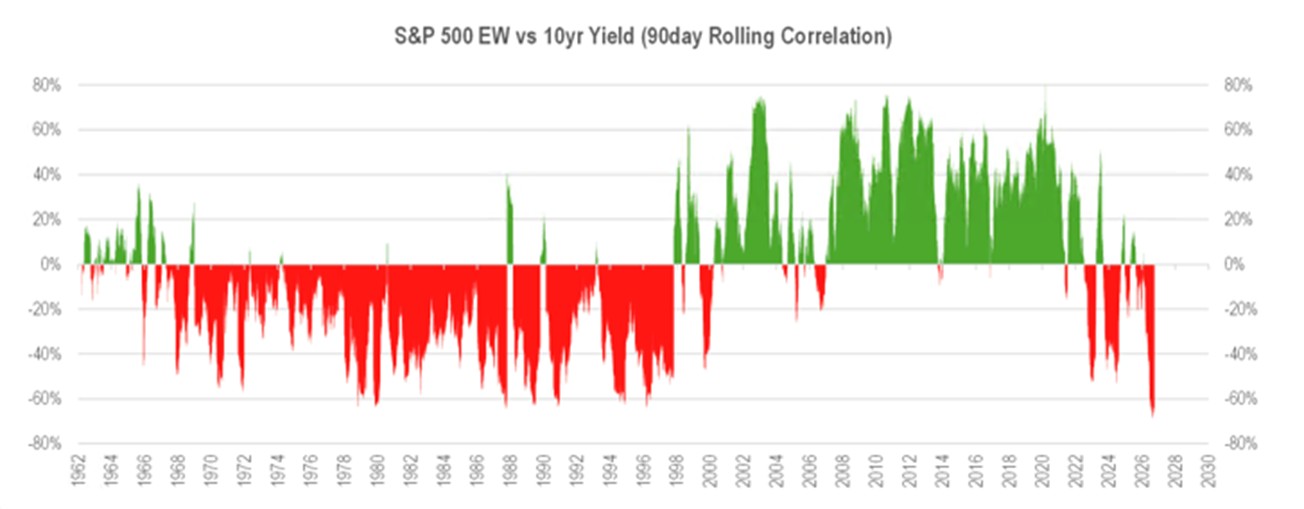
This chart might look complicated, but it really isn’t.
It’s just asking one question: Are stocks and interest rates moving together, or are they moving in opposite directions?
Green means they were generally moving together. Red means they were generally moving opposite each other.
Look at all that red from the 1960s through the 1990s. Then look at all the green during much of the 2000s and 2010s.
Now we’re seeing a lot more red again.
The market has changed.
We’ve Been Talking About This
I love the phrase “inflation anxiety” because it puts a simple name on something we’ve been talking about around here for a while.
Earlier this year, I wrote The 60/40 Portfolio Died Years Ago.
The basic idea behind 60/40 is that stocks and bonds are “supposed to” do different jobs. Stocks are there to help you grow your money. Bonds are supposed to provide some protection when stocks get into trouble.
For decades, investors got very comfortable with that relationship.
The problem is that markets don’t care what your financial advisor’s brochure says.
In 2022, stocks got crushed and bonds got crushed at the same time. The thing that was supposed to protect you was going down right alongside the thing it was supposed to protect you from.
And as I wrote again in Your 60/40 Portfolio Is Now Just 100, when stocks and bonds start moving together, owning both doesn’t necessarily give you the diversification you thought you were getting.
That’s why this relationship between stocks and interest rates matters so much.
Kantro’s inflation anxiety is another way of seeing the same change we’ve been watching.
Higher rates aren’t simply a sign that the economy is doing well anymore.
When investors start worrying that rates are rising because inflation is sticking around, stocks can have a problem, too.
And here’s my favorite part: The phrase “inflation anxiety” isn’t even new.
The 1972 Economic Report of the President actually used the term “inflation-anxiety” when discussing consumers and businesses.
Funny. What was happening then?
Richard Nixon was in the White House, and inflation had become a major problem.
The United States had recently stopped letting people exchange dollars for gold at a fixed price, and the president had even imposed a 90-day freeze on wages and prices.
Imagine that. Your grocery store wants to raise the price of milk and the government basically says, “Nope.”
The government hoped these policies would reduce what it called the “inflation-anxiety of consumers and businessmen.”
More than half a century later, we’re talking about inflation anxiety again.
The circumstances aren’t identical. They never are.
But markets have long memories.
Watch the Bond Market
So what are we supposed to do with this?
Fortunately, we don’t need an economics degree. We don’t need to predict next month’s inflation report or spend our mornings staring at business television on basic cable.
We can just watch the market.
If this inflation anxiety regime is really back, one of the most important numbers to watch is the yield on the 10-year U.S. Treasury bond.
Think of it as one giant interest-rate thermometer.
When that number keeps rising, investors start asking why.
Maybe inflation isn’t going away. Maybe interest rates need to stay higher for longer.
Maybe the bond market is telling us something the Fed hasn’t admitted to yet.
Higher rates also make money more expensive. Mortgages cost more. Car loans cost more. Business loans cost more.
Companies have to pay more to borrow, and investors become less willing to pay high prices for profits that might not arrive until years from now.
This gets us right back to the 60/40 problem we’ve been discussing.
If stocks are falling because rates are rising, bonds may not be the life raft investors expect. Rising yields mean falling bond prices.
So the same thing hurting your stocks can also be hurting the part of your portfolio that was supposed to protect you.
That’s a different world from the one investors got used to during much of the 2000s and 2010s.
Trillions of dollars have been allocated under the assumption that stocks provide growth while bonds provide protection.
What I’m Watching Now
This is why I’m watching Treasury bonds so closely right now.
Here’s TLT, the ETF that tracks long-term U.S. Treasury bonds:
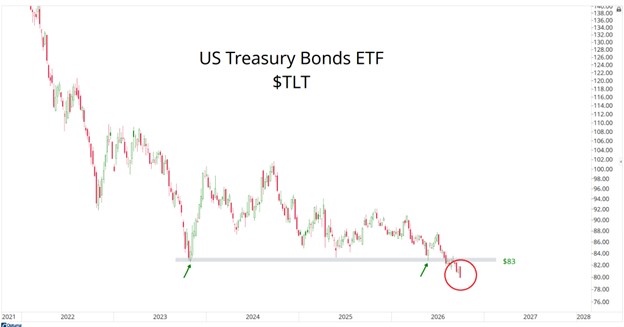
There’s an important level on this chart that I think could tell us a lot about what comes next.
Remember, bond prices and bond yields move in opposite directions. So if TLT starts breaking higher, long-term interest rates are likely moving lower.
Based on the relationship we just looked at, that could take some of the pressure off stocks.
If bonds can get back above this level and stay there, I think it could help spark another leg higher in the stock market.
And what if the thing everyone keeps telling us is a headwind for stocks actually turns into a tailwind?
Of course, the opposite matters, too.
If TLT stays below this level for an extended period, that means long-term bond prices remain under pressure and yields remain elevated.
In the Inflation Anxiety environment we’ve been discussing, that could become a bigger problem for stocks.
That’s what makes this chart so useful.
I don’t need to predict inflation. I don’t need to guess what the Fed is going to do.
And I certainly don’t need to argue with economists about where interest rates should be.
I can watch the bond market and let it tell me.
But there’s an important catch: Falling interest rates aren’t always good, either.
If rates are falling because inflation is cooling down, great. If rates are falling because the economy is falling apart, that’s a different story.
That’s why we never want to look at just one number.
Still, this relationship is telling us something important: The stock market isn’t always afraid of the same monster.
For much of the 2000s and 2010s, the monster under the bed was a weak economy. Investors worried about recessions, unemployment, and companies making less money.
Today, inflation and higher interest rates are getting a lot more attention.
Funny enough, they had a name for that in 1972.
“Inflation anxiety.”
More than half a century later, the name still fits.