
Founder’s Note: Sam Gatlin continues to validate all the long-term promise he shows because he just keeps learning, and he just keeps delivering.
His contributions to our community will only grow over time, we’re grateful to have him here, and we look forward to seeing what comes next.
Here’s Sam with a meaningful tribute to one of our mentors. – JC
By Sam Gatlin
I had the privilege of spending time this week with Louise Yamada, one of the greatest technical analysts to ever walk God’s green earth.
Louise has done pioneering work in this industry for decades, and she remains one of the sharpest market minds I’ve ever encountered.
But what stood out to me most was her respect for history.
Louise has stacks of old charts, many of them hand-drawn, showing patterns from decades ago.
She studies them the way historians study old letters, maps, and battlefields.
That’s one of the most underrated parts of technical analysis.
We’re studying history, psychology, supply, demand, and the repeating behavior of human beings across multiple timeframes.
Markets Are Fractal
The same patterns show up on quarterly, monthly, weekly, daily, hourly, and even one-minute charts.
The timeframe changes, but the battle between buyers and sellers doesn’t.
That’s why history matters, and nobody understands that better than Louise.

One of my favorite Louise Yamada quotes is “the bigger the base, the higher in space.”
That may sound like a cute Wall Street phrase, but it’s also one of the most powerful ideas in technical analysis.
When an asset spends years, or even decades, building a massive base, the eventual breakout can produce a move that most investors aren’t prepared for.
Micron Technology (MU) is a perfect example.
MU peaked during the .com bubble in 2000, then spent roughly 25 years going nowhere.
It rallied, failed, rallied again, failed again, and frustrated investors for more than two decades.
Then it finally broke out:
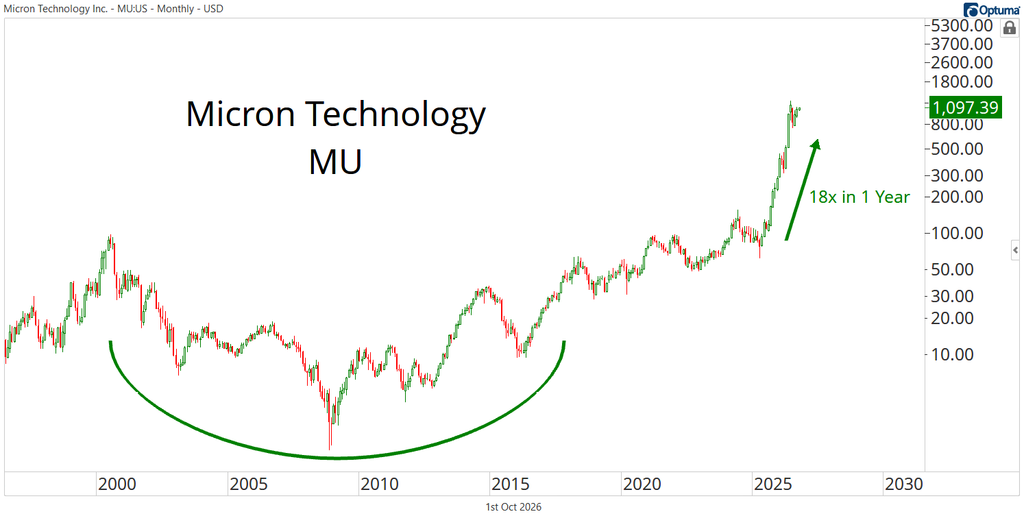
Once Micron resolved that massive 25-year base, the stock rallied roughly 18x in a single year.
Eighteen times your money.
In one year.
That’s hard to overstate.
Micron became a trillion-dollar company and one of the most important players in the AI revolution.
But the chart told the story before the narrative did.
The base was there all along…
You just had to respect what history was showing you.
Coffee Is Percolating
That brings me to coffee futures, where price peaked near $3.40 per pound in 1977, 1997, and 2011.
For nearly half a century, that area has acted like a ceiling.
Now, price is flirting with a major breakout:
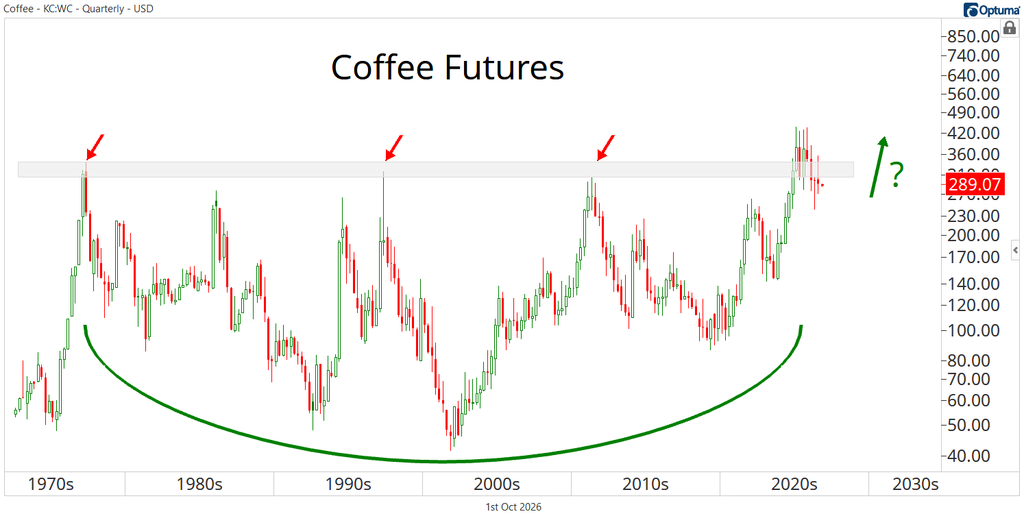
Coffee recently tried to break out to new all-time highs, and while the move has stalled a bit, the bigger picture remains incredibly compelling.
This is a multi-decade structure that’s been building since the 1970s.
That doesn’t guarantee a breakout.
Nothing does.
But when a commodity spends almost 50 years building pressure beneath the same major level, you have to respect the possibility that something much larger is developing.
If coffee resolves higher, I believe it’ll move much further than most people expect.
Because that’s what big bases do.
Stay safe out there,
Sam Gatlin
Analyst, Everybody’s Wrong