
Something interesting happened in the stock market this month.
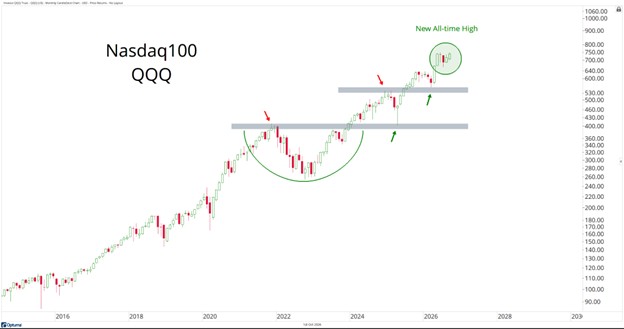
The Nasdaq-100 closed at a new all-time high.
Technology stocks are still doing their thing. No down month there. No breakdown.
Just another record high:
Underneath the surface, things looked a little different.
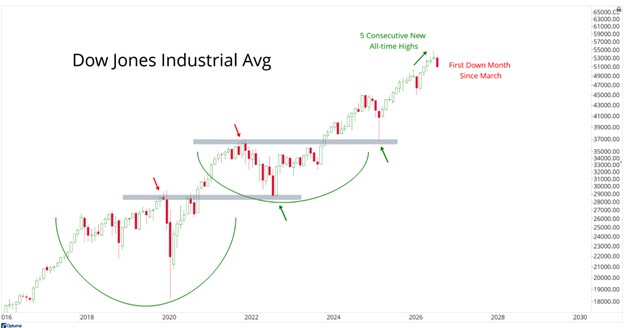
The Dow Jones Industrial Average had made a new all-time high five months in a row. This month, that streak ended.
The Dow had its first down month since March:
Meanwhile, the average stock in the S&P 500 tells a similar story.
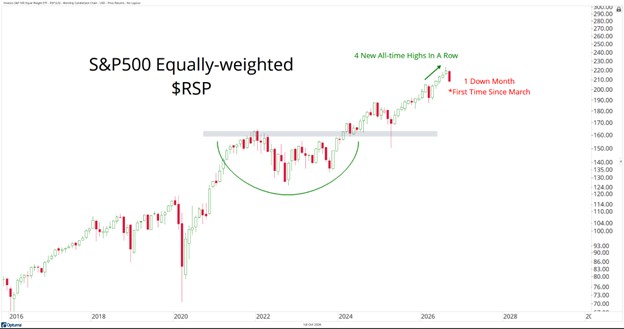
One way we measure the “average stock” is with the equally weighted S&P 500.
Instead of letting the biggest companies like Apple (AAPL), Microsoft (MSFT), and Nvidia (NVDA) have the most influence, this index gives all 500 stocks the same weight.
That index had made new all-time highs four months in a row. This month, it didn’t.
For the first time since March, the average S&P 500 stock had a down month:
And people are already scared.
More than half of individual investors say they expect stocks to be lower six months from now. At the same time, money has been pouring into cash and cash-like ETFs.
Investors aren’t just saying they’re nervous. Some of them are moving their money like they’re nervous, too.
That’s what makes this so interesting to me.
The Nasdaq-100 is literally sitting at an all-time high. The Dow just finished a five-month streak of new all-time highs. The average S&P 500 stock just finished a four-month streak of new all-time highs.
Then we get one down month in the Dow and the average stock.
And fear shows up fast.
So I think it’s worth asking a simple question:
What does one down month actually mean?
Every Bear Market Starts Somewhere
Here’s the tricky part.
Every bear market starts with one down month. Every major stock market crash starts with one down month, too.
Before you can have two down months, you need one. Before you can have six, you need one. Before stocks can fall 30%, they have to fall 3%.
So I’m not suggesting we should ignore weakness just because it’s only been one month.
This could be the beginning of something bigger.
But there’s another side to this.
While every bear market begins with a down month, most down months don’t become bear markets.
That’s an important difference.
Think about rain.
Every hurricane comes with rain. But that doesn’t mean every time it rains you should board up the windows.
Sometimes, it just rains.
Markets work the same way.
Stocks go up and stocks go down. Even during some of the strongest bull markets in history, there are bad days, bad weeks and bad months along the way.
We tend to forget that after stocks have been going up for a while.
Five straight months of record closes in the Dow starts to feel normal.
Four straight months of historic new highs for the average S&P 500 stock starts to feel normal.
Then you get one red candle and everybody’s wondering if something’s wrong.
Maybe something is wrong.
But one month isn’t enough evidence for me to know that yet.
Whenever in Doubt, Zoom Out
One of the most useful things we can do as investors is zoom out.
Whenever in doubt, zoom out.
Look at those three charts again.
The Nasdaq-100 just closed at a new all-time high.
The Dow just had five consecutive months of new all-time highs before finally having a down month.
The average S&P 500 stock just had four consecutive months of new all-time highs before finally having a down month.
That’s the context.
Now, if this one down month becomes two, then three, while fewer stocks are participating and important trends start breaking, that’s new information.
I want to see it.
If investors start dumping the riskiest stocks, I want to see it. If credit markets start showing real stress, I want to see that, too.
If more and more stocks start breaking down underneath the surface, that’s evidence we can use.
If those things don’t happen, that’s information, too.
I’m not married to either outcome.
This one down month could eventually turn into something much worse. Every bear market has to start somewhere.
But I don’t see a reason to turn one down month into 20 down months in our heads before the market actually gives us the evidence.
That’s especially true when the Nasdaq-100 is still making new all-time highs.
That’s really the part that interests me here.
After five straight months of new highs in the Dow and four straight months of new highs in the average S&P 500 stock, it only took one down month for fear to come rushing back.
More than half of individual investors are bearish. Money is moving toward cash.
Maybe they’re right. Maybe this is the beginning of something much bigger.
Or maybe one down month is exactly that.
One down month.