
I know. Bonds are boring.
I’d rather talk about stocks making new highs, Bitcoin ripping, or some company nobody has ever heard of doubling in three weeks.
But every once in a while, the bond market tells us something important about stocks.
Right now, there’s something weird happening in junk bonds that I think is worth understanding.
Don’t worry. You don’t need to know anything about bonds.
I’m going to make this easy.
When companies borrow money, they don’t all pay the same interest rate.
A huge, healthy company with plenty of cash can borrow pretty cheaply. A struggling company buried in debt has to pay a lot more.
Makes sense.
If your brother-in-law has a great job, owns his house and asks to borrow $1,000, you might not be too worried about getting your money back.
If your other brother-in-law is unemployed, owes everyone money, and wants $1,000 because he has a “can’t-miss business opportunity,” you’re probably going to have some questions.
The bond market works the same way.
Companies are graded based on how likely they are to pay back their debts.
Once we get into the junk-bond market, BB is the better stuff. B is worse. CCC is the really crappy stuff.
And something fascinating is happening between them:
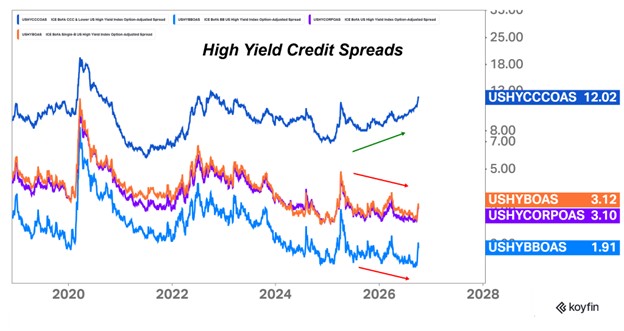
That dark blue line is CCC-rated debt. Those are the weakest borrowers.
And look at what’s happening.
The interest-rate premium investors are demanding to lend to CCC companies has climbed to about 12 percentage points above Treasuries.
Meanwhile, B-rated bonds are around 3%. BB bonds are below 2%.
That’s a massive difference.
The bond market is basically saying the following…
We’re perfectly happy lending money to decent companies.
But if your balance sheet looks like a dumpster fire, it’s going to cost you.
And that’s the distinction that matters the most.
Not All Junk Is Created Equal
Here’s the part that keeps getting lost in the conversation.
The entire U.S. junk bond market is roughly $2.2 trillion.
About $1.25 trillion of that is BB-rated debt. Another roughly $750 billion is rated B.
CCC and below? About $193 billion.
That’s it.
The part of the junk bond market everybody’s freaking out about represents less than 10% of the whole thing.
Meanwhile, the other 90% — nearly $2 trillion worth of junk bonds — is behaving very differently.
This is the important part.
Because if this were really a broad credit event, you’d expect the stress to spread.
You’d expect B spreads to start blowing out, too. You’d expect BBs to get hit.
You’d expect investors to start demanding significantly more yield across the entire high-yield complex.
That’s not what we’re seeing.
Right now, the real stress is concentrated among the worst borrowers in America.
And you can see the same thing when you look inside HYG, one of the largest high-yield bond ETFs in the world.
Most of HYG isn’t CCC debt. It’s BBs and Bs.
Here’s what the spread between HYG and the equivalent Treasury securities ETF looks like:
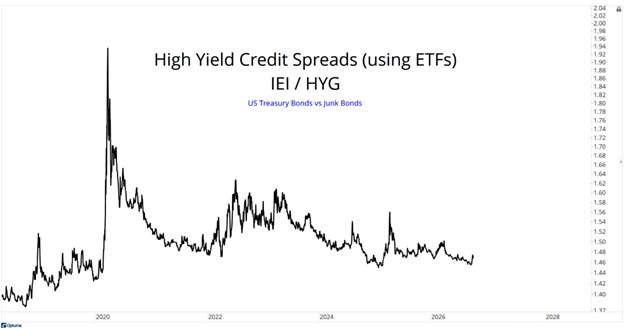
Nothing.
So when someone throws a chart of CCC spreads on your screen and tells you the credit market is sounding the alarm, remember what you’re actually looking at.
You’re looking at the riskiest little corner of a roughly $2.2 trillion market.
Could that be the first domino? Absolutely.
But if it is, the rest of the junk bond market hasn’t gotten the memo yet.
Watch the Next Domino
This brings us to the chart I’m most interested in.
I want to compare CCC spreads directly with B spreads:
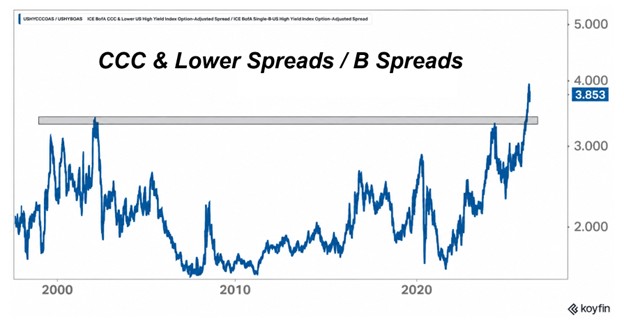
The higher this ratio goes, the more the bond market is separating the truly crappy borrowers from the merely crappy borrowers.
And that gap has become enormous.
This is what I want you to remember: CCC is the first domino.
Of course the weakest companies should have problems first. That’s why they’re rated CCC in the first place.
The question isn’t whether CCC spreads are rising.
The question is, who’s next?
I’m watching B.
If CCC spreads keep climbing while B stays around 3% and BB stays around 2%, I’m not losing much sleep over it.
The bond market is basically telling us that bad companies are having a bad time.
Thank you, Captain Obvious.
But if B starts breaking higher too? Now I’m paying attention.
And if BB follows? Now I’m paying a lot more attention.
Because the problem would be moving from the weakest borrowers into the much larger part of the junk-bond market.
“CCC → B → BB” is the progression I’m watching.
And if it never happens? That’s information, too.
Maybe the message from credit isn’t that the economy is falling apart.
Maybe the message is that investors have become much better at separating the winners from the losers.
That’s what markets are supposed to do.
So, yes, I’m a stock guy talking about junk bonds.
I know. Try to contain your excitement.
But stocks don’t live on an island.
Credit markets are one of the places I look for confirmation that what we’re seeing in equities makes sense.
Right now, the weakest borrowers are screaming. But the rest of the credit market isn’t screaming with them.
Until that changes, I think that’s the most important part of the story.