Founder’s Note: Jason Perz is back with an update on what might be the biggest story in the market right now.
Interest rates at the long end of the maturity curve are rising, fast, and everybody’s getting nervous.
Not Jason… – JC
By Jason Perz
A few weeks ago, I wrote about a simple idea:
The basic premise was that when a financial system accumulates enough debt, policymakers eventually face an ugly choice.
Allow the system to deleverage. Or keep finding ways to inflate it.
History tells us which option governments usually prefer.
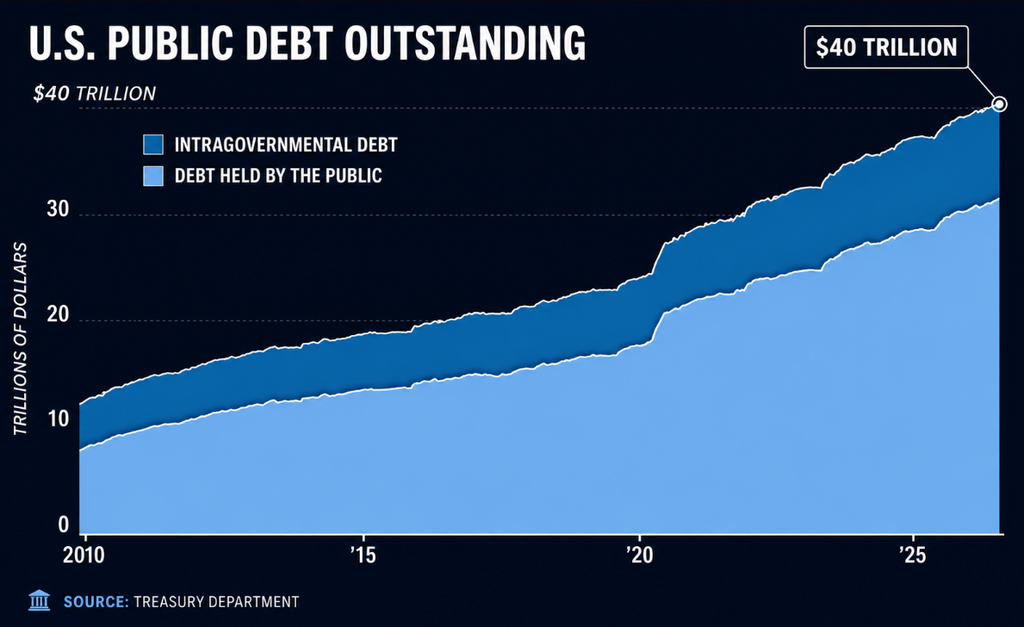
This week, we crossed another milestone. U.S. public debt has now reached $40 trillion:
Don’t overcomplicate it. Don’t make it political.
Just look at the direction: Up and to the right.
The Treasury’s own data tracks total outstanding federal debt daily, including both debt held by the public and intragovernmental holdings.
The question isn’t whether $40 trillion is a big number. Of course it is.
The more interesting question is this…
How do you ever pay it back?
You Don’t Have to Default
There are two ways to default on someone.
You can refuse to give them their dollars back. Or you can give them their dollars back after destroying what those dollars can buy.
The second method is considerably more politically convenient.
This is why I believe inflation is not some temporary phenomenon that policymakers will eventually defeat and that we’ll all go back to the world we knew before 2020.
Inflation is part of the solution to the debt problem.
Not hyperinflation tomorrow.
Not wheelbarrows of dollars next year.
But a persistent incentive to make tomorrow’s dollar worth less than today’s dollar.
Because the debt is denominated in dollars.
And if the value of those dollars falls, the real value of the debt falls with it.
History has already shown us what the extreme version looks like.
The Weimar Lesson
Everyone has seen the photographs from Weimar Germany.
People carrying stacks of cash:
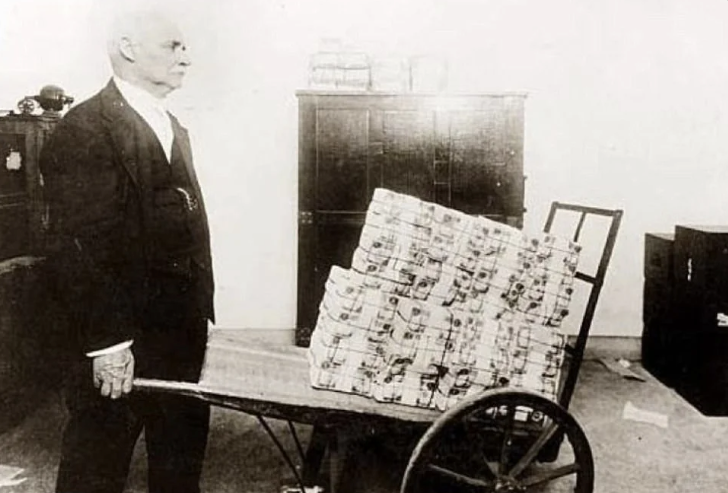
Prices changing throughout the day.
Workers rushing to spend their wages before the money lost even more value.
By 1923, Germany’s currency had essentially stopped functioning as money.
But there is another part of the story that doesn’t get talked about nearly as much.
The inflation annihilated Germany’s domestic debt.
Germany entered the period carrying enormous debts from World War I.
The government increasingly borrowed from the Reichsbank, which created more money to finance the government while the supply of actual goods failed to keep pace.
Eventually the process became reflexive.
People didn’t want the money anymore. They wanted things, like food, coal, and land. Anything tangible.
That is the moment inflation becomes something much more dangerous.
The Bundesbank estimates that Germany’s 154 billion marks of war debt had been reduced through inflation to the equivalent of just 15.4 pfennigs by the introduction of the Rentenmark.
Think about that.
The debt wasn’t magically paid through some incredible explosion in German productivity.
The currency the debt was denominated in was destroyed.
The International Monetary Fund (IMF) describes the result even more directly: the hyperinflation effectively defaulted on virtually all of Germany’s domestic debt.
Foreign obligations and reparations were another matter, which is an important distinction.
Creditors got destroyed. Debtors escaped.
And the biggest debtor of them all was the government.
Cash Is Supposed To Feel Safe
This is the part I find philosophically interesting.
We are conditioned from childhood to think of cash as safety.
Save your money. Put some away. Don’t spend it all.
And those are perfectly reasonable lessons.
But over a long enough period, there’s a strange contradiction.
Cash is one of the few assets guaranteed to lose purchasing power over time.
Your house can become more valuable. A farm can become more valuable.
Stocks can become more valuable.
Gold can become more valuable. Copper can become more valuable. Oil can become more valuable.
The dollars sitting in your pocket?
The entire monetary system is designed around them buying a little less over time.
And when governments become extraordinarily indebted, that incentive becomes even stronger.
Which brings me to gold miners.
They spent more than a decade going nowhere.
The VanEck Gold Miners ETF (GDX) peaked around this same area in 2011:
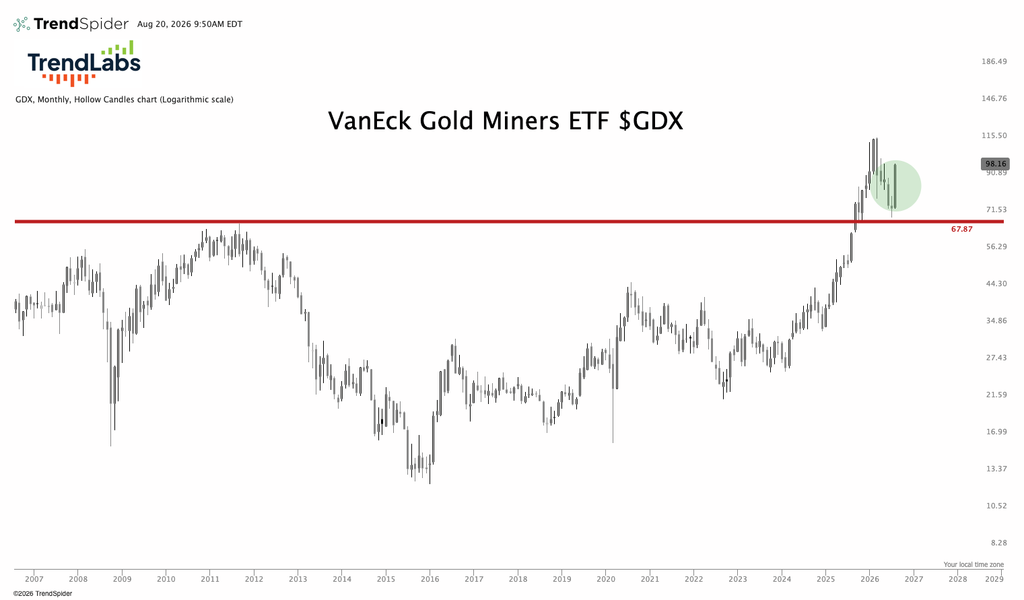
Then came a brutal bear market.
Years of disappointment. Years of investors wanting absolutely nothing to do with the sector.
Then something changed. GDX finally broke through that enormous long-term level around $68.
Now the sector is exploding higher.
Gold miners are already up more than 30% this month, and we’re only 14 trading days into August.
That isn’t something I want to ignore.
Markets have a funny way of figuring things out before economists do.
Gold doesn’t need to read a CPI report.
Gold miners don’t need to watch a Fed press conference.
Price knows.
And right now, one of the most tangible sectors in the entire market is screaming higher.
If It’s in the Ground, We Need It
This is why I keep coming back to real things.
Gold. Silver. Copper. Oil. Natural gas. Uranium. Agriculture. Land. Infrastructure.
Businesses that produce things civilization physically cannot function without.
If it’s in the ground, we need it.
You can’t print another copper deposit. You can’t create an oil field with a keystroke.
You can’t manufacture another acre of land at an FOMC meeting.
That’s what makes the coming decades so interesting.
We have built a financial system containing enormous quantities of paper claims against a world containing a finite quantity of real things.
And now the pile of claims keeps growing: $20 trillion… $30 trillion… $40 trillion…
Something eventually has to adjust.
Maybe that adjustment happens slowly through years of persistent inflation.
Maybe financial repression keeps interest rates below inflation for extended periods.
Maybe nominal economic growth does some of the work.
Maybe, at some point far down the road, confidence in the currency itself becomes the problem.
I don’t know.
Thankfully, as a trader, I don’t have to know.
Own Things
I am not predicting Weimar America.
That’s not the point.
The lesson of Weimar isn’t that every indebted country eventually experiences hyperinflation.
The lesson is what happens when the credibility of money begins to break.
People stop wanting claims on things.
They start wanting the things themselves.
That’s the transition I care about.
And it’s why, over the long run, I’d rather own productive businesses, commodities, land, metals, and other scarce assets than sit on an ever-growing pile of currency.
There will be corrections. There will be crashes.
Gold miners will get smoked sometimes.
Commodities will have vicious bear markets.
Nothing goes straight up.
But zoom the chart out far enough and remember what we’re actually measuring these assets in.
Dollars.
Your house doesn’t necessarily become twice as useful because its price doubles.
Sometimes the measuring stick simply became worth less.
That’s the game.
And if the government has $40 trillion worth of promises denominated in that measuring stick, we should at least consider which direction the incentives point.
The shadows are always convincing.
Until you step into the light.
Own real things.
Save the bees,
Jason Perz
Senior Analyst, TrendLabs