
Founder’s Note: Jason Perz is back with another look at price stability.
In fact, it’s “price instability,” as you’ll learn below.
That’s not necessarily bad news for people who are well positioned… – JC
By Jason Perz
The Federal Reserve didn’t raise rates this week. It didn’t cut them, either.
Instead, the Fed did something almost more important. It reminded the market that inflation remains public enemy No. 1.
Kevin Warsh’s second meeting as Fed chair ended with rates unchanged at 3.50% to 3.75%.
But the message couldn’t have been much clearer: Inflation is still too high.
Rate cuts are off the table, and if inflation refuses to cooperate, the next move is likely higher.
Stocks sold off. The dollar rallied. Two-year Treasury yields jumped as traders quickly priced in another hike before year end.
On the surface, this looks like a hawkish central bank.
But every time I hear a Fed chair talk about fighting inflation, I think back to Richard Russell’s famous line: “Inflate or die.”
For decades, that’s been the real choice facing every central bank.
Debt based economies need inflation. Governments owe too much money. Consumers borrow. Businesses borrow.
Entire financial systems have been built around the assumption that tomorrow’s dollars will be worth slightly less than today’s.
Inflation quietly reduces the real burden of debt.
Deflation does exactly the opposite.
It makes debt heavier.
That’s why central banks almost always tolerate more inflation than investors think they will.
Until they can’t.
Eventually inflation becomes the larger threat. Confidence in the currency begins to matter more than supporting economic growth.
That’s when central banks have no choice but to tighten financial conditions, even if it means slowing the economy.
History has shown us that these moments are rare.
But they matter.
The question isn’t whether the Fed wants inflation.
The question is whether it’s reached the point where it can no longer tolerate it.
Forget the Press Conference. Follow the Money.
Every Fed meeting creates a new narrative. Every press conference gives investors something new to argue about.
But markets don’t move because of what central bankers say. They move because of where capital flows.
The chart below has quietly become one of my favorite macro charts:
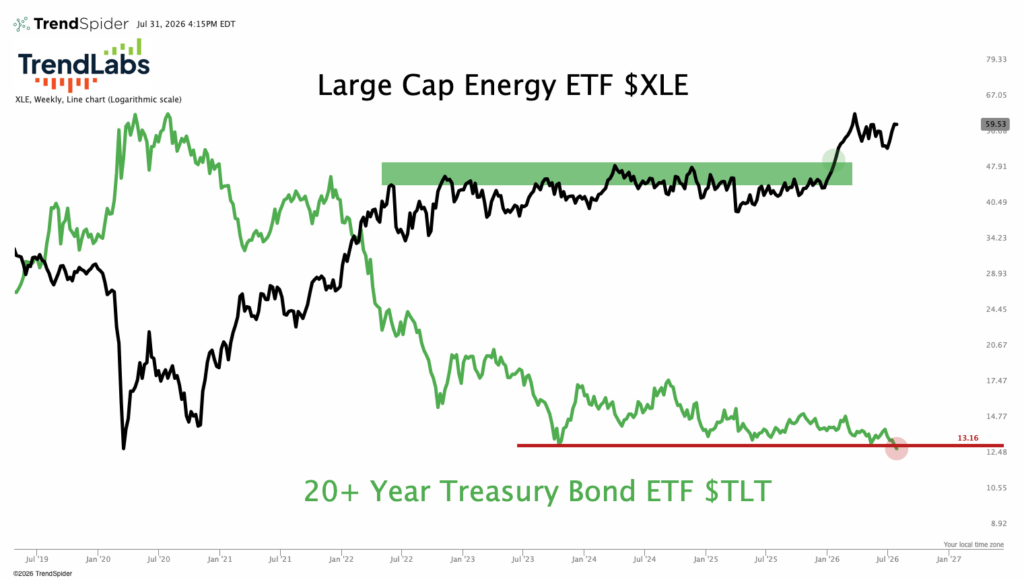
On the top is XLE, the Energy Select Sector ETF. On the bottom is TLT, the 20+ Year Treasury Bond ETF.
Notice what happened earlier this year.
While everybody was debating whether inflation had finally been defeated, energy stocks quietly broke out to new highs.
Institutions weren’t hiding in defensive assets. They were buying one of the most inflation-sensitive sectors in the market.
At the same time, Treasury bonds stopped responding to every bullish headline.
Instead of rallying, they simply churned sideways.
Now they’re doing what I suspected they eventually would: They’re breaking down.
That relationship isn’t random.
It’s exactly what you’d expect during a structural inflationary environment.
As investors demand higher yields to own long duration bonds, bond prices fall. That’s exactly what we’re seeing in TLT.
Meanwhile, many of the companies inside XLE benefit from that same backdrop.
Higher commodity prices, stronger cash flows, and an economy still generating enough demand to support elevated energy prices.
One market is discounting persistent inflation. The other is discounting the end of the long bond bull market.
They’re telling the same story from opposite directions.
Price Pays. Opinions Don’t.
Richard Russell believed the Fed would always choose inflation over deflation until it no longer had a choice.
I think that chart captures the battle perfectly.
The Fed can promise 2% inflation. It can threaten more rate hikes. It can try to manage expectations.
But markets don’t care about speeches. Markets care about outcomes.
If investors truly believed inflation was headed back to 2%, long-duration Treasuries would likely be leading while energy struggled.
Instead, we’ve seen almost the exact opposite.
Energy broke out months ago. Bonds are finally confirming the message.
To me, that’s not just another trade. That’s a change in regime.
It’s why we’ve spent the past year building positions in commodities, energy, agriculture, shipping, materials, and emerging markets.
These aren’t isolated themes. They’re all expressions of the same macro environment.
The Fed may sound hawkish today. It may even raise rates in September. But one or two hikes don’t necessarily end an inflation cycle.
Historically, commodities and energy often perform well during the early stages of tightening because inflation proves more persistent than policymakers expect.
Until policy becomes restrictive enough to truly break inflation, not simply slow it, I continue to believe the primary trend favors real assets over long-duration financial assets.
As Richard Russell understood decades ago, central bankers don’t choose inflation because they like it.
They choose it because the alternative is usually worse in their opinion.
And until price tells me otherwise, I’ll continue doing what I’ve always done.
Ignore the headlines.
Follow the money.
Save the bees,
Jason Perz
Senior Analyst, TrendLabs