
I spent several days this week in Vancouver, British Columbia, speaking at a Monument Traders Alliance event.
Huge thanks to the organizers, the MTA, and everyone who came by to say hello. I really appreciate all the kind words. It means a lot.
Vancouver is one of those cities that reminds you why people love it: great food in a beautiful setting with friendly people.
I’d forgotten just how much character this place has.
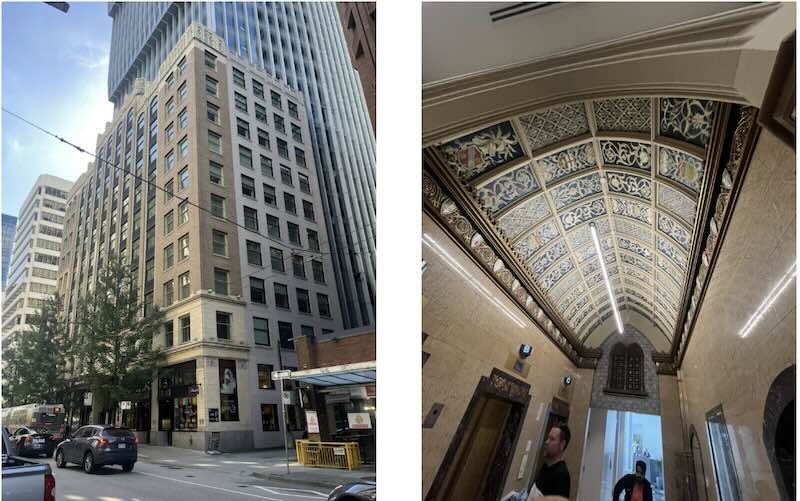
One afternoon this week, I walked over to the original Vancouver Stock Exchange building.
The lobby is still there. The old ceiling is incredible. You can almost picture traders running around yelling orders a hundred years ago:
Then I learned something I didn’t know.
The Vancouver Stock Exchange officially opened in 1929, just a few months before one of the biggest market crashes in history.
I couldn’t help but laugh.
Because if there is one thing Vancouver became famous for, it’s junior mining stocks.
Talk about an interesting place for that story to begin.
Some of the greatest stock market winners of all time started as tiny mining companies.
So did countless disasters. Many doubled. Some went up 10 or 100 times. Many more lost almost everything and never came back.
It turns out the exchange that was born right before one of history’s worst crashes also became the spiritual home of one of the most volatile corners of the market.
That got me thinking.
What does the market look like today?
What Does Price Say?
History is fascinating. But history doesn’t pay us.
Today’s prices do.
Every market cycle is different, so I don’t want to assume this one will play out exactly like the last one.
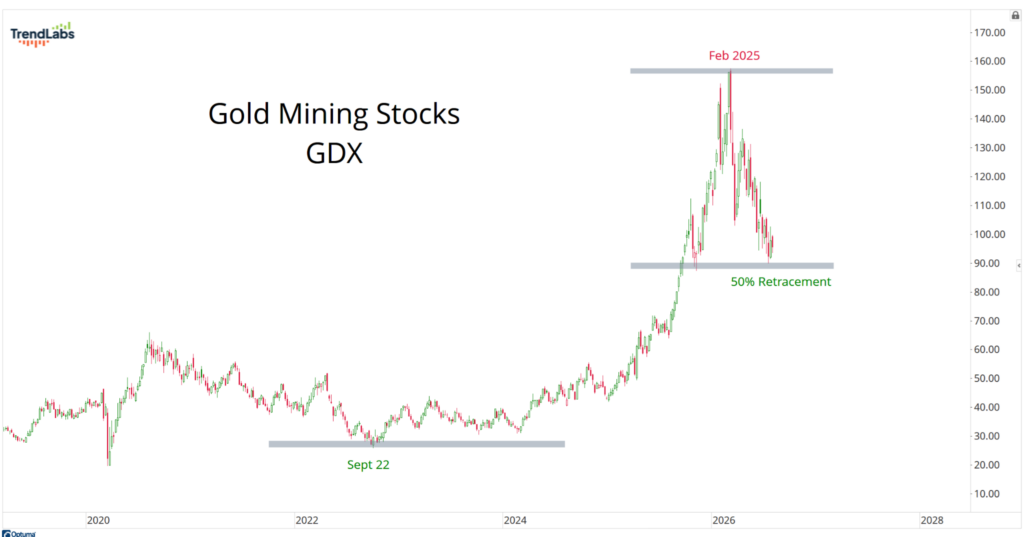
What I do know is that both gold miners and junior gold miners are telling a similar story.
The larger gold mining stocks have pulled back almost exactly half of the rally that began in September 2022 before peaking earlier this year:
Let’s look at the junior miners, too. These are the smaller, more speculative gold mining companies.
If regular gold miners are considered risky, the juniors take that up another notch.
They’ve also given back about half of their entire advance from the 2022 lows:
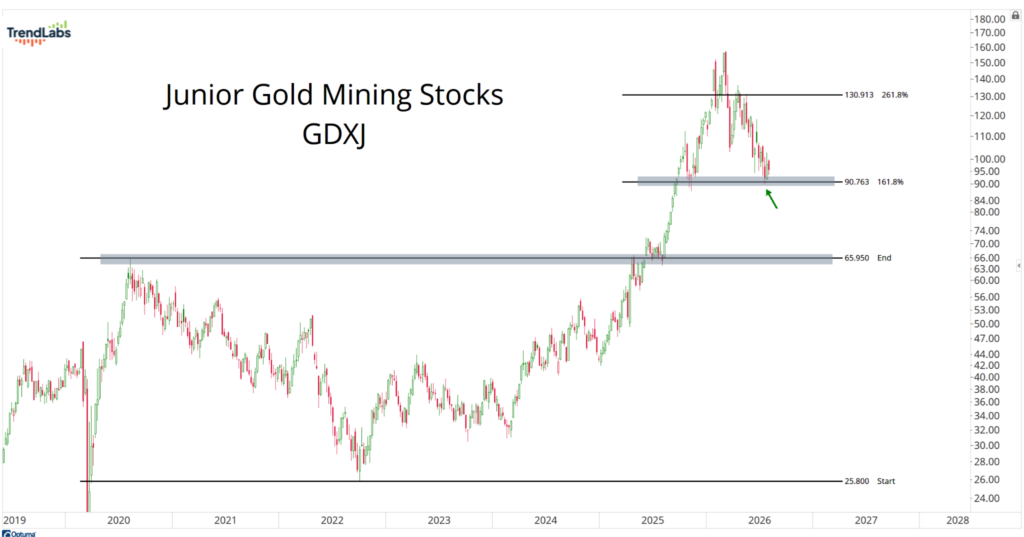
Both groups are now sitting near areas where buyers have stepped in before.
That doesn’t guarantee they’ll bounce. Nothing in the market is guaranteed.
But when different parts of the same industry are reaching similar support levels at the same time, I pay attention.
The market is always leaving clues.
Our job isn’t to predict what happens next.
Our job is to recognize what the market is already telling us.
Markets Don’t Care About Good Stories
Standing inside that old exchange, it wasn’t hard to picture what it must’ve been like.
I’m sure people thought they knew exactly what was coming next.
I’m sure there were smart people with great stories. There always are.
Markets have a funny way of making smart people look silly. They’ve been doing it for hundreds of years.
They’ll probably keep doing it for hundreds more.
That’s why I don’t spend much time worrying about the stories.
I worry about the prices.
If the gold miners are breaking out, I want to know about it.
If the junior gold miners are breaking out, too, I want to know that as well.
And if both of them start breaking down, I want to know that even more.
History is worth studying.
But history doesn’t tell us what to buy today.
Price does.
That’s why I always start there.
This Week in Everybody’s Wrong
On Monday, we discussed how an IPO makes it seem like the public is getting in at the beginning.
Maybe that was true a long time ago.
Whatever the case may be, you need to understand what you’re buying and who’s selling it to you.
On Tuesday, we revisited the idea that markets are one of the greatest laboratories for human psychology ever created.
We’re trying to understand how people are behaving.
When it comes to “Facts vs Feelings,” we start with price.
On Wednesday, we got a reminder to recognize our teachers and be grateful for everything they’ve given us.
Guru Purnima is also a reminder that we all have the opportunity to become that person for someone else.
On Thursday, we noted that the Fed didn’t raise the federal funds rate, but interest rates exploded higher.
The 10-year Treasury is the benchmark for the financial system. The 30-year Treasury helps drive mortgage rates.
We’re interested in the rates that actually affect people.
On Friday, we saw that some of the biggest advances in history have followed some of the longest periods of repair.
Technology spent almost 20 years healing before beginning one of the greatest runs of the past decade.
Banks have completed a remarkably similar repair.
On Saturday, Jason Perz returned for another look at inflation.
Energy is breaking out, bonds are breaking down, and price is revealing the macro regime.
It’s not necessarily bad news for people who are well positioned.
Have a great Sunday.
We’ll see you Monday morning…
Stay sharp,
JC Parets, CMT
Founder, TrendLabs