
SpaceX (SPCX) has already been cut roughly in half from its highs, just days after the biggest IPO in history.
That sounds dramatic. But it really shouldn’t be surprising.
We’ve been talking about this for months.
In Exit Liquidity, I wrote about how the Cerebras IPO looked less like the beginning of an investment and more like an opportunity for early investors to cash out.
Then in Before There Was SpaceX, There Was VOC, we talked about how SpaceX could become one of the most important companies in history and still become part of a massive speculative bubble.
Those two things can both be true. A great company can still be a terrible stock at the wrong price.
When SpaceX finally went public, I wrote SpaceX: How To Trade the Granddaddy of All IPOs and introduced the Genesis Line.
That’s simply the average price paid for the stock since it began trading, adjusted for how many shares changed hands.
Above that line, buyers are in control.
Below it, sellers are.
In Everybody’s Wrong About SpaceX, we followed up as the company joined the Nasdaq-100, raised billions more and continued attracting headlines.
But the stock remained below its Genesis Line.
Now it’s been cut in half.
This is no longer just a SpaceX story.
It’s an IPO story.
The “Initial” Part Happened Years Ago
The words “initial public offering” make it sound like the public is getting in at the beginning.
That may have been true a long time ago.
Companies used to go public because they needed money to build factories, hire workers and expand the business.
Public investors helped fund the next stage of growth.
Today, most of that happens before the company ever reaches the stock market.
Venture capital firms provide the early money. Private equity funds and large institutions come in later. Each new group buys shares as the company grows.
Regular investors usually aren’t invited.
By the time a company like SpaceX goes public, the products have already been built, the employees have already been hired and the company may already be one of the largest businesses in the world.
There’s nothing very initial about that.
The initial investors arrived years ago. Over 20 years ago in the case of SpaceX that was founded in 2002.
There are investors who took the biggest risks when the company was small and could have failed. If the business succeeded, they deserved to make money.
Good for them.
That’s the entire point of investing early.
But eventually those investors want to turn their paper profits into actual cash.
They need someone to buy their shares.
That’s where the public comes in.
For public investors, the IPO feels like the beginning.
For private investors, it may be the end.
The Chart Says It All
Apollo recently published a chart showing how the average IPO performed over the following three years compared with the rest of the stock market.
The results are ugly:
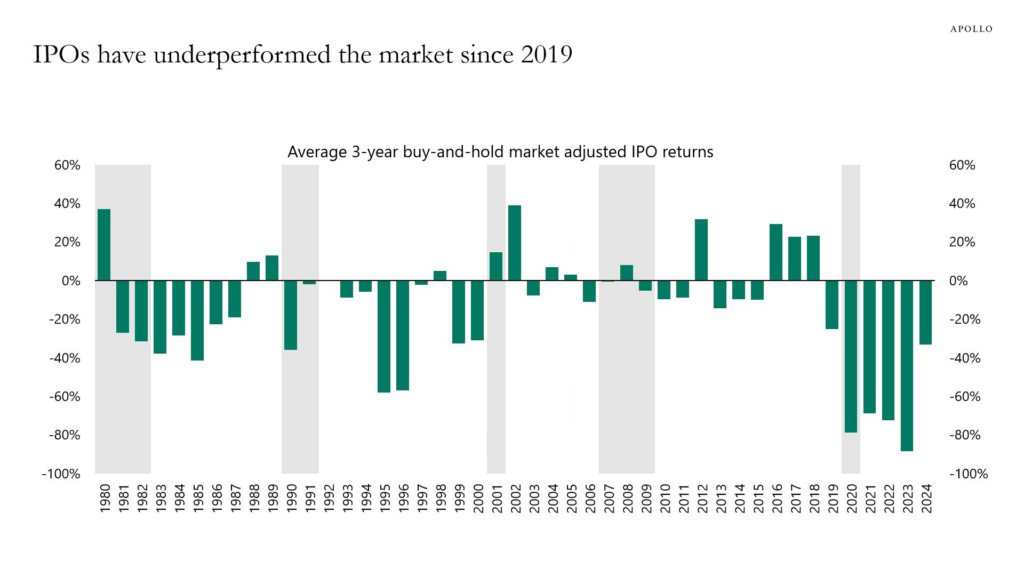
Since 2019, every annual group of IPOs on the chart has underperformed the market.
Some missed by a little.
Others got completely destroyed.
The IPOs from 2020, 2021, 2022, and 2023 underperformed by enormous amounts.
This was also the period when some of the biggest stories entered the market.
Electric vehicles were going to change transportation. Crypto platforms were going to replace traditional finance. Software companies were going to dominate every industry.
Some of those stories were real.
That wasn’t the problem.
The problem was the price.
Public investors were often being asked to pay valuations that already assumed years of future success.
This is where people get confused.
A company can have an incredible product and still be a horrible investment at the wrong price.
Meta (META) fell more than 60% after its IPO. Blackstone (BX) lost about 90%. Coinbase (COIN) and Rivian (RIVN) were both cut by more than 90%.
Uber (UBER) got crushed, too.
Some of those stocks eventually recovered and became great investments. Others never did.
The IPO itself was still a terrible trade.
That’s why I keep coming back to the Genesis Line.
We don’t need to guess which company will become the next Meta. We don’t need to debate how large the space economy will become 20 years from now.
We can let the market prove it.
When the stock remains below the average price paid by public investors, sellers are still in control.
When it finally reclaims that level and stays above it, the conversation changes.
Until then, patience is a position too.
The public markets used to be where companies went to finance their future.
Increasingly, they’re where early investors go to monetize the past.
That doesn’t make IPOs a scam.
It just means public investors need to understand what they’re buying and who is selling it to them.
There’s nothing “initial” about an initial public offering anymore.
The initial part happened years ago.
The public is the exit.
Stay sharp,
JC Parets, CMT
Founder, TrendLabs