
Everybody’s furious.
The idea of letting public companies report earnings twice a year instead of four has people acting like it’s some giant giveaway to CEOs.
Critics say companies will hide bad news, investors will be left in the dark, and corporate America will suddenly become less transparent.
I don’t see it that way.
In fact, I think everybody’s wrong.
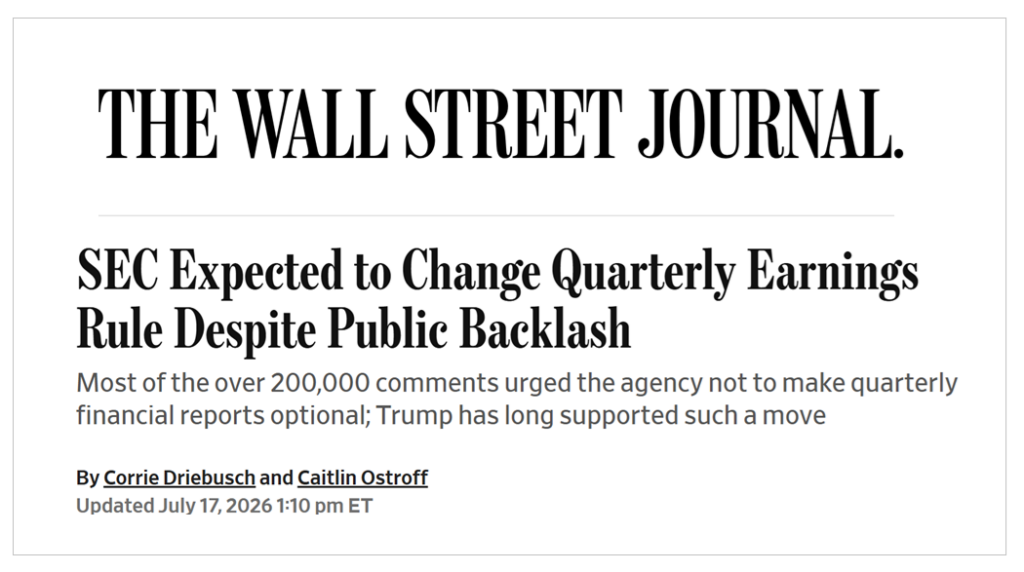
The headlines make it sound like this will fundamentally change investing.
I don’t think it will.
Running a Business Is Different Than Running a Quarter
Imagine you’re building a treehouse.
Halfway through the project, your parents make you stop every few hours to explain why it isn’t finished yet.
Then they ask why you spent so much money on wood. Then they want to know why your friends haven’t come over to use it yet.
Eventually, you spend almost as much time explaining the project as you do building it.
Public companies face a similar challenge.
Every three months, they stop what they’re doing to prepare financial statements, earnings presentations, and conference calls.
Those things are important, but they also take time, energy, and attention away from actually running the business.
Over time, the incentive quietly changes.
Instead of asking, “What’s the best decision for this company over the next ten years?” management starts asking, “What’s the best decision for this quarter?”
Those two questions don’t always have the same answer.
The best businesses are usually built over years.
Wall Street often judges them every 90 days.
Great Investments Often Look Worse Before They Look Better
Think about the biggest investments a company can make.
Maybe it wants to build a new factory. Maybe it decides to spend billions developing artificial intelligence.
Maybe it’s creating a new drug, expanding into another country or hiring hundreds of engineers to build the next generation of products.
Almost all of those decisions hurt profits in the short run because they cost money today. The payoff might not arrive for years.
That’s where the quarterly mindset becomes a problem.
If management knows missing Wall Street’s earnings estimate by a penny could knock 10% off the stock price tomorrow morning, the temptation is to delay spending, cut investment, or make decisions that help this quarter instead of helping the business five years from now.
Sometimes that’s the right decision.
Often it isn’t.
This Doesn’t Mean Companies Can Hide Bad News
This is where the conversation seems to go off the rails.
A lot of people are acting as if reporting earnings twice a year means companies can suddenly keep investors in the dark.
That’s simply not how public markets work.
If something important happens, investors still have to know about it. A merger, a new CEO, a bankruptcy, a major acquisition, or any other material event would still have to be disclosed.
Those rules aren’t changing.
Companies would also continue filing their annual reports, and nothing prevents them from reporting quarterly if they believe that’s the best way to communicate with shareholders. Many probably will.
The proposal simply gives companies more flexibility.
Instead of Washington deciding that every public company must follow exactly the same reporting schedule, companies would have more freedom to choose what works best for their business.
Personally, I like that idea.
This Probably Won’t Matter Nearly as Much as People Think
Here’s the part I find most interesting.
I don’t think much is actually going to change.
All the largest companies in America will probably keep reporting every quarter because investors have grown accustomed to it. Analysts will still publish earnings estimates. Conference calls will still happen. Financial television will still spend hours debating whether a company beat expectations by three cents instead of four.
In other words, the daily experience of being an investor won’t change at all.
Where this could potentially make a difference is for smaller companies.
If you’re running a young business that’s investing heavily in growth, spending less time preparing quarterly presentations and more time building products, hiring employees and serving customers sounds like a perfectly reasonable tradeoff.
Does this suddenly make CEOs less accountable? No.
Is this some giant corporate giveaway? I don’t think so.
Is it another example of some secular grift that’s going to permanently change investing? Not even close.
My guess is fewer than 10% of public companies ever decide to change their reporting schedule.
Most of the companies investors care about won’t do anything differently.
Five years from now, I’d bet most people won’t even remember this debate happened.
Everybody’s Wrong
The biggest question isn’t whether companies should report every three months.
It’s why the government should decide how often every public company communicates detailed financial results in the first place.
If investors truly value quarterly reporting, they’ll reward companies that continue providing it.
If they prefer management teams that spend a little less time preparing presentations and a little more time building great businesses, they’ll reward those companies instead.
That sounds a lot like capitalism to me.
The irony is that many of the same people who complain that CEOs only think about the next quarter are now defending one of the biggest reasons they do.
Maybe giving companies a little more flexibility will help some of them think longer term. Maybe it won’t.
Either way, I don’t think this is the earth-shattering change people are making it out to be.
My guess is that a handful of smaller companies take advantage of the option, almost every major company keeps doing exactly what it’s doing today, and investors move on with their lives.
Years from now, this will probably be remembered as one of those debates that generated thousands of headlines… and changed almost nothing.
This Week in Everybody’s Wrong
On Monday, we showed you a chart that’s designed to scare you.
But if you stop and think about it for a minute, it doesn’t make much sense.
Here’s why everybody’s wrong about margin debt.
On Tuesday, we talked about one of the biggest mistakes investors make.
What worked yesterday won’t necessarily work tomorrow.
Indeed, the market only cares about how portfolios behave today.
On Wednesday, we broke down how the biggest names grab headlines, move indexes, and dominate your conversations.
But bull markets are healthier when more companies participate.
And sometimes the most important stock in America isn’t the biggest one.
On Thursday, we asked another simple question, but one with profound implications.
It’s the biggest investor that never was.
So should Social Security own stocks?
On Friday, we made the very basic point that famous CEOs aren’t making decisions for you.
Nor should they be.
Famous CEOs have their own processes, and you need to have your own process, too.
On Saturday, Grant Hawkridge informed us that investors can now earn a respectable return above inflation from government bonds.
But the bull market remains intact.
It’s simply asking more of us right now.
Have a great Sunday.
We’ll see you Monday morning…
Stay sharp,
JC Parets, CMT
Founder, TrendLabs