Founder’s Note: Grant Hawkridge is our data man Down Under.
But there’s much more to it than that. Grant’s been around a lot, and all over, and he’s learned a lot about how markets and the world work.
It always pays to read what he has to say about where things are. – JC
By Grant Hawkridge
There are three things I try to focus on.
The first is taking care of myself. For me, that means getting away from the screens every now and then, eating well, getting outside, and finding time for a round of golf.
The market is an important part of my life, but it’s not the only part, and the screens will still be there when I come back.
The second is taking care of my family. That means spending time with the people who matter, celebrating birthdays and milestones, watching the nieces grow up, and trying to be present for the moments that never appear on a price chart.
The third is taking care of business. In my case, that business just happens to be trading stocks.
The importance of the first two rarely changes. Markets rise and fall, headlines come and go, and investors always find something new to worry about.
Through all of that, looking after yourself and the people around you remains far more important than whatever Wall Street happens to be discussing this week.
Taking care of business is different because the market changes every day. The evidence moves, leadership rotates, and the areas being rewarded today may not be the same ones being rewarded next month.
My job is not to decide what the market should be doing. It’s to pay attention to what it’s actually doing and adjust when the evidence changes.
This week, inflation returned to the conversation. Oil prices moved higher. Treasury yields climbed.
Before long, the financial media had shifted its attention back toward interest rates, the Fed, and whether inflation might prove more stubborn than investors had hoped.
Those are important conversations, but after 20 years of doing this, I’ve learned that the headlines are rarely where the best answers are found.
The better questions usually come from watching how markets respond.
That led me to a chart I have not spent much time thinking about.
The Return of a Real Alternative
This chart tracks the US 10-year real yield:
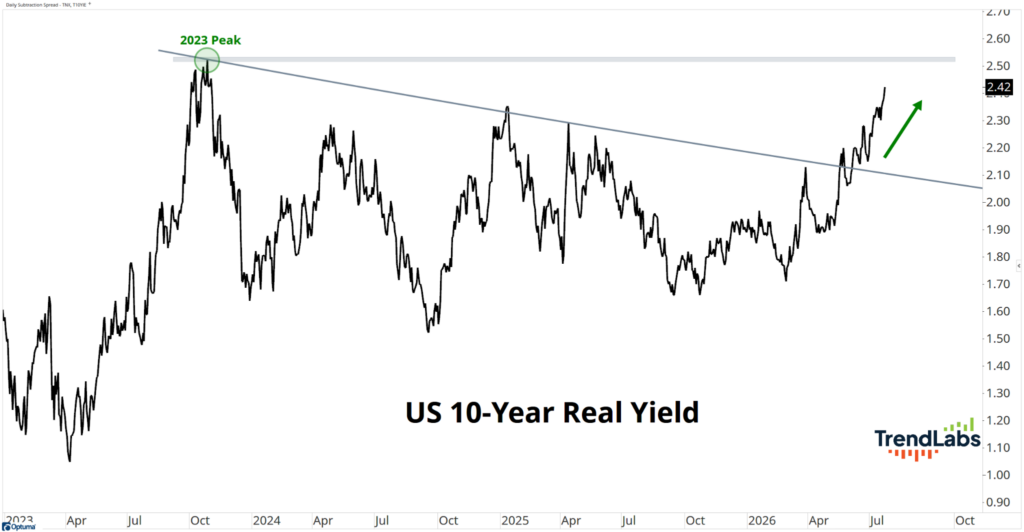
This is the return investors can earn from owning a 10-year US government bond after accounting for inflation.
That number is now back near 2.4%.
More importantly, the real yield has broken above a downtrend that had been in place since its 2023 peak.
After trending lower from that peak, it’s now pushing back toward the upper end of its range.
That changes the investment equation.
Investors can now earn a respectable return above inflation from government bonds without accepting the volatility that comes with owning stocks.
Equities can still provide greater upside, but they’re no longer competing against cash and bonds that pay almost nothing.
Stocks finally have some competition again.
The inflation story is not important simply because prices may rise.
It’s important because higher inflation and higher real yields can change where investors are willing to put their money.
When the risk-free return improves, stocks need to offer a more compelling reason for money to stay involved.
The obvious assumption is that this should create problems for equities.
Higher real yields should pressure valuations, reduce enthusiasm for risk and make it harder for the market to keep moving higher.
That’s the theory.
The more useful question is whether we can see any evidence of it in price.
The Index Has Stopped Making Easy Progress
During the same period that real yields have been moving higher and breaking through their downtrend, the S&P 500 has stopped making much progress:
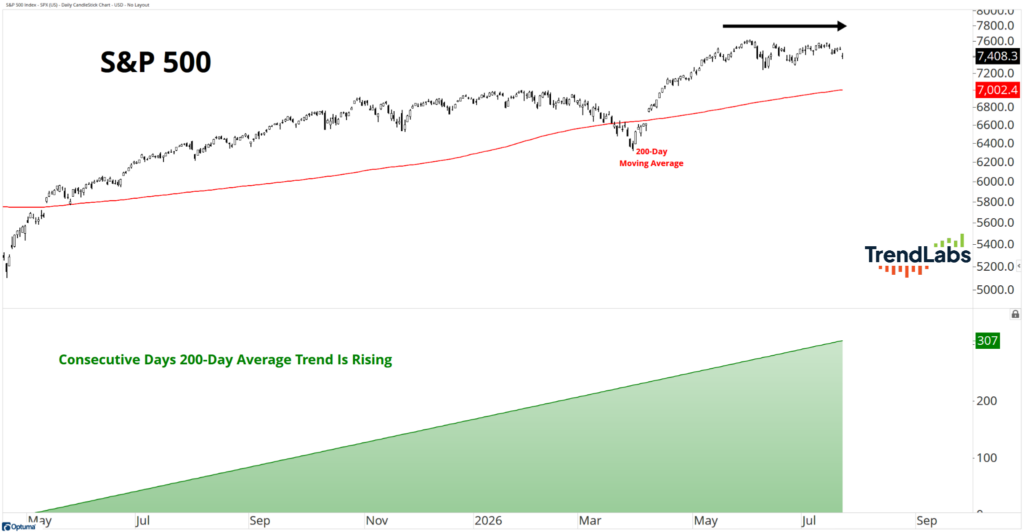
The index has spent the past few months grinding sideways near its highs.
Buyers haven’t disappeared, but they’ve also been unable to extend the rally in the same way they did earlier in the move.
That doesn’t mean the bull market is over.
In fact, one of the reasons I remain constructive is sitting right there on the chart. The S&P 500’s 200-day moving average has now been rising for 307 consecutive trading days.
That tells us the primary trend remains pointed higher, even though price has paused over the past few months.
Bull markets rarely move in a straight line. They advance, they pause, they rotate and then they advance again.
A period of sideways movement near the highs, while the longer-term trend continues to rise, is very different from a market that’s breaking down.
But markets can remain in a primary uptrend while conditions underneath the surface begin to change.
The index can look relatively calm while leadership rotates and money moves toward different parts of the market.
That’s why I rarely stop at the index level.
The S&P 500 tells us what the largest companies are doing. It doesn’t always tell us what’s happening across the broader market.
To understand that, we need to look underneath the surface.
Money Is Moving, Not Leaving
At a sector level, leadership hasn’t disappeared. It has moved.
Energy, Health Care and Industrials have all strengthened, making them some of the most important areas beneath the index right now:
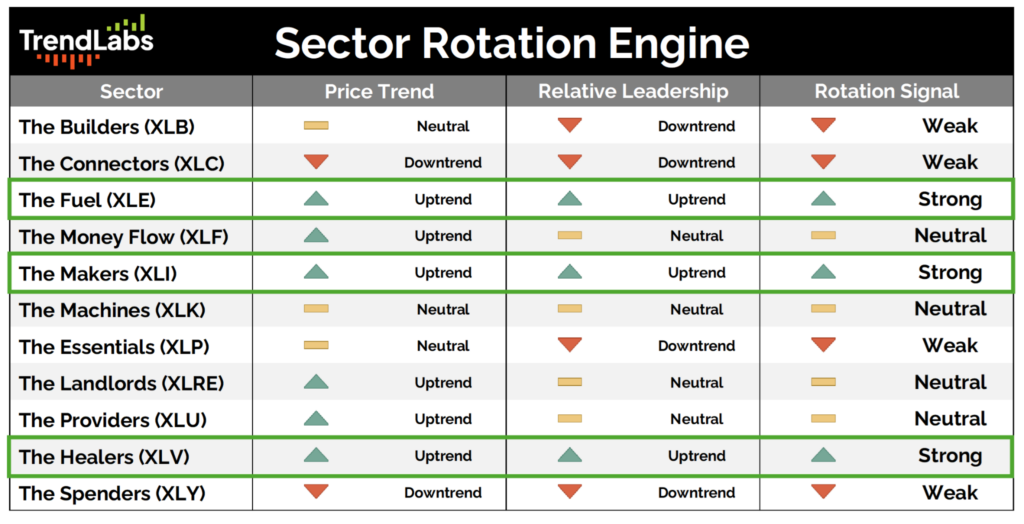
Energy is especially interesting because it connects directly with the inflation story. Rising oil prices are helping renew concerns about inflation at the same time that Energy stocks are becoming one of the market’s clearest areas of leadership.
That doesn’t mean Energy is leading only because investors fear inflation. Price is never that simple. But the relationship deserves our attention.
The same force contributing to renewed inflation concerns is also helping create leadership inside the equity market.
Industrials are another important part of the message. Their strength tells us investors are not abandoning economically sensitive assets altogether.
Health Care has also improved, adding a more defensive source of leadership as money rotates away from some of the areas that drove the earlier stages of the rally.
On its own, this rotation wouldn’t concern me. Bull markets regularly pass leadership from one sector to another.
Technology doesn’t need to lead every advance, and leadership from Energy, Industrials and Health Care can be a healthy development.
Money is still finding opportunities rather than leaving equities completely.
That rotation helps explain why the index has remained stable even as real yields have moved higher.
Money is not leaving equities completely. It’s moving toward the areas investors believe can clear the higher hurdle.
Still Bullish, But No Longer Easy
It would be easy to look at higher real yields and assume the bull market must be close to ending.
I don’t think the evidence supports that conclusion.
The primary trend remains higher, and leadership continues to emerge across Energy, Industrials and Health Care.
But the environment is not unchanged.
Stocks now have to compete with a respectable return from government bonds. Investors have less reason to accept average opportunities when they can earn a real return without taking equity risk.
The process has not changed.
The hurdle has.
Taking Care of Business
We continue to treat this as a bull market because the primary trend remains higher. That keeps our attention on opportunities rather than trying to predict when the next major decline will begin.
But higher real yields change the level of competition for money and raise the standard for where we are willing to put new money.
We want the strongest sectors, the strongest industries inside those sectors and the strongest stocks within those industries.
We want clean trends, improving relative strength and evidence that buyers remain in control.
We don’t need to own everything.
When stocks have little competition, “good enough” can sometimes work. And, when investors can earn a respectable real return from government bonds, “good enough” becomes a much lower-quality proposition.
That’s the practical message coming from the evidence today.
Higher real yields have given investors another option, while the S&P 500 has moved sideways rather than breaking down. Leadership has rotated toward Energy, Industrials and Health Care.
The bull market remains intact.
It’s simply asking more of us.
Markets will always give us something new to worry about. This week it happens to be inflation and rising bond yields. Next month, it will probably be something else.
I will still be trying to do the same three things.
Take care of myself.
Take care of my family.
And when it is time to get back in front of the screens, take care of business.
Happy hitting🏌️⛳
Grant Hawkridge
Quantitative Analyst, TrendLabs